
Pattern Copy Collection: 30 Brilliant Pencil Adventures
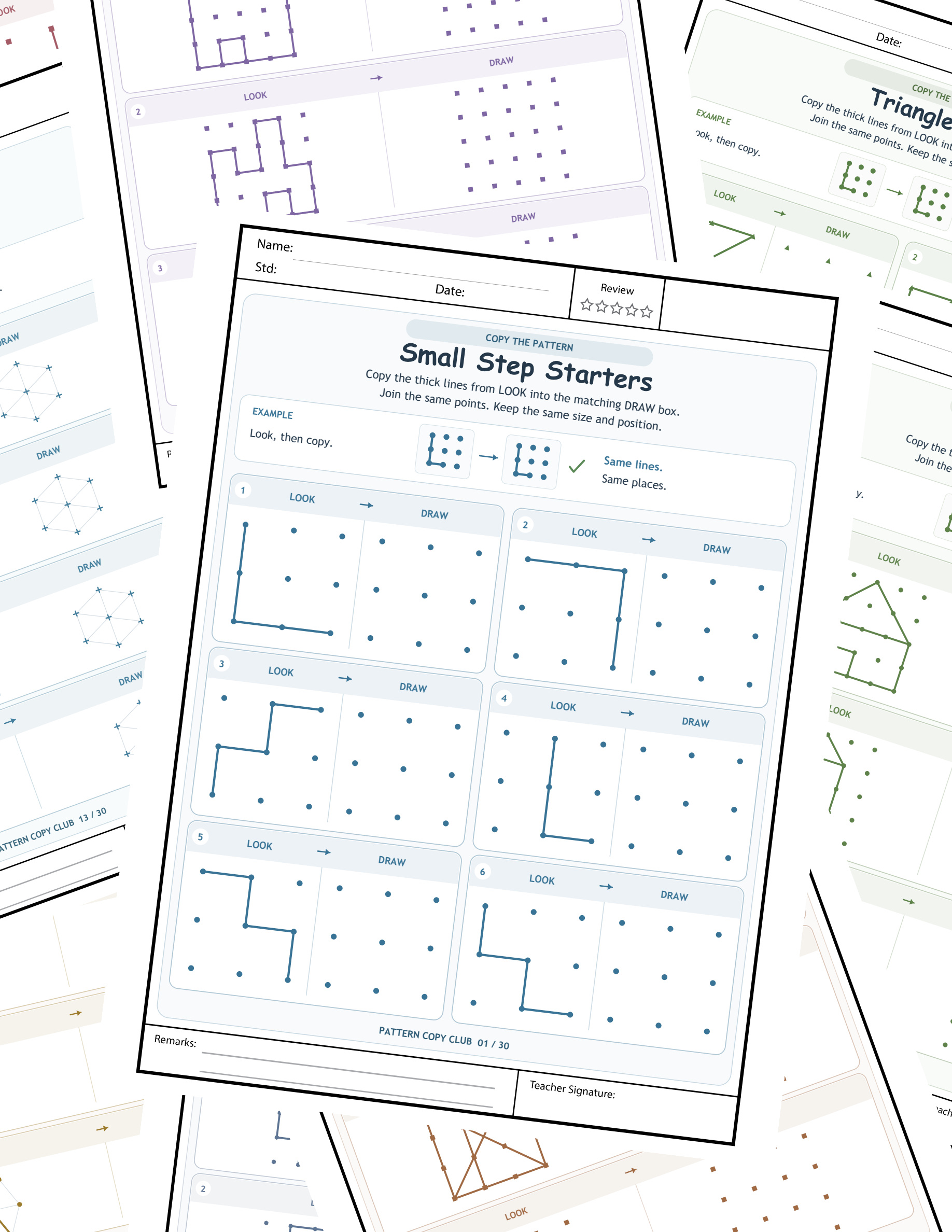
Thirty sheets can become a small drawing library instead of a pile to finish. The Pattern Copy Collection brings together simple corner paths, angled shapes, picture models and intricate final designs. Children study a completed LOOK pattern, then recreate its thick lines beside matching points in DRAW. Every sheet includes a worked example. Choose an approachable design today and keep the harder pictures for later. This clean, printable collection costs $3 and puts all thirty activities into one PDF, ready for short, supported sessions at home or in an early-years classroom.
What belongs in this drawing library — Pattern Copy Collection
The Pattern Copy Collection contains the supplied activities numbered 01 through 30, in that order. It is a collection of copying tasks: a child transfers line positions across a pair of matching point fields. It does not ask children to continue an alternating colour sequence, follow numbered dot-to-dot instructions, or reflect a picture across a mirror line.
With the Pattern Copy Collection, the example remains available while a child works. Looking back is part of the exercise. The goal is a corresponding arrangement of endpoints, turns and joins, rather than memorising a picture after one glance. A deliberate comparison is more useful than a hurried page.
Begin with corners, then choose a new kind of anchor: Pattern Copy Collection
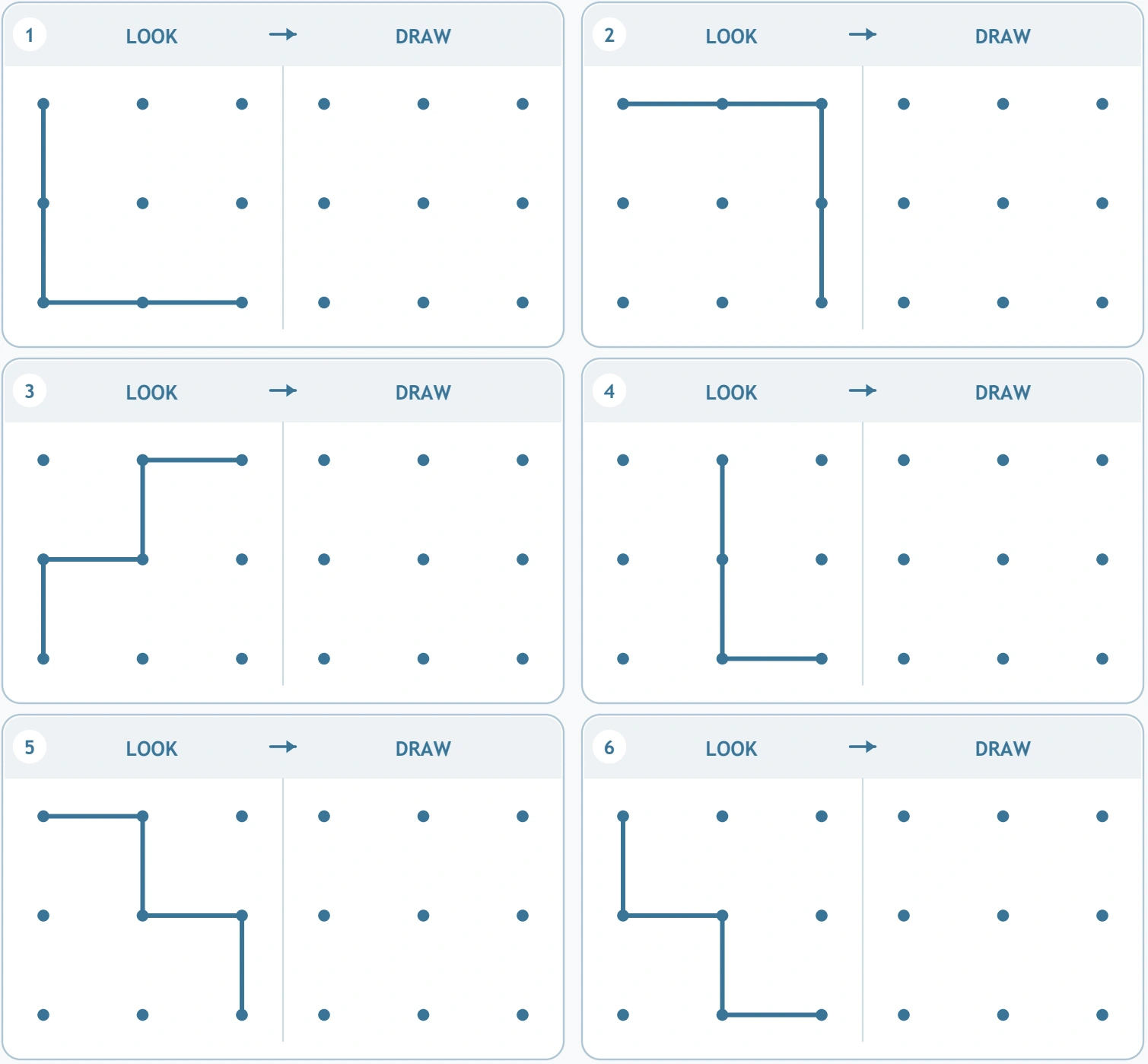
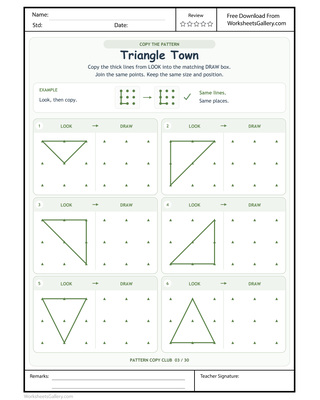
Small Step Starters introduces short horizontal and vertical paths. Zigzag Park adds slants, while Triangle Town and Square Workshop draw attention to position and span. Diamond Doodles includes internal dividers and extended strokes; Rainbow Line Play uses mixed coloured markers. These six sheets offer a sensible starting shelf within the Pattern Copy Collection.
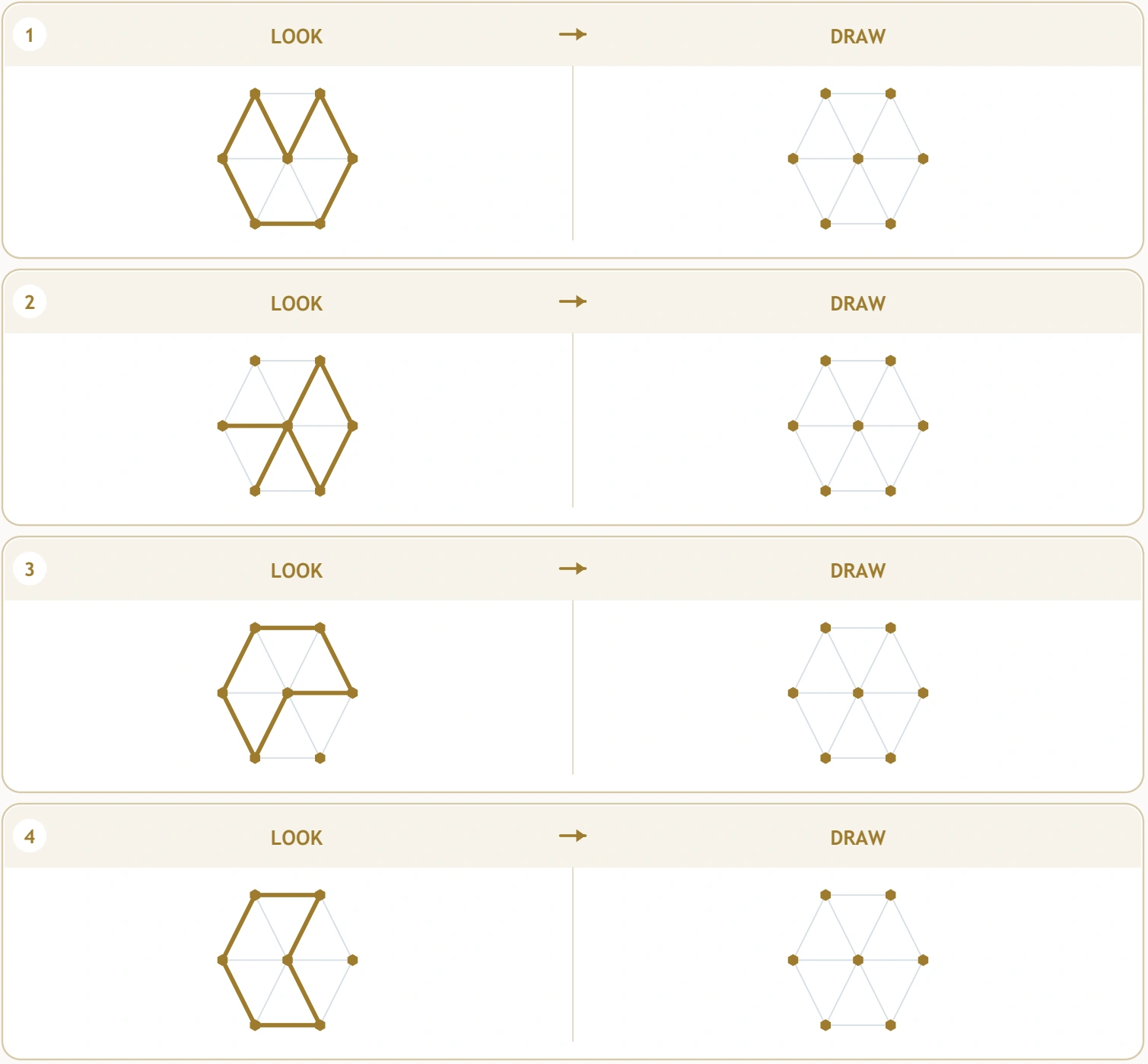
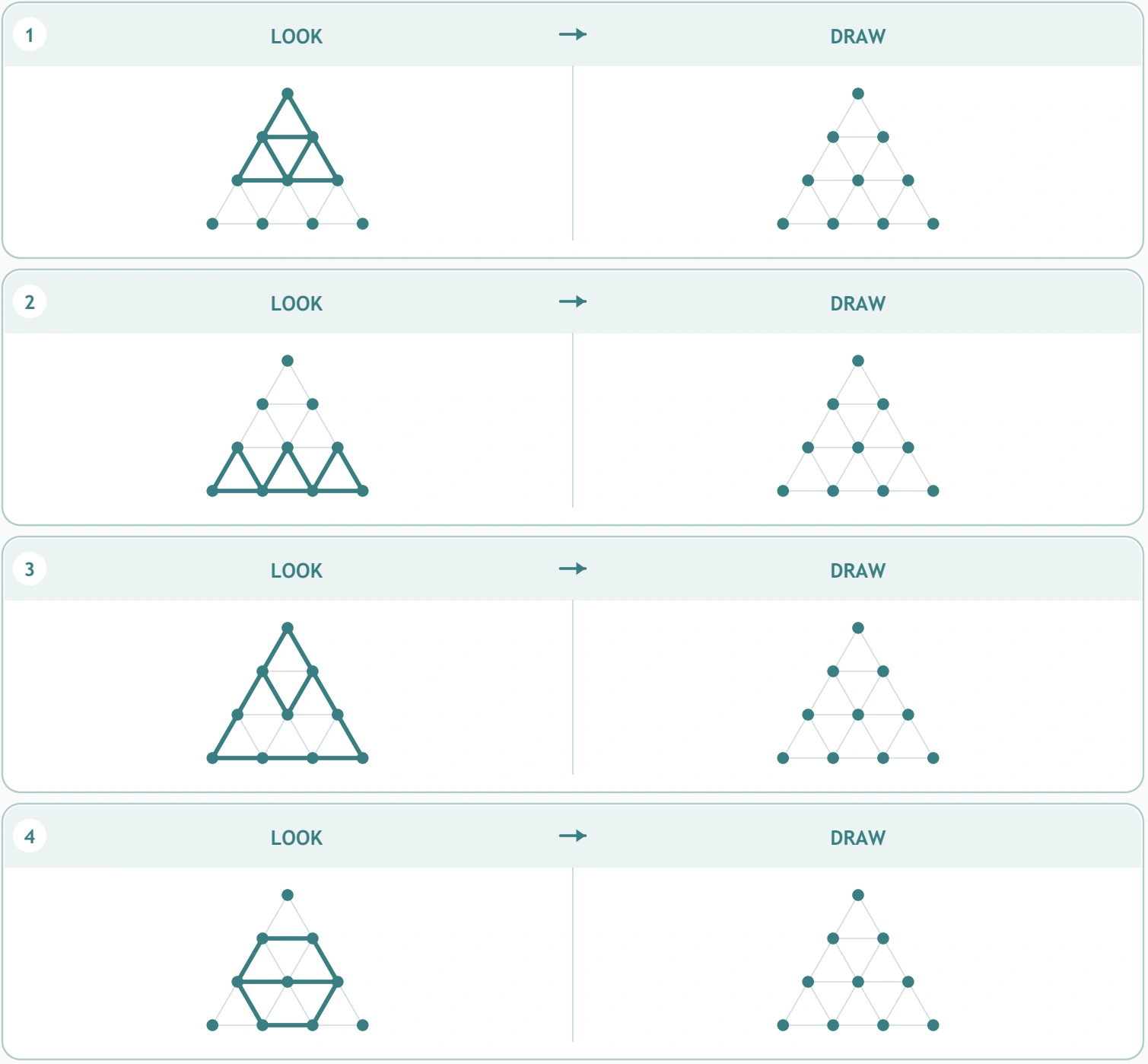
The next choices change the arrangement of points. Honeycomb Helpers and Cube Corner Copies use seven-point layouts with pale scaffolds. Star Point Studio places its marks around a star-like field. Those differences matter: transferring a centre join is a different observation from remembering a square-grid corner. The Pattern Copy Collection gives adults several ways to adjust the visual challenge without demanding faster pencil movement.
Thirty titles, with room to choose: Pattern Copy Collection
Small grids and first changes in Pattern Copy Collection
| Small grids and first changes | Practice structure |
|---|---|
| 01 Small Step Starters | 6 model pairs; 9 point fields |
| 02 Zigzag Park | 6 model pairs; 9 point fields |
| 03 Triangle Town | 6 model pairs; 9 point fields |
| 04 Square Workshop | 6 model pairs; 9 point fields |
| 05 Diamond Doodles | 6 model pairs; 9 point fields |
| 06 Rainbow Line Play | 6 model pairs; 9 point fields |
New point families and angular designs in Pattern Copy Collection
| New point families and angular designs | Practice structure |
|---|---|
| 07 Honeycomb Helpers | 4 model pairs; 7 point fields |
| 08 Cube Corner Copies | 4 model pairs; 7 point fields |
| 09 Star Point Studio | 4 model pairs; 6 point fields |
| 10 Button Box Patterns | 6 model pairs; 9 point fields |
| 11 Gem Dot Garden | 6 model pairs; 9 point fields |
| 12 Little Triangle Dots | 6 model pairs; 9 point fields |
| 13 Snowflake Studio | 4 model pairs; 7 point fields |
| 14 Shape Dot Mix | 6 model pairs; 9 point fields |
Arrows, buildings and picture parts in Pattern Copy Collection
| Arrows, buildings and picture parts | Practice structure |
|---|---|
| 15 Arrow Artists | 3 model pairs; 16 point fields |
| 16 Kite Sky Copies | 3 model pairs; 25 point fields |
| 17 Little House Plans | 3 model pairs; 25 point fields |
| 18 Toy Track Turns | 3 model pairs; 16 point fields |
| 19 Mountain Sketches | 3 model pairs; 16 point fields |
| 20 Castle Builders | 3 model pairs; 25 point fields |
| 21 Flower Ring Patterns | 4 model pairs; 9 point fields |
| 22 Sailboat Sketches | 3 model pairs; 16 point fields |
Detailed models and mixed challenges in Pattern Copy Collection
| Detailed models and mixed challenges | Practice structure |
|---|---|
| 23 Robot Drawing Lab | 3 model pairs; 25 point fields |
| 24 Rocket Pattern Lab | 3 model pairs; 25 point fields |
| 25 Patchwork Puzzles | 3 model pairs; 16 point fields |
| 26 Triangle Mosaics | 4 model pairs; 10 point fields |
| 27 Double Ring Designs | 4 model pairs; 9 point fields |
| 28 Friendly Animal Lines | 3 model pairs; 25 point fields |
| 29 Shape and Grid Mix | 3 model pairs; 7, 9, 16 point fields |
| 30 Copy Master Challenge | 3 model pairs; 25 point fields |
A pencil-ready age range, with flexible entry points: Pattern Copy Collection
Learners within the approximate four-to-seven age band may explore selected pages from the Pattern Copy Collection with help. The whole collection is not a single age-level test. A child may enjoy a simple L today and find a dense castle difficult for some time. Choose according to what the child can inspect and attempt comfortably, rather than expecting a birthday to settle readiness.
Before offering the Pattern Copy Collection, notice whether the learner can locate two matching points, make a short controlled line, and pause when asked. An adult can demonstrate on spare paper if those actions are unfamiliar. Large stick arrangements, finger paths and free drawing remain useful companions; detailed copying need not replace them.
Six things to watch beyond a finished picture: Pattern Copy Collection
- Endpoint accuracy. A child checks where a segment lands instead of merely drawing a similar-looking shape. The matching fields make that decision visible.
- Distance judgement. Spanning one interval or two changes a design, even when both lines travel in the same direction.
- Selective attention. On scaffold pages, the learner separates bold target strokes from the pale supporting network.
- Motor planning. Breaking a house into roof, walls and doorway offers manageable pencil actions instead of one overwhelming contour.
- Spatial language. Descriptions such as inward corner, shared centre and lower edge give an adult and child precise ways to discuss a mark.
- Revision confidence. Finding one misplaced endpoint and making a small repair shows that review can be constructive rather than disappointing.
These are opportunities for practice in the Pattern Copy Collection, not promises that a particular skill will improve after a fixed number of sheets. Keep observations concrete: “You compared the doorway before drawing it” is more informative than assigning a general ability label.
Set up a choice tray rather than a completion race: Pattern Copy Collection
Open the Pattern Copy Collection and print one selected sheet. Provide a pencil, a comfortable working surface and enough space for the supporting hand. Show the example's LOOK and DRAW boxes. Explain that the practice pairs need the same thick lines in corresponding places, with their size and direction preserved.
Let the child point to a first part before making a mark. After a small group of strokes, compare the two fields. Some designs have open ends or separate components, so lifting the pencil is entirely appropriate. A session may end after one pair. The Pattern Copy Collection remains ready for a later choice; unused boxes do not create a debt to finish.
An imagined afternoon at the kitchen table: Pattern Copy Collection
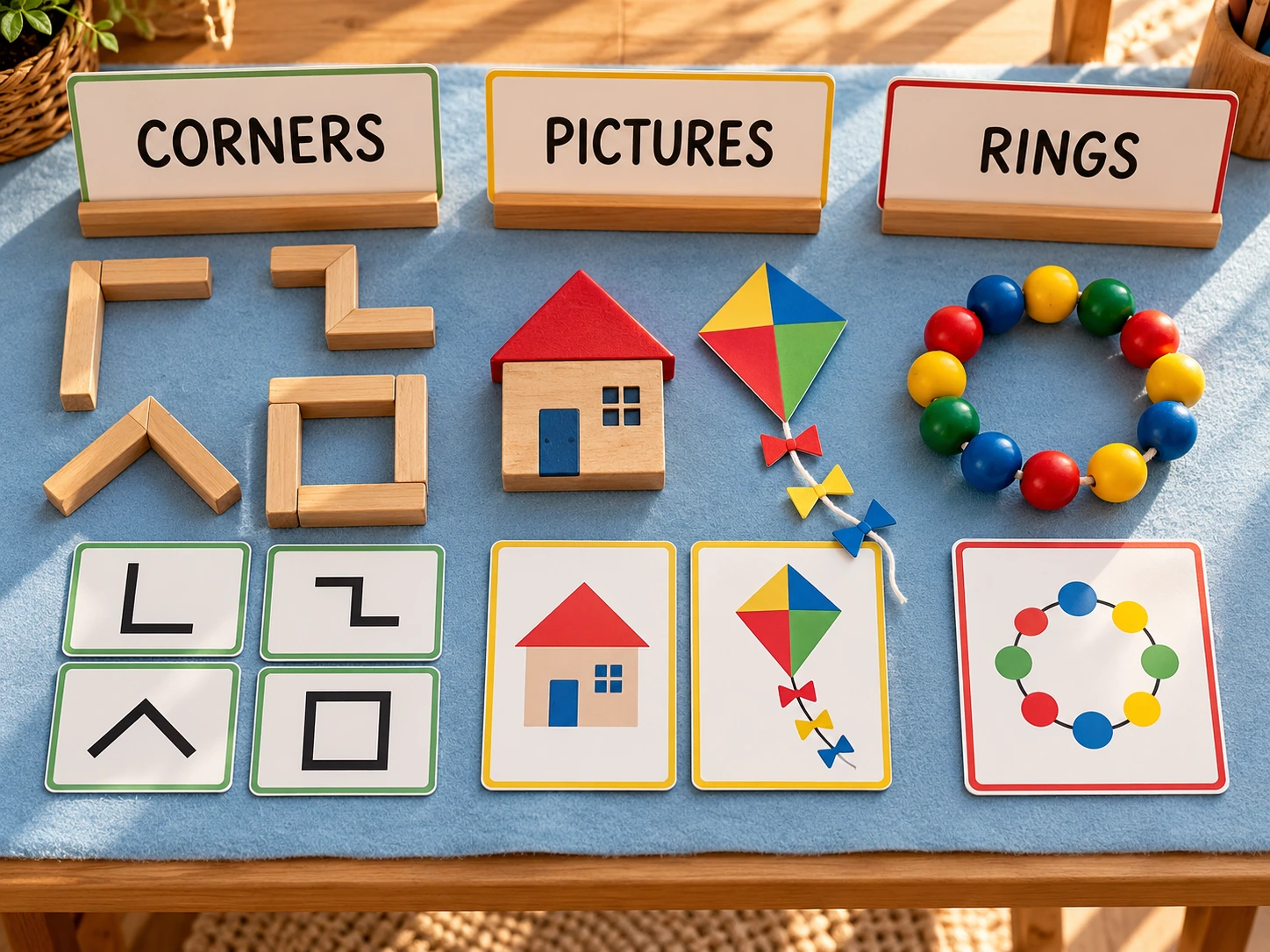
Picture Leni selecting Small Step Starters from the Pattern Copy Collection while a parent sets out wooden blocks. Leni builds an L, then finds its lower corner on the sheet. After drawing the upright, Leni wants to go across too soon. The parent asks which point matches the turn, and they compare the two sides together.
This is an imagined home-use example, not a report of a child's results. Its useful feature is the small decision: checking one turn. The parent can keep the blocks nearby, accept a slightly wobbly line and stop after a successful comparison. Tomorrow's Pattern Copy Collection visit might involve the smaller L rather than a new page.
A classroom drawing workshop, imagined: Pattern Copy Collection
Imagine a teacher placing three Pattern Copy Collection selections on a table: an easy corner sheet, Honeycomb Helpers and a house page. Children choose with guidance. One learner describes a centre point, another copies a roof, and a third works through a single right-angle bend. They are not racing to produce identical amounts of work.
The teacher checks a particular spatial decision at each seat. A brief note might record “matched upper-left corner” or “needed help distinguishing pale guide.” Those descriptions can inform the next invitation. In this classroom scenario, the Pattern Copy Collection provides varied material while the adult keeps the objective narrow enough to observe.
Five ways to carry copying into play: Pattern Copy Collection
Build a corner museum: Pattern Copy Collection
Use blocks to make several right-angle arrangements. Choose one construction, sketch it, and put the model beside the sketch. Ask what changed between the physical object and the drawing. This extension suits the opening Pattern Copy Collection sheets without turning the paper into a tracing board.
Run a tiny architecture desk: Pattern Copy Collection
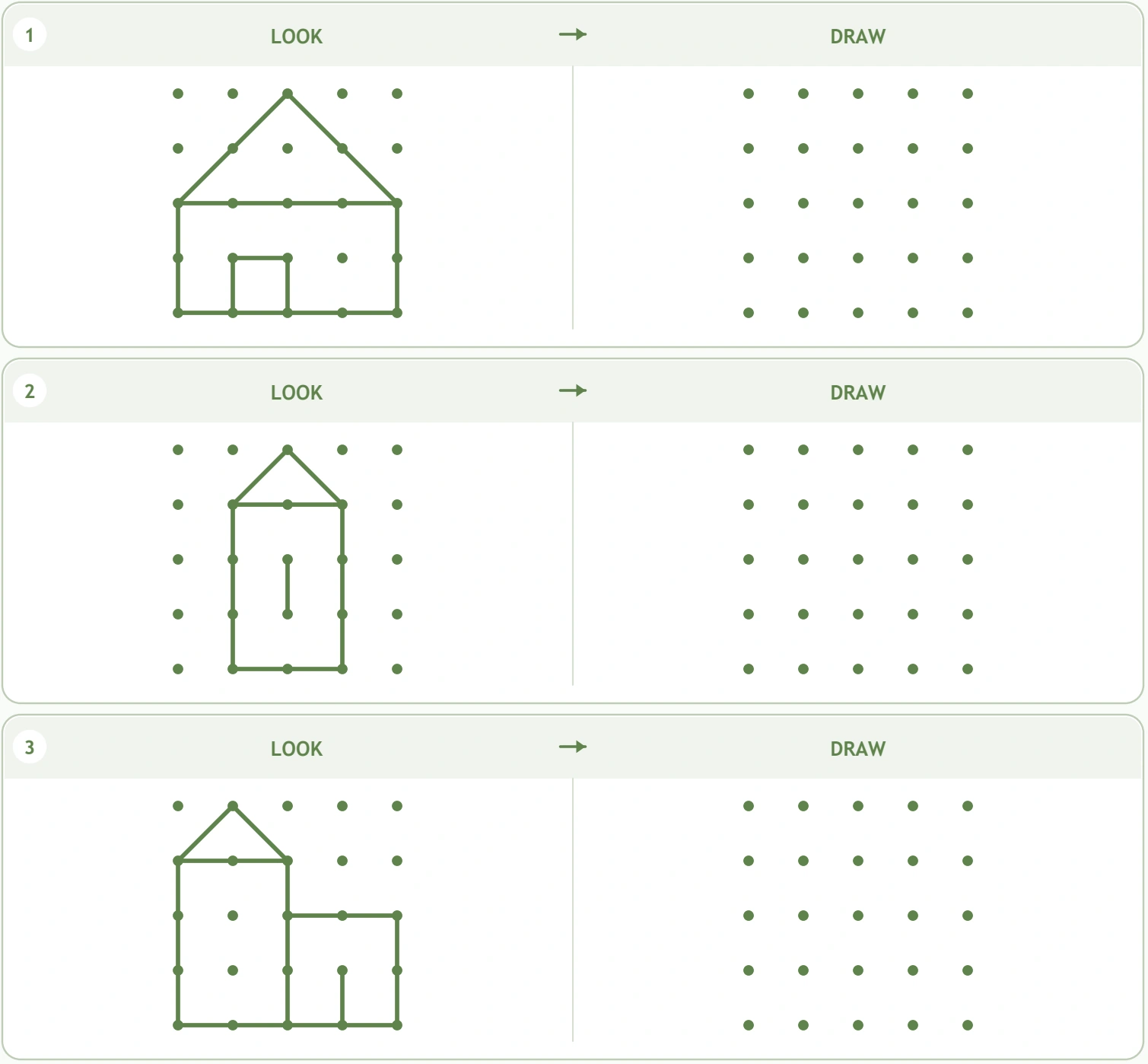
After a house or castle copy, invent a building on separate paper. Label its roof or doorway and let a partner describe it. Keep invention separate from the printed model so children understand when accuracy matters and when they are designing freely.
Sort the anchor families: Pattern Copy Collection
Choose a square-grid, ring and triangular-scaffold page from the Pattern Copy Collection. Compare the point arrangements before drawing anything. Which has a centre? Which has tiers? This observation game can remain entirely spoken when a pencil break is welcome.
Curate a picture exhibition: Pattern Copy Collection
Select a kite, sailboat and robot. Give each copied picture a spoken introduction about one tricky part. A child can explain the boat's hull or a robot's broad body without being expected to read a formal caption independently.
Become a friendly repair team: Pattern Copy Collection
On spare paper, an adult draws a simple model and a copy with one intentionally altered corner. The child locates the difference, explains it and suggests a repair. Then swap roles. Keep this game cooperative; the Pattern Copy Collection is practice material rather than a contest to catch mistakes.
Pale scaffolds and blank-looking DRAW fields: Pattern Copy Collection
Most Pattern Copy Collection practice boxes contain point markers without copied dark lines. Honeycomb Helpers, Cube Corner Copies, Snowflake Studio and Triangle Mosaics retain a pale complete scaffold on both sides. That faint structure is intentional. The learner selects and reproduces the thicker model strokes rather than darkening every available connection.
Colours can make a sheet pleasant to inspect, but children may use a pencil or chosen crayons. Line placement is the shared purpose. The Pattern Copy Collection does not require matching every printed hue. Printing a test sheet first is sensible if grayscale output makes the distinction between thin and bold strokes difficult to see.
Avoid the errors that hide useful observation: Pattern Copy Collection
Do not turn a DRAW box into a mirrored version just because it sits on the right. Do not rotate a sailboat into a preferred direction or add windows to an exact house copy. A line crossing without a printed point is not automatically a new destination. These distinctions become especially useful in the later Pattern Copy Collection designs.
Another common problem is offering the densest sheet as a test of effort. A crowded model can exceed a child's present attention or pencil comfort. Reduce the amount, choose an earlier page, or build a part with sticks. For the Pattern Copy Collection, a smaller accurate comparison preserves the learning purpose better than a forced full-page attempt.
Returning to a familiar design can feel satisfying: Pattern Copy Collection
A visible small improvement can make another visit appealing. Save a dated copy and invite a closer look at one chosen feature during a later session. Perhaps the lower square reaches the intended point, or a kite tail is easier to separate from its spars. Keep the observation about the design rather than comparing children.
Offer the Pattern Copy Collection at a predictable quiet moment, with a choice between two suitable sheets. Alternate paper work with construction and movement. A learner who asks for a pause can return later. Confidence grows more easily when stopping is allowed. The aim is willing, thoughtful practice, not thirty consecutive days of compulsory pages.
Get the complete clean PDF for $3: Pattern Copy Collection
Select the purchase button for the Pattern Copy Collection, sign in when prompted, and complete the website's $3 checkout. Once the purchase is authorised, use the protected download control to save the complete PDF. This paid collection contains thirty activity pages; it is not a free preview and does not unlock simply because a visitor opens an image.
The purchased Pattern Copy Collection PDF has no website watermark, domain lettering or promotional advertisements on its pages. Print on US Letter paper at Actual Size or 100%, checking your printer's preview before using a stack of paper. The download is the printable PDF; the overlapping picture is a browsing preview. Keep the file for selecting individual pages later.
Related practice and trusted adult reading: Pattern Copy Collection
Compare Pattern Copy Collection with Path Copy Thinking. After Pattern Copy Collection, try Drawing Size Choices. For Pattern Copy Collection, consider Shape Border Journeys.
For adults choosing playful next steps around the Pattern Copy Collection, NAEYC's family play resources offer a broader view of learning through play. Families can also explore PBS Parents learning ideas when planning activities beyond pencil work. These are external educational resources, not endorsements of this product or extra pages included in the purchase.
Popular Worksheets
Printable resources families and teachers are downloading now.
 Free
 Free
 Free
 Free