
Master Pattern Copying: 3 Amazing Layered Designs
Master Pattern Copying: Divide dense nested, rotating and spiral-like models into manageable line groups.
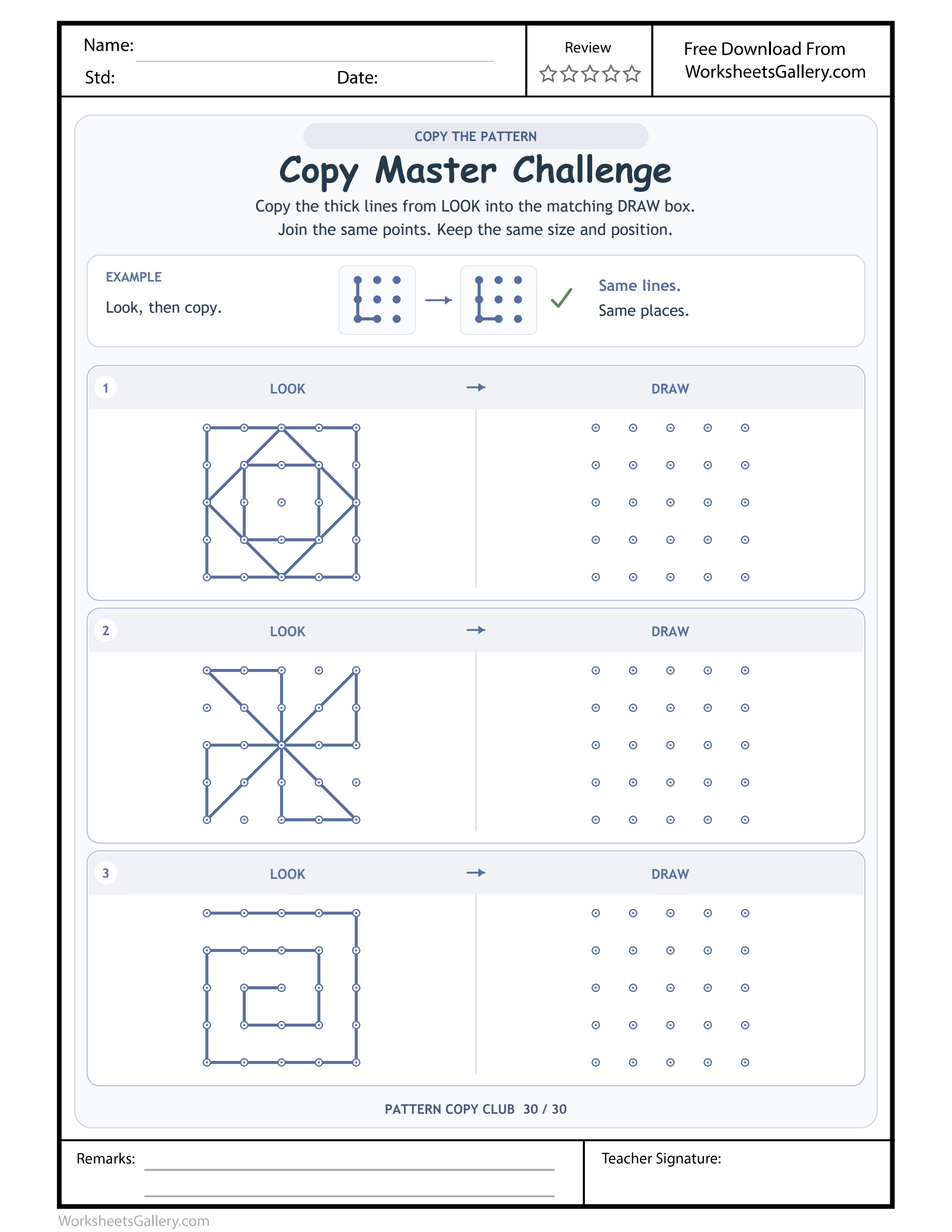
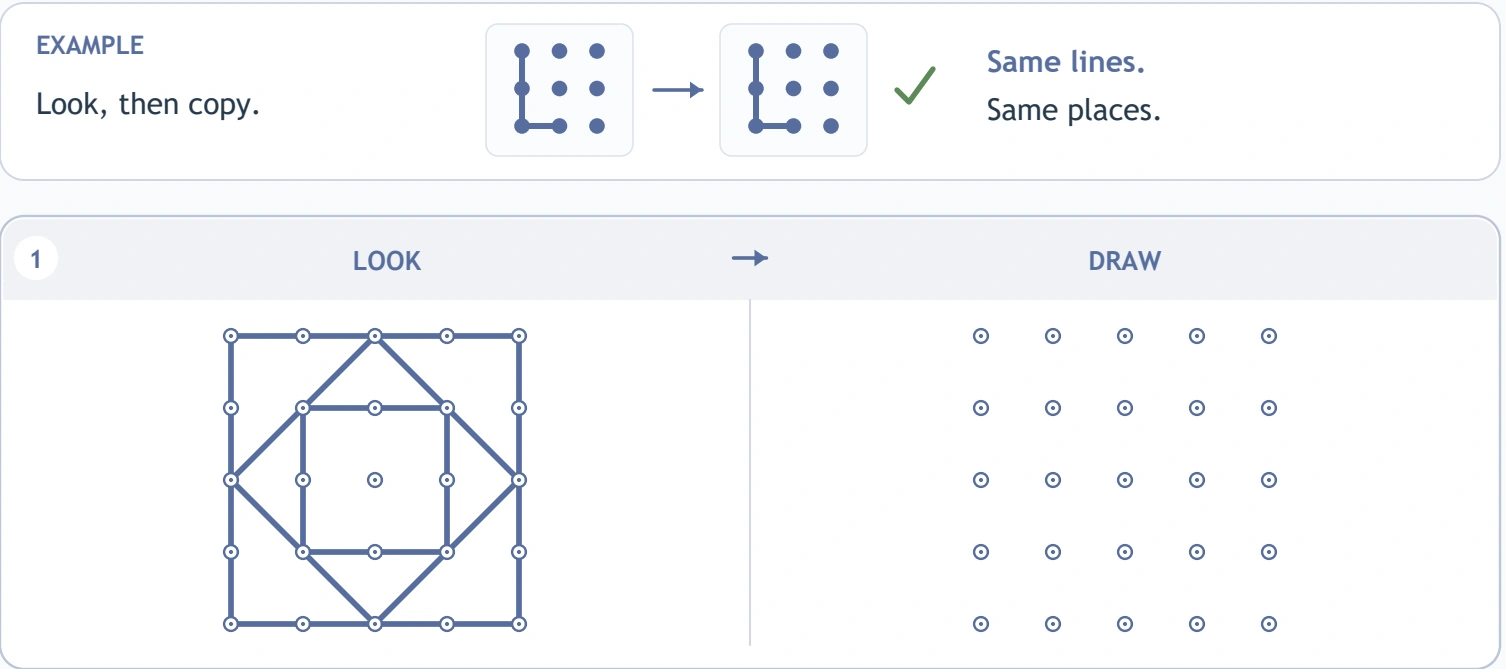
Complexity becomes more approachable when a learner can choose one part to inspect. Master Pattern Copying offers three detailed line constructions on paired twenty-five-point fields. The Copy Master Challenge source combines nested frames, angular rotating sections and an open-ended square spiral. A completed example establishes the copying relationship before the dense practice models. Despite its challenge theme, this page need not become a timed test or a demand to finish everything. Offer it to a child ready to return repeatedly to a visible reference and work through a manageable group of connections.
Choose a part, rather than accepting a whole-page demand — Master Pattern Copying
The dense models in Master Pattern Copying can appear difficult when considered all at once. Begin by asking which clear corner or component the child wants to investigate. A short outer edge may be easier to locate than a crowded centre. One correctly understood relationship can be a complete small goal.
The challenge label does not require speed or full completion. There is no supplied timer or mandatory stroke order. Keep LOOK available, allow pencil lifts and return to a familiar landmark when the selected part becomes hard to follow. The page is a reference-copy activity, not a memory examination.
Three detailed constructions to inspect separately: Master Pattern Copying
| Master Pattern Copying pair | Visible Copy Master Challenge model | Model structure |
|---|---|---|
| 1 | Outer square around a diamond and inner square | 25 anchors / 32 bold pieces in Copy Master Challenge |
| 2 | Four angular blades around one shared centre | 25 anchors / 24 bold pieces in Copy Master Challenge |
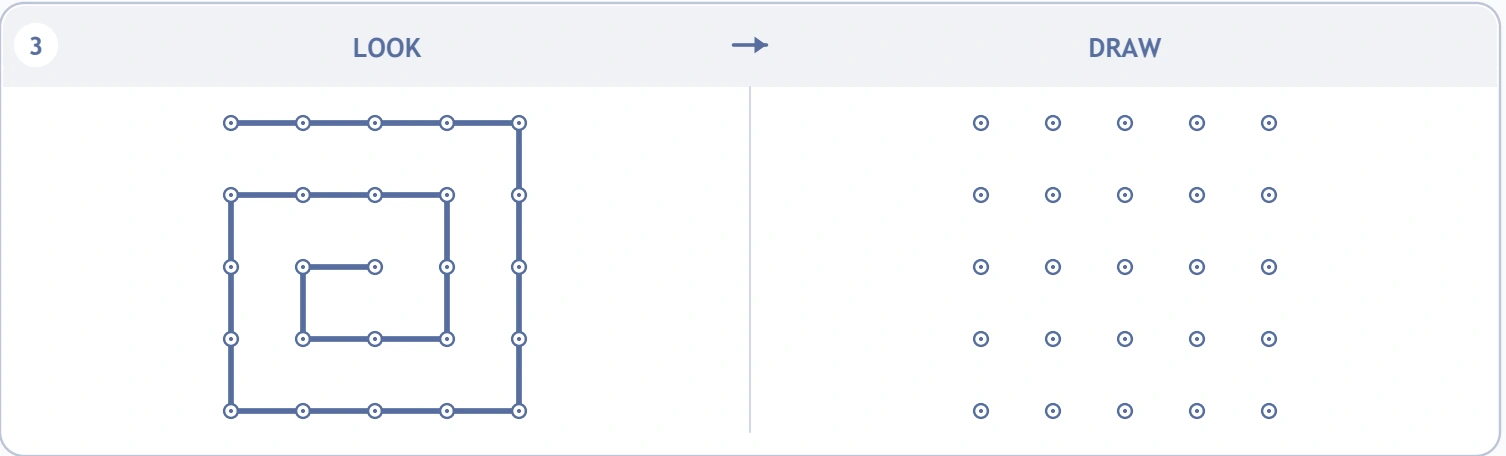
| 3 | Nested square spiral with an open inner end | 25 anchors / 24 bold pieces in Copy Master Challenge |
The Master Pattern Copying bold segment totals describe the printed pieces, including aligned sections. They do not prescribe an equal number of strokes or establish a performance score. All practice fields contain twenty-five markers, but different designs use different connections and groups within that common arrangement.
Distinguish the nested layers before following them: Master Pattern Copying
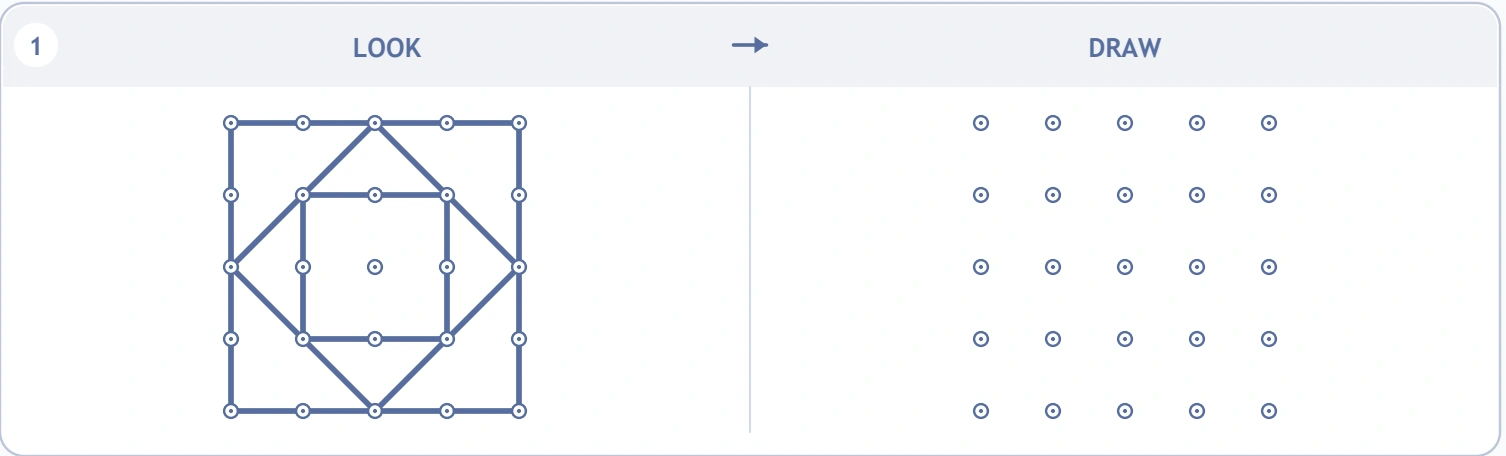
The first Master Pattern Copying model combines an outside square, an intermediate diamond and a smaller square. Ask the learner to identify one component by pointing around its boundary. Then select a short edge and locate its corresponding endpoints in DRAW before making the mark.
At a crossing or near another layer, check whether the chosen edge continues rather than switching automatically to a nearby line. A child may copy one component across several small visits. Naming the layer provides a useful plan, but the actual endpoint positions still need inspection on the printed reference.
Dion's imagined pattern-conservator desk: Master Pattern Copying
Imagine Dion examining a layered frame construction at home. An adult places Master Pattern Copying nearby and invites Dion to choose an outer corner to reproduce. Dion begins adding a diagonal from another layer, then pauses to compare which component they were following. They rebuild that relationship with large strips before returning to paper.
This invented home scenario illustrates a practical conversation, not a measured outcome. Dion may stop after the one repaired comparison. The remaining construction can wait. Treating the work as careful inspection gives the child a purposeful role without requiring the small answer field to be fully completed that day.
Six decisions an adult can observe: Master Pattern Copying
- Selective entry. The learner chooses a manageable component instead of treating a dense figure as one indivisible demand.
- Layer continuity. Attention stays with a selected frame through areas where other lines compete for notice.
- Component organisation. Outer boundaries, inner parts and repeated angular sections can be considered as groups.
- Pencil regulation. Short precise movements alternate with pauses, lifts and deliberate restarts.
- Checking a plan. The visible reference supports testing a proposed connection before extending the copy.
- Reflective language. Words such as layer, inward turn and open end help explain what the learner intends to preserve.
These experiences in Master Pattern Copying are possibilities to notice, not promised developmental gains. A child may identify the correct layer while finding the fine drawing tiring. Use a larger construction to support the idea and acknowledge spatial understanding separately from current hand control.
Rotating sections need individual checks: Master Pattern Copying
The middle Master Pattern Copying model places four angular blade-like parts around a central region. Their repeated appearance can tempt the eye to assume the remainder after inspecting only one. Compare each section's actual direction and endpoints before copying it into the answer field.
A repeated family does not mean every visible line should be extended through the centre. Follow one supplied connection at a time or group a small part that the child can explain. The source does not require a single continuous path through the whole design. Pencil lifts can help prevent unintended joining strokes between separate groups.
A classroom investigation without rankings: Master Pattern Copying
For a possible classroom use of Master Pattern Copying, a teacher offers pupils a choice of one clearly named component. Learners point to the component in LOOK, then show a corresponding landmark in their own DRAW field. The adult demonstrates a small endpoint comparison on a larger spare arrangement.
This hypothetical lesson values the chosen strategy rather than the amount completed. A teacher might note that a child returned to the reference after reaching a crowded crossing. Some pupils may use large strip constructions instead of small pencil copies. Avoid turning the challenge title into a class ranking or an expectation that all three designs must be finished.
Readiness includes the freedom to pause: Master Pattern Copying
The page may interest supported learners around four to seven in later preschool or early primary work, but its density can also suit a later revisit. Prior comfort with simple point-to-point copying is helpful. Start with a fingertip check: can the learner distinguish a chosen part and its corresponding anchor without frustration.
If nearby layers remain confusing, return to a simpler model or broad physical construction. The child need not prove readiness by persevering through fatigue. Master Pattern Copying can be explored in small sections across different days, with willingness to inspect and physical comfort guiding each attempt rather than a completion deadline.
Five pattern-lab extensions at a broader scale: Master Pattern Copying
Curate a nested-frame display: Master Pattern Copying
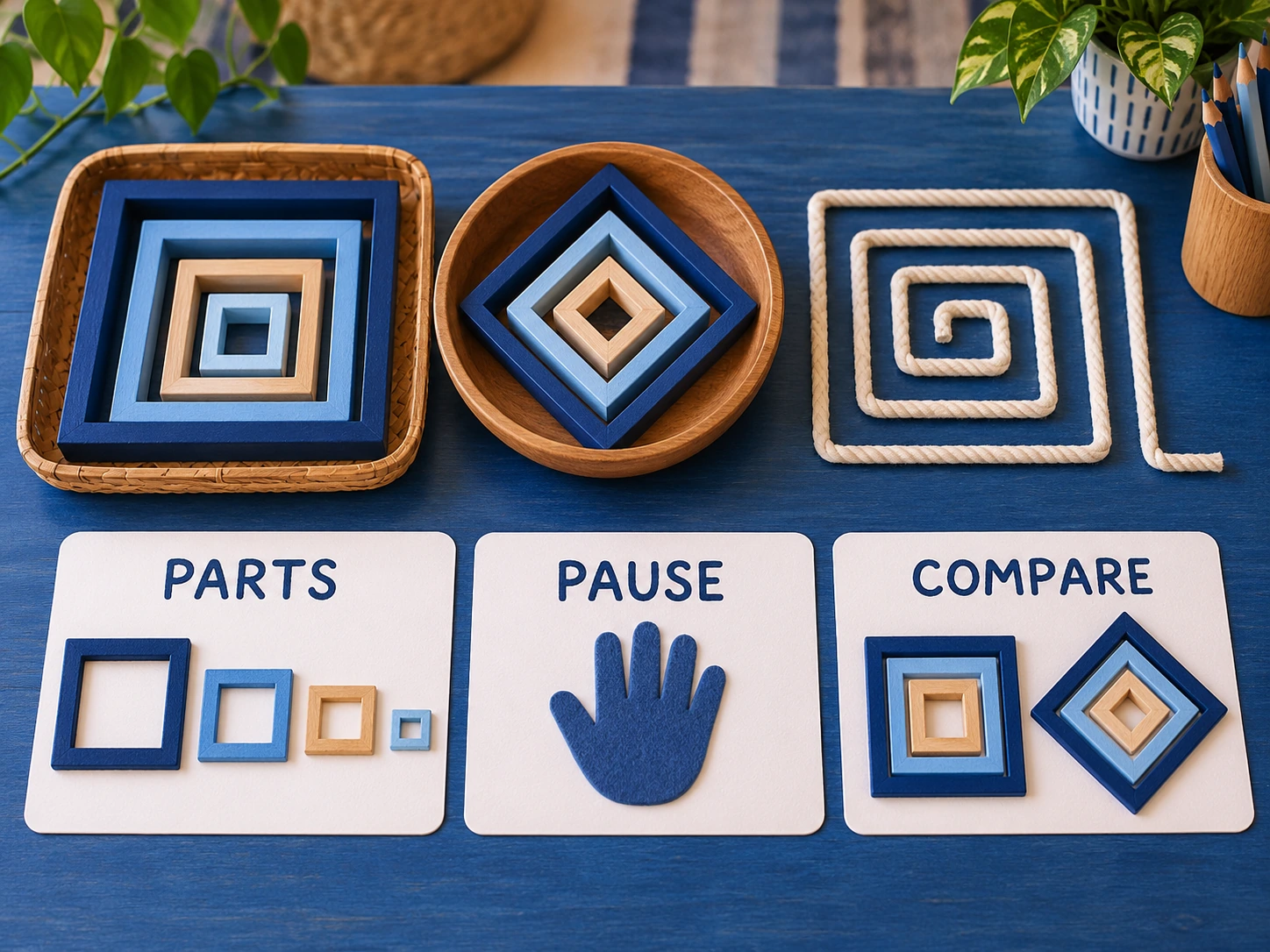
Arrange a large square, a diamond and a smaller square from strips. Ask a partner to identify one layer and recreate it while looking. Discuss which corners belong to that component. This makes Master Pattern Copying's layered relationship visible without adding fine pencil work.
Offer a blade-position briefing: Master Pattern Copying
Build broad angular sections around a centre and describe one section's direction to a toy designer. A partner points to the intended part, then explains the clue. Keep the reference available so the conversation tests description rather than memory.
Make a square-spiral construction: Master Pattern Copying
Use long strips to form an open angular spiral. Follow it slowly with a finger and inspect where it stops. Do not turn it into a closed nest of squares. Relate the open ending to Master Pattern Copying's final model only if another comparison interests the learner.
Investigate one deliberate layer jump: Master Pattern Copying
An adult recreates a broad design but switches from one frame onto another at a crossing. A child locates the change and proposes a repair. Reverse roles. The mistake is part of a friendly inspection game, not a reason to criticise the whole construction.
Invent a challenge with a chosen stopping place: Master Pattern Copying
Let a learner create an original layered pattern on spare paper or with strips. They identify a small component for a partner to copy. Agree that reproducing that component is the complete task. This makes manageable goal-setting part of play rather than an adult-imposed reduction after frustration.
Follow the spiral without closing its open end: Master Pattern Copying
The last Master Pattern Copying design turns inward through an angular spiral. Its nested appearance may suggest several separate closed squares, but that interpretation can add connections the source does not supply. Begin at a clearly visible end or corner and inspect the next turn before continuing.
The child may pause anywhere and return to LOOK. There is no requirement to draw the spiral in one breath or one uninterrupted stroke. Ask where the printed line stops and compare that place in DRAW. An open endpoint is information to preserve, not an unfinished part that automatically needs closing.
Repair a specific connection, then decide whether to continue: Master Pattern Copying
Common Master Pattern Copying differences include jumping layers at a crossing, assuming repeated blades have identical positions, adding a link between separate groups or closing the spiral. Choose one altered connection and compare its two endpoints. A local explanation is more helpful than asking the child to make the dense picture generally neater.
A thoughtful stopping point belongs in a careful copying routine. If erasing produces a crowded patch, discuss the intended repair using larger pieces. The learner can explain what would change without finishing the small field immediately. Avoid repeated dark tracing that makes the original positional distinction harder to inspect.
Let the next visit start with a remembered discovery: Master Pattern Copying
Some children enjoy Master Pattern Copying because its intricate patterns look like something worth investigating. Keep that curiosity separate from pressure to earn a mastery label. Invite the child to choose one small feature and use feedback such as “You stayed with the same layer through that crossing.”
Offer occasional short returns among building, open drawing and movement. Regular practice can be one clear component at a time. Note the relationship the child explained comfortably, then begin there at a later visit. Their next goal can grow from that discovery rather than from the amount of unfinished paper remaining.
Download the detailed reference as a PDF: Master Pattern Copying
The free Copy Master Challenge download retains the supplied original. The separate clean Master Pattern Copying PDF is served through the premium option for a signed-in account with qualifying membership currently active. The clean edition removes website watermark, domain references and promotional advertising, preserving all models, guides, worksheet instructions and student fields.
The native package panel leads to thirty clean worksheets combined in one PDF, priced separately at $3. Save the file authorised for your account. Select US Letter paper and retain original dimensions with Actual Size or 100% scaling. Inspect the complete border in preview so Master Pattern Copying's dense layers remain clearly spaced on the printed page.
Other model comparisons and independent activity resources: Master Pattern Copying
Compare Master Pattern Copying with Path Copy Thinking. After Copy Master Challenge, try Drawing Size Choices. For Copy Master Challenge, consider Shape Border Journeys.
Adults accompanying Master Pattern Copying can browse NAEYC's family play articles or PBS Parents' learning and growth activities. These optional educational links do not imply sponsorship, supply an answer key or add extra downloadable files to this collection.
Popular Worksheets
Printable resources families and teachers are downloading now.
 Free
 Free
 Free
 Free