
Mountain Line Sketches: 3 Amazing Peak Studies
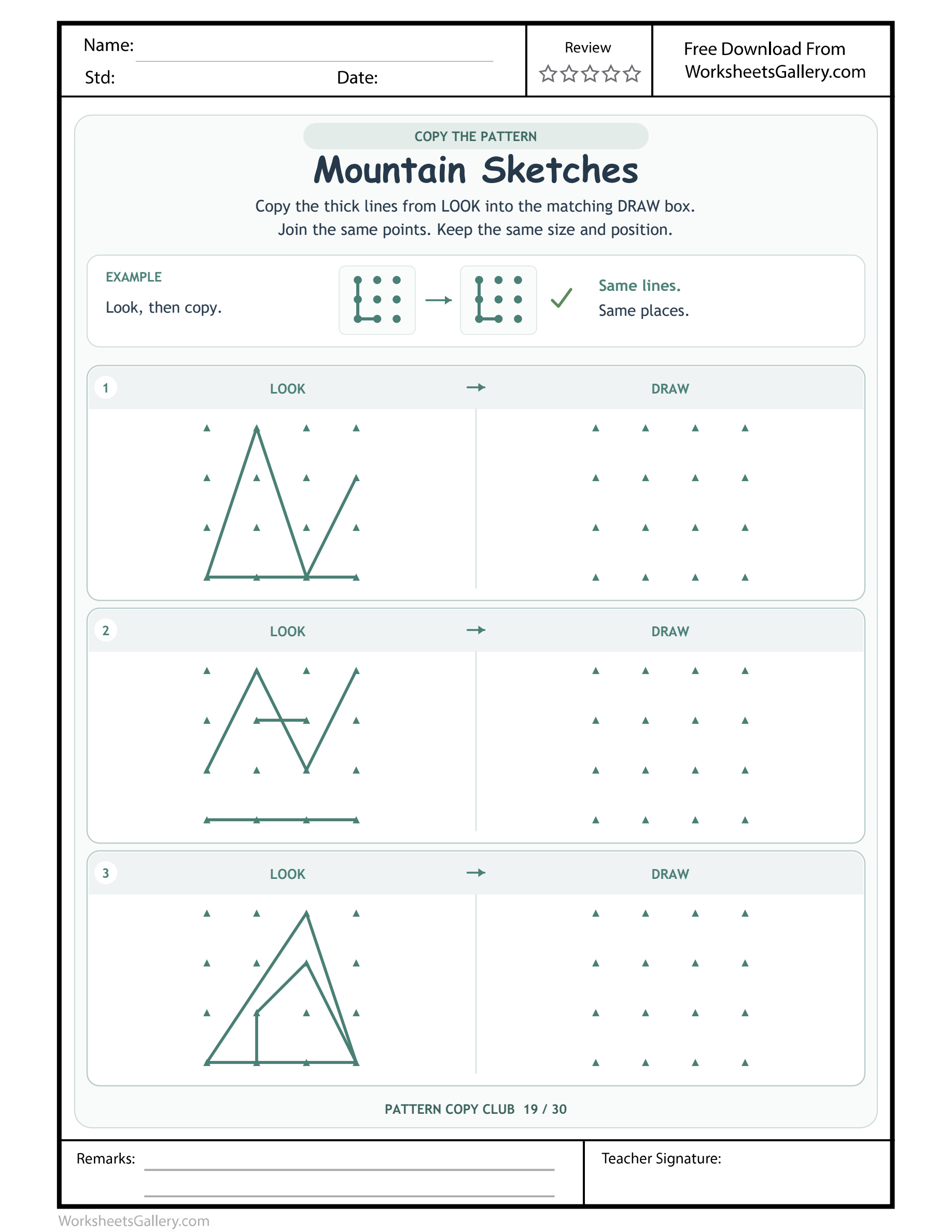
Mountain Line Sketches: Keep separate baselines and nested slopes distinct from the main mountain outline.
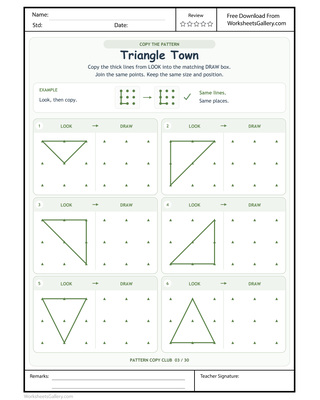
Peaks can share a page without sharing the same outline. Mountain Line Sketches offers three mountain-inspired line models, each paired with a sixteen-point drawing field. Children transfer the printed slopes, baselines and inner details rather than inventing a landscape. The Mountain Sketches source includes open parts as well as connected edges, making careful looking especially useful. Its completed example shows how a model can be reproduced nearby. Choose this page when a young drawer is ready to compare the height and direction of straight slants while keeping a reference within easy view.
An open mountain is still the intended model — Mountain Line Sketches
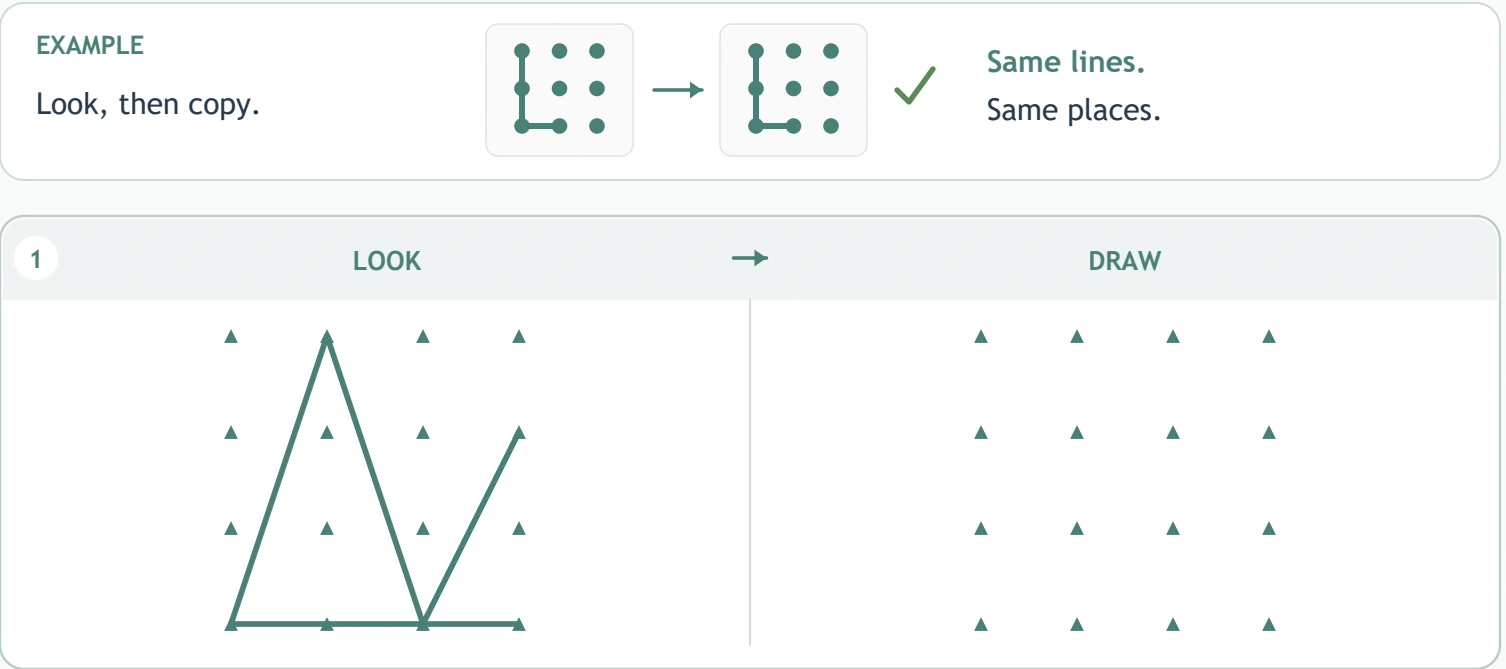
A familiar mountain drawing often has a complete triangular boundary. Mountain Line Sketches asks for something more particular: copying the supplied connections even where they do not form that familiar closed shape. Some slopes stand beside separate lower lines. Other details sit inside a larger peak.
Keep openings that the source leaves open. Closing every gap would change the model, even if the result looked more like a finished mountain. The relationship between endpoints is the drawing task. A child can enjoy imagining snow, climbers or forests afterward on a different sheet without needing those additions in this copy.

Inspect the ridge families before choosing one: Mountain Line Sketches
| Mountain Line Sketches pair | Visible Mountain Sketches model | Model structure |
|---|---|---|
| 1 | High left peak and rising right slope | 16 anchors / 6 bold pieces in Mountain Sketches |
| 2 | Open peak over a separate low baseline | 16 anchors / 7 bold pieces in Mountain Sketches |
| 3 | Large outer peak around a smaller inner peak | 16 anchors / 8 bold pieces in Mountain Sketches |
Each Mountain Line Sketches model sits on a four-by-four point arrangement. The segment totals describe the printed construction, including short pieces sharing a straight direction. They do not establish a required stroke sequence. A learner may group nearby slopes or lift the pencil to reach a separate baseline.
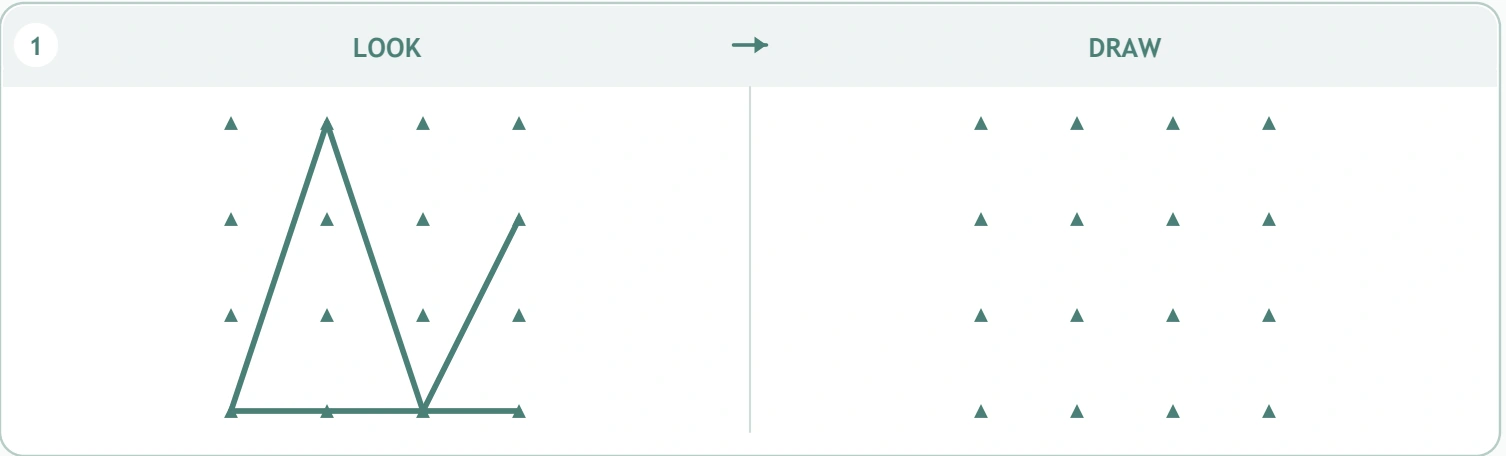
A peak, a landing point and a useful pause: Mountain Line Sketches
For a first attempt at Mountain Line Sketches, identify one peak and point to the corresponding marker in DRAW. Then follow one slope with a finger. Notice whether it descends a short distance or reaches a much lower anchor. Locate that endpoint before committing to the pencil line.
After that single slant, compare both ends with the model. Continue only when the learner is comfortable. A quick return to LOOK can catch a wrong landing place before later lines depend on it. Starting at a lower corner is equally acceptable if the child finds that landmark clearer; the source gives no compulsory start dot.
Outer slopes and inner slopes have different jobs: Mountain Line Sketches
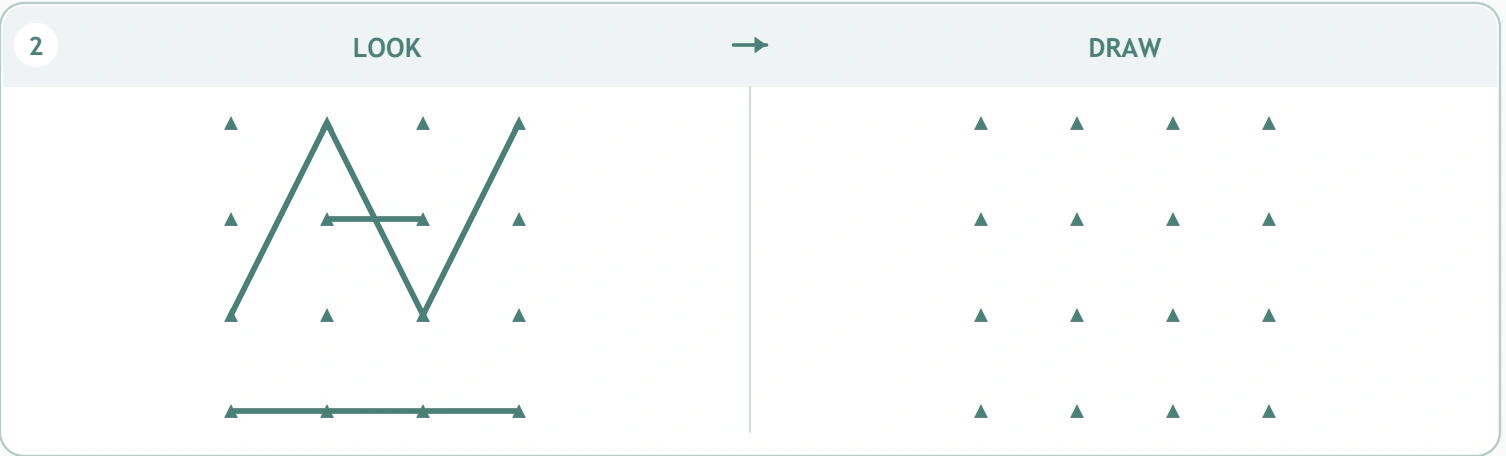
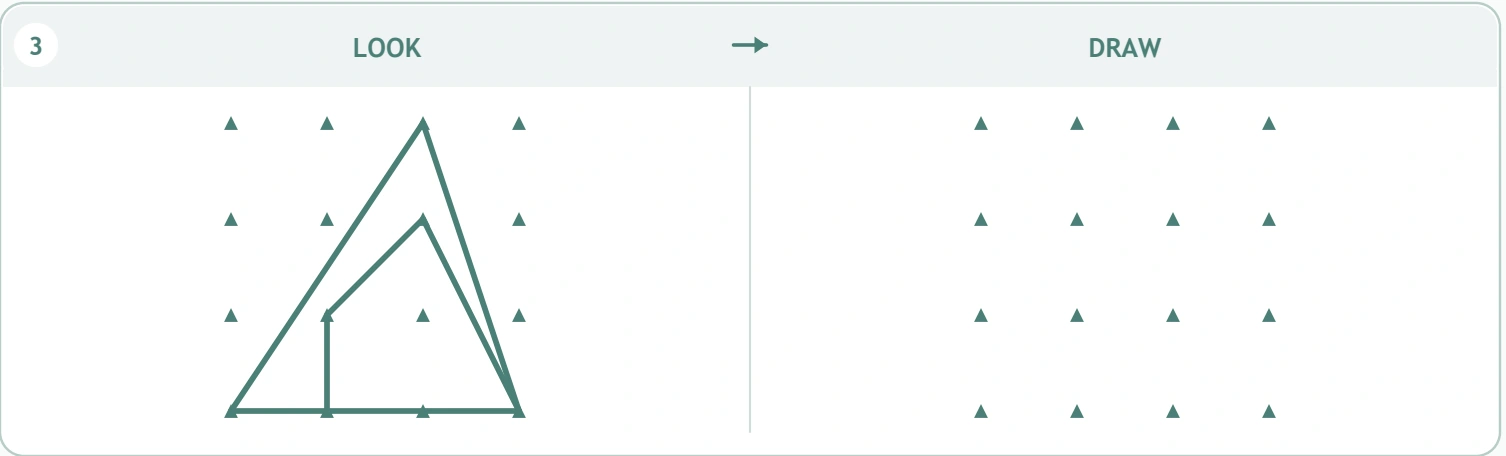
The third Mountain Line Sketches design places a smaller peak inside an outer one. Both matter, but they do not occupy the same anchors. Ask the child to identify the outside boundary first, then show which printed lines belong to the inner detail. Words such as nested, inside and lower can clarify the relationship without a formal geometry lesson.
The middle model also rewards attention to separation. Its baseline is not a command to connect every nearby point. Examine where the line actually begins and ends. Mountain Line Sketches can become a useful conversation about what a picture includes and what the eye is tempted to add.
Five observations worth making while a child draws
- Slant discrimination. Children compare which way a line rises and how far it travels across the field.
- Height relationships. A high outer peak and a lower inner point occupy recognisably different levels.
- Visual selection. Looking for an actual endpoint discourages completing an imagined triangle automatically.
- Pencil coordination. Short straight slopes offer occasions to aim, move steadily and stop deliberately.
- Explanatory language. Describing a separate baseline or an inside peak makes a spatial decision available for discussion.
Treat these as possible experiences during Mountain Line Sketches, not a developmental score. A child might explain the nested peaks accurately while drawing a wavering diagonal. Recognising that distinction helps an adult respond to the spatial idea and the hand movement separately.
Sami's imaginary walking map: Mountain Line Sketches
Imagine Sami bringing a toy hiker to the kitchen table. An adult places Mountain Line Sketches nearby and asks which mountain has a smaller peak inside. Sami points to the last model, then creates two broad peaks from sticks. They compare the inner and outer heights before returning to a single printed slope.
In this invented home example, the toy provides a reason to talk about location; it does not turn the worksheet into a route-finding puzzle. Sami may narrate a long adventure while copying only two lines. Keep that distinction clear so the story adds interest without supplying extra marks that the model never contained.
A school drawing discussion with room for different starts: Mountain Line Sketches
For an imagined classroom use of Mountain Line Sketches, a teacher invites children to point to a separate line before anyone begins drawing. Some notice the lower baseline; others find an inside detail. Each learner explains their choice verbally or by gesture, with the reference still visible.
The adult can then demonstrate comparing two endpoints on a larger spare grid. Children choose one model section on their own pages. Observe whether they return to LOOK after a pencil lift. The purpose is not a silent, memorised reproduction: Mountain Line Sketches supports repeated visual checks while children decide how the pieces fit.
Readiness matters more than the mountain theme: Mountain Line Sketches
The page can suit supported learners around four to seven, spanning later preschool and early school work. However, the small slants and sixteen candidate anchors may be demanding for a child who is still exploring broad marks. Try a single fingertip comparison before expecting a pencil copy.
If the learner cannot yet distinguish the intended landing point, enlarge the idea with sticks or tape instead. Adults can offer spoken choices without moving the child's hand through an answer. Revisit Mountain Line Sketches after a comfortable construction activity, or save it for another day. Finishing all three panels is not a condition for a worthwhile attempt.
Six slope investigations away from the answer fields
Arrange a two-peak skyline
Use strips to build a tall peak with a smaller one inside. Change only the inner height and ask a partner to spot the difference. The comparison echoes Mountain Line Sketches's nested design on a larger, movable scale.
Make a baseline gallery: Mountain Line Sketches
Place a horizontal stick beneath several open peaks, leaving different gaps. Children describe which pieces touch and which remain separate. Keep the constructions visible so the task is visual comparison rather than remembering a hidden arrangement.
Give a mountaineer clear directions: Mountain Line Sketches
A toy climber asks where one sloping edge ends. The child supplies a short explanation using a large model, then a partner checks it. This playful exchange gives endpoint language a purpose without prescribing an invented route on Mountain Line Sketches.
Compare steep and shallow constructions: Mountain Line Sketches
Build two slants with different rises using the same broad tabletop space. Invite the child to describe what changed. Formal angle measurement is unnecessary; words and pointing can establish that the slopes do not have the same shape.
Discover a missing connection in a copy
An adult recreates a stick mountain but deliberately omits one supplied edge. A child identifies the omission and chooses a matching piece. Reverse the roles, keeping the tone collaborative and the original model available.
Draw a completely invented landscape
Offer spare paper for clouds, trees and adventurous characters. Explain that this drawing welcomes new details, whereas Mountain Line Sketches preserves a particular reference. Valuing both activities makes their different purposes easier to understand.
Repair the slope that changes the comparison: Mountain Line Sketches
Typical Mountain Line Sketches slips include closing an intentional opening, moving a peak sideways, joining a separate baseline or making inner and outer slopes coincide. Identify one such difference and compare the affected endpoints. A general instruction to make the picture neater does not tell the child which relationship changed.
A gap can be a feature to preserve. If the child has joined two separate parts, point to the original space and discuss a possible repair. When erasing becomes frustrating, make the comparison on a larger demonstration instead. A thoughtful explanation can end the session even if the small answer panel remains unfinished.
Let another visit begin with curiosity: Mountain Line Sketches
Mountain pictures may appeal because children can attach a story to a simple collection of lines. Invite the learner to choose an outer slope or inside detail as the next small goal. Specific feedback such as “You checked where the lower line stopped” acknowledges an observable action.
Return to Mountain Line Sketches occasionally alongside outdoor looking, loose-parts play and free art. Keep sessions short enough that a child can leave with a clear discovery rather than tired hands. An adult's note about one carefully preserved opening is a more useful reminder for next time than a demand to complete every panel.
Download a print file with the edition you need: Mountain Line Sketches
The free option supplies the original Mountain Sketches PDF. An eligible active member can obtain the separate clean Mountain Line Sketches edition through the premium control after signing into their account. Its website watermark, domain branding and promotional ads have been removed; the copying models, pupil fields and remaining worksheet instructions are preserved.
The native collection card points to the complete thirty-sheet PDF at $3, available as its own purchase. Save the permitted download, select US Letter paper and use 100% scaling or Actual Size. Check that the full border fits the print preview. Mountain Line Sketches's page images illustrate details for browsing; use the PDF itself for the classroom or home printout.
Related drawing choices and adult reading: Mountain Line Sketches
Compare Mountain Line Sketches with Drawing Size Choices. After Mountain Sketches, try Shape Border Journeys. For Mountain Sketches, consider Path Copy Thinking.
Alongside Mountain Line Sketches, consider PBS Parents' Learn and Grow suggestions for everyday learning and NAEYC's resources on family play. These links lead to independent educational organisations, not to answer keys or extra files in this collection, and imply no sponsorship.
Popular Worksheets
Printable resources families and teachers are downloading now.
 Free
 Free
 Free
 Free