
Toytrack Turn Copies: 3 Brilliant Inward Bends
Toytrack Turn Copies: Pause at inward track turns instead of smoothing the model into a plain rectangle.
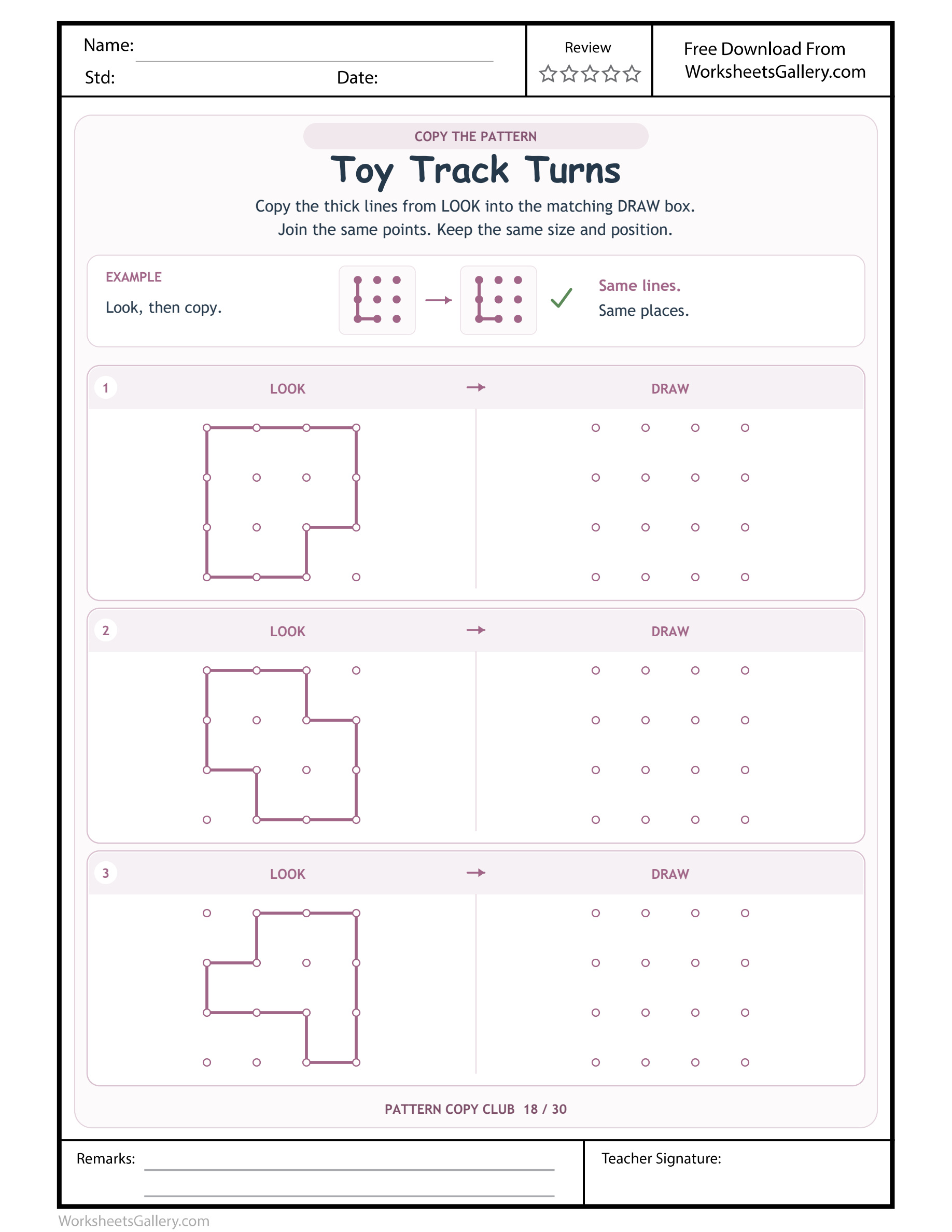
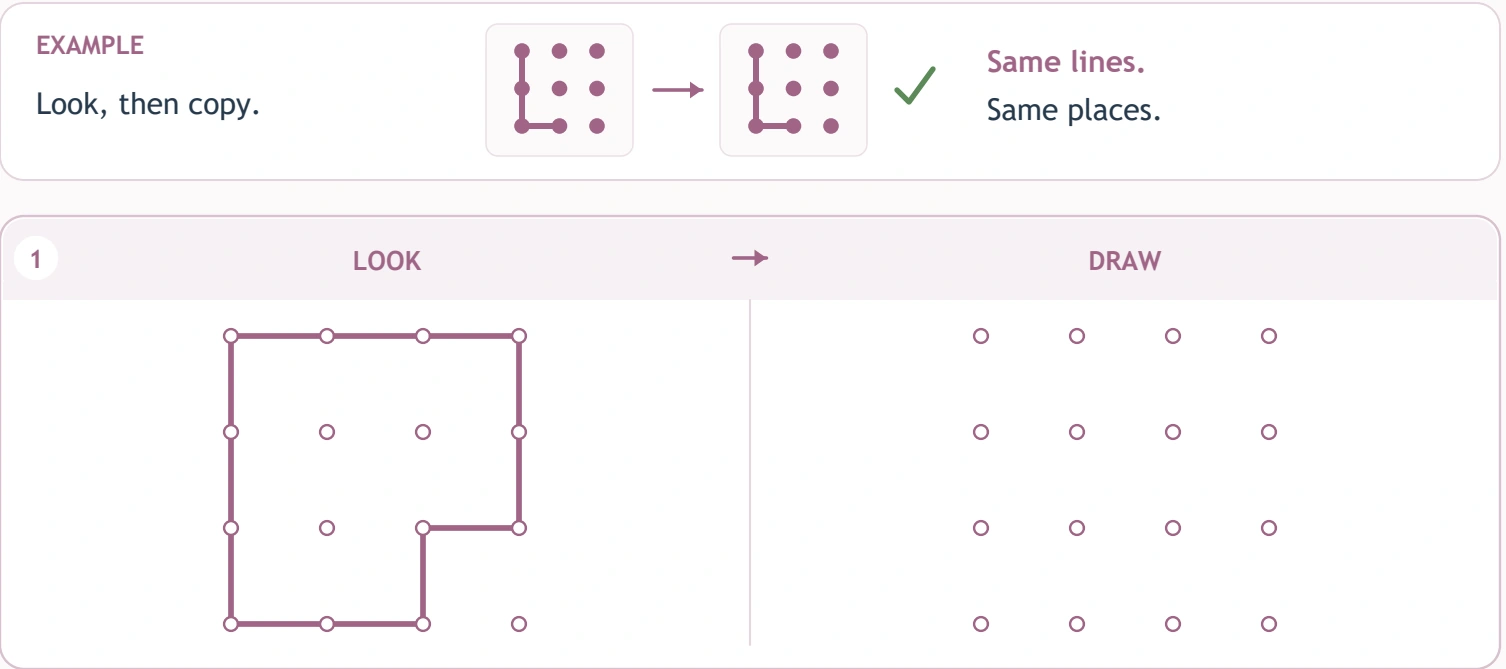
Tracks do not always follow the outside of a rectangle. In Toytrack Turn Copies, three green outlines turn inward before continuing around their shapes. Children compare each model with a neighbouring sixteen-point field and recreate the selected connections. Toy Track Turns uses familiar railway-style bends to encourage close inspection of corners, not a race from a marked start to a finish. A small completed example introduces the copying arrangement. Bring the page to a learner who can follow a short straight segment and is beginning to notice how an indentation changes a whole outline.
Rosa notices a space inside the track — Toytrack Turn Copies
Picture Rosa arranging a toy railway at home. An adult offers Toytrack Turn Copies, and Rosa chooses the first model because its lower edge steps inward. Before drawing, they build a broad version with straight wooden pieces. Rosa points to the small space where a piece could have continued across but instead turns upward.
This is an imagined home situation, not a claim about a particular child's progress. The useful exchange is specific: an inside corner deserves attention just as an outside corner does. On Toytrack Turn Copies, Rosa might copy that short inward step first and leave the remainder for another visit.
Track-shaped outlines, rather than travelling instructions: Toytrack Turn Copies
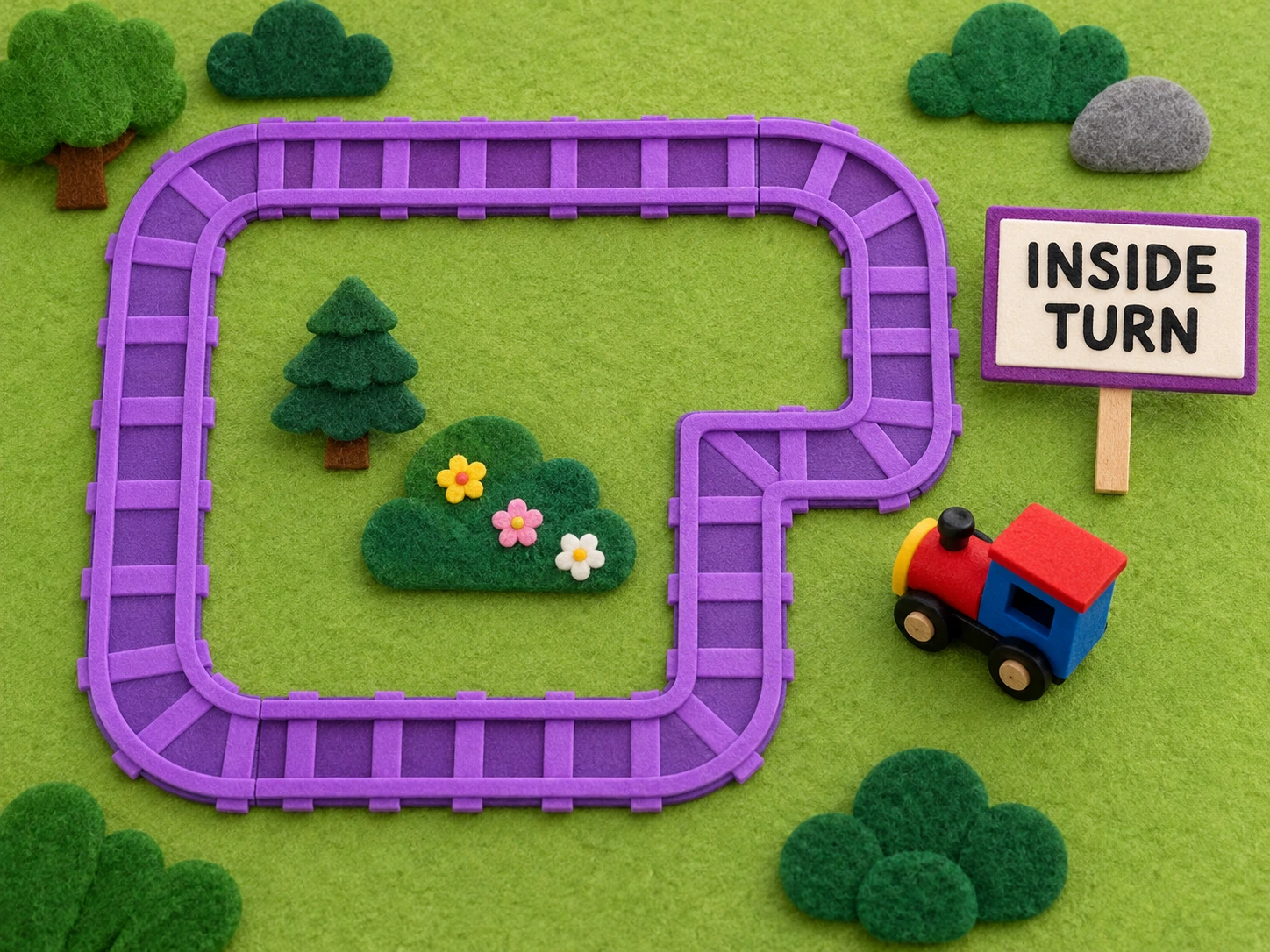
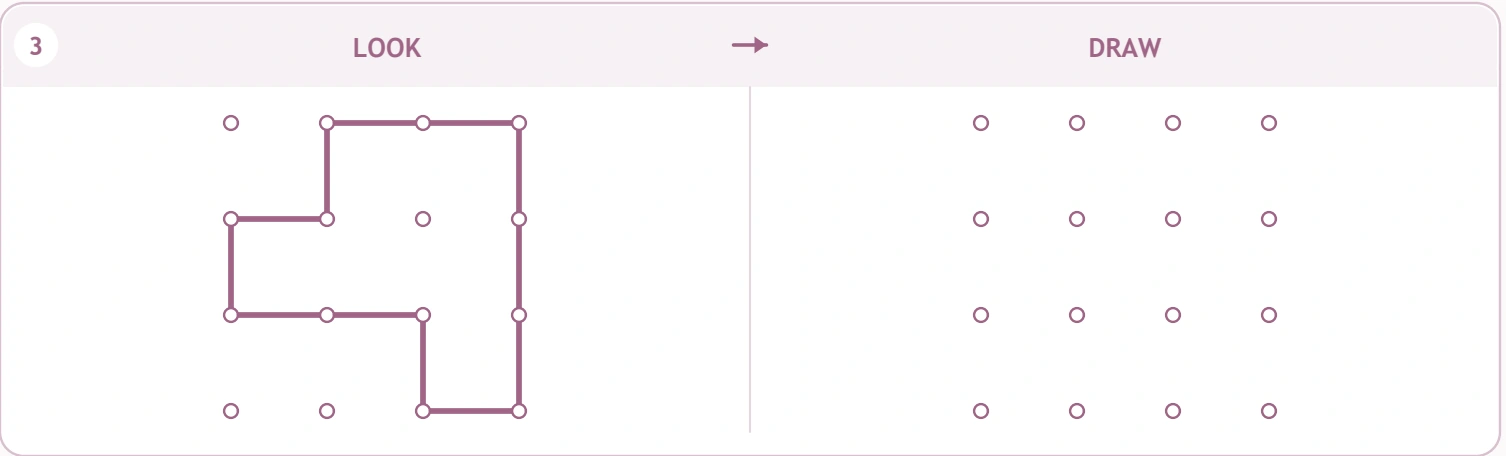
The source supplies three closed rectilinear figures. Each uses horizontal and vertical edges, with twelve counted bold segments in its model. The rails suggested by Toytrack Turn Copies's theme are geometric outlines; there are no printed stations, direction codes or destinations to solve.
Follow the reference's corners, including its notches. A child who draws a tidy rectangle may have produced a recognisable shape while omitting the very detail that distinguishes the model. Keeping LOOK available beside DRAW makes that comparison possible throughout the task.
A guide to the three turn arrangements: Toytrack Turn Copies
| Toytrack Turn Copies pair | Visible Toy Track Turns model | Model structure |
|---|---|---|
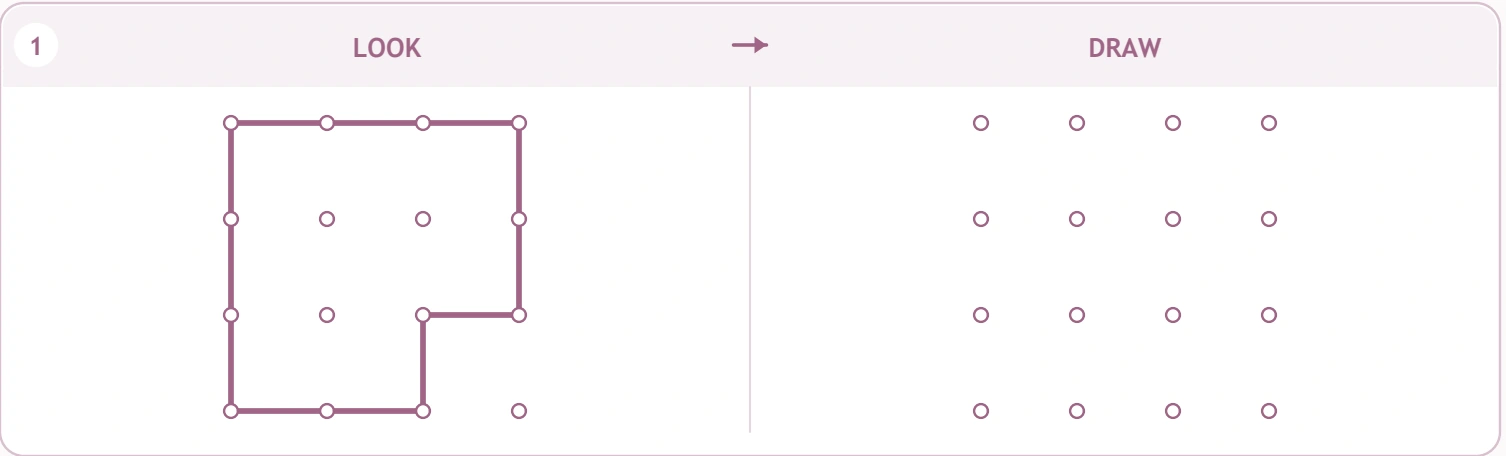
| 1 | Large upper loop with an inward lower step | 16 anchors / 12 bold pieces in Toy Track Turns |
| 2 | Opposed top and bottom rectangular turns | 16 anchors / 12 bold pieces in Toy Track Turns |
| 3 | Left-side projection between two right uprights | 16 anchors / 12 bold pieces in Toy Track Turns |
In Toytrack Turn Copies, a long straight side can contain more than one counted segment where anchors divide it. Those counts describe the printed lines, not compulsory pencil strokes or a speed target. Check where a side changes direction rather than trying to finish a prescribed number of moves.
Find an indentation before making the long sides: Toytrack Turn Copies
Begin Toytrack Turn Copies by identifying a distinctive inward corner. Ask the learner to locate its partner in the answer field, perhaps comparing how far it lies from the top and left edges. Point with a finger first. A careful choice of anchor is more useful than an immediate pencil mark.
Copy one short edge entering that corner, pause, then decide where the next edge ends. Continue around a manageable portion of the outline. If the learner starts at another clear corner, accept that plan: the worksheet does not enforce one starting point. A pencil lift can make a difficult restart easier without changing the final copying goal.
Watch the empty spaces change shape: Toytrack Turn Copies
The spaces around the printed track offer extra clues. In Toytrack Turn Copies, a projection extends outward while a notch takes a bite into the outline. Ask whether the chosen turn adds an outside section or leaves an inside recess. That language can prevent the child from flattening all bends into a simple box.
Keep the question grounded in the actual picture. Children need not learn formal polygon terminology to compare two corners. Words such as inward, upright, lower and across are enough to explain a chosen connection. Pointing is a valid response when speaking and drawing together feels demanding.
Six reasons to pause at a corner
- Contour discrimination. Small inward steps become visible features instead of disappearing into a familiar rectangle.
- Spatial correspondence. A selected bend must occupy a matching location in another sixteen-point field.
- Controlled stopping. The hand slows at an anchor before changing between horizontal and vertical movement.
- Planning in portions. Several short sides can be inspected as one useful section of a longer outline.
- Position language. Describing an inside recess or outside projection gives precise words a practical purpose.
- Checking a proposal. Children can test whether a copied section preserves the reference before continuing farther.
These are opportunities within Toytrack Turn Copies, rather than promises about development. Notice whether a learner recognises the notch even when pencil control is still uneven. Their spoken explanation and their drawn accuracy may show different strengths on the same day.
Who might enjoy this railway-table challenge?: Toytrack Turn Copies
Preschool children approaching school age and learners in the early primary years, broadly four to seven, may explore Toytrack Turn Copies with support. A sixteen-point field asks for more precise anchor selection than a small three-by-three arrangement. Familiarity with copying two connected lines can provide a useful starting point.
Offer a brief trial: can the child point to a model corner, then find a plausible corresponding marker? If the many nearby points are confusing, return to large floor or tabletop constructions. Toytrack Turn Copies need not be completed simply because it has been printed. A willing attempt at one turn is an appropriate session-sized goal.
A classroom corner-inspection crew
For a possible classroom session, put Toytrack Turn Copies beside a tray of straight construction strips. Invite partners to describe a model's inward turn while keeping the actual sheet visible. One child points to the model; the other identifies the matching place on their own answer field. Then they exchange jobs.
The teacher can note whether pupils preserve the recess after drawing the long outer sides. This imagined example offers an observation routine, not evidence of a tested outcome. Allow individual copies and different working lengths. The number of finished tracks is less informative than the corner relationship a child can explain.
Four railway-inspired investigations after the page
Build a bend museum: Toytrack Turn Copies
Make two broad strip outlines, one with a notch and one without. Let a child label the difference orally and display both constructions. Invite a visitor to identify the version that matches a supplied reference. Connect the discussion to Toytrack Turn Copies's distinctive inside turns.
Ask a station designer to describe a recess: Toytrack Turn Copies
A toy figure needs a sheltered waiting space beside an imaginary track. Children explain which inward bend could represent it, then invent a construction on the table. Keep this pretend story separate from the printed models so an imaginative station does not become an added worksheet line.
Trade corner instructions: Toytrack Turn Copies
Choose one corner on a large adult-made outline. Describe its neighbouring sides without naming its location immediately. A partner points to the intended bend and explains the clues. Exchange roles, using Toytrack Turn Copies's vocabulary when it fits the model.
Compare footprints with string: Toytrack Turn Copies
Lay string around a simple rectangular frame and then around a frame with an indentation. Discuss where the second boundary travels inward. The activity makes a changing perimeter tangible without asking a child to calculate length. Return to one printed notch only if another pencil attempt sounds appealing.
When a neat copy misses the important turn: Toytrack Turn Copies
Common Toytrack Turn Copies mismatches include bridging across a recess, drawing a projection on the opposite side, extending a short upright or shifting the whole outline one column. Compare the first clearly different corner instead of asking for the entire shape to be redrawn. A single positional repair can clarify several following edges.
Accuracy here means keeping the same bends in corresponding places. It does not require one uninterrupted pencil journey. If erasing leaves a crowded patch, discuss the intended correction with a finger or larger demonstration. Avoid turning repeated corrections into a requirement to trace over every line until it becomes dark and difficult to inspect.
A satisfying stop can come before the loop closes: Toytrack Turn Copies
The toy-track association can give Toytrack Turn Copies an appealing purpose for children who enjoy construction. Let the learner name the section they want to investigate: a narrow passage, an inward step or a broad upper edge. Choice can make a small copying task feel more personal.
Use feedback that identifies an action, such as “You looked back before making that inside turn.” Invite another short visit on a different day rather than expecting all three outlines immediately. Alternate Toytrack Turn Copies with vehicles, blocks and free drawing so paper copying remains one option among varied forms of play.
Save the correct edition and keep the point spacing: Toytrack Turn Copies
The free file is the supplied Toy Track Turns worksheet. The separate clean Toytrack Turn Copies PDF can be requested using the member control; your account needs qualifying membership in active status. That clean edition retains the complete exercises and student fields, with the website watermark, domain and promotional advertising removed.
The related package card opens the thirty-page collection, priced separately at $3. Choose the edition your account permits and save its PDF before printing. In the print dialog, select US Letter paper and avoid enlargement or shrink-to-fit; Actual Size or a 100% scale preserves Toytrack Turn Copies's anchor positions. Review the complete border in preview before using the page with a child.
Other ways to explore changes of direction: Toytrack Turn Copies
Compare Toytrack Turn Copies with Path Copy Thinking. After Toy Track Turns, try Drawing Size Choices. For Toy Track Turns, consider Shape Border Journeys.
Adults extending Toytrack Turn Copies's construction theme can explore NAEYC's family play information and browse learning activities from PBS Parents. These independent education resources offer further reading; they are not endorsements of this printable or additional components of the purchased collection.
Popular Worksheets
Printable resources families and teachers are downloading now.
 Free
 Free
 Free
 Free