
Triangle Position Copies: 6 Clever Shape Studies
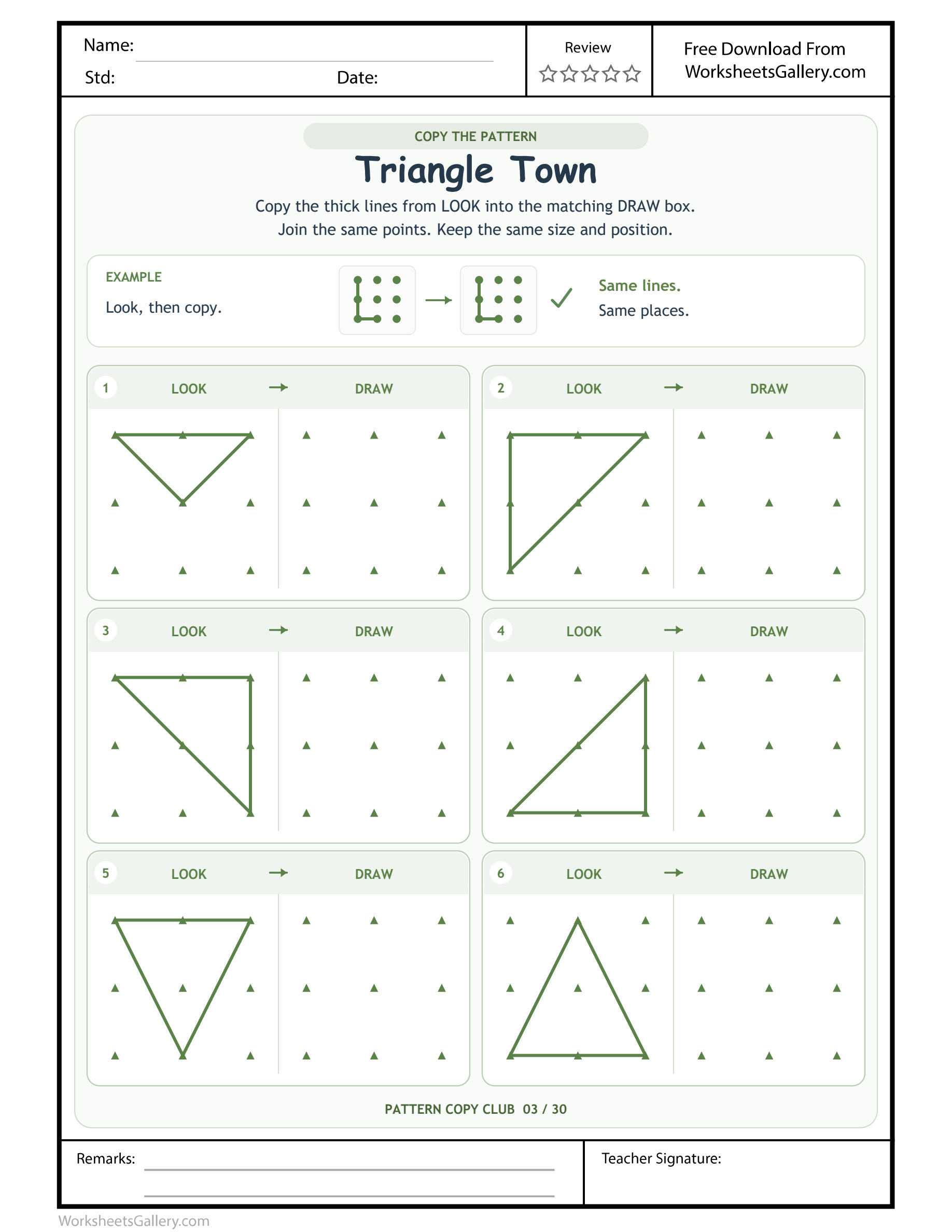
Triangle Position Copies: Place triangles in their printed grid positions instead of drawing every triangle centrally.
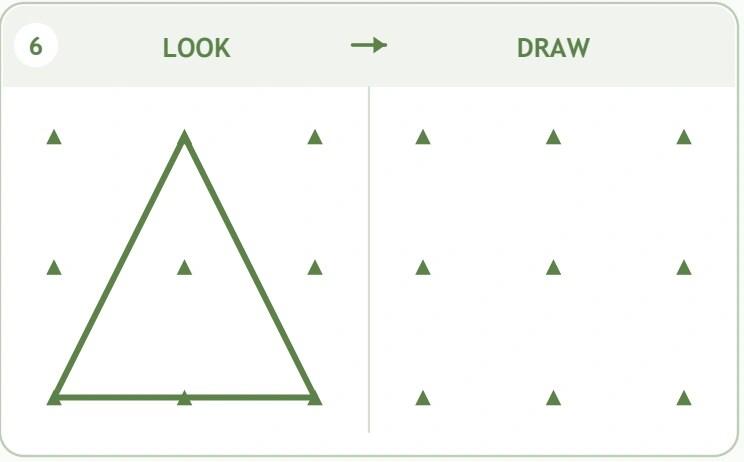
Triangles do not always sit neatly in the middle. Triangle Position Copies asks children to copy six green models whose points occupy different parts of matching nine-point fields. Some triangles stretch across a top edge; others use a side upright, and the last two reach farther vertically. Each DRAW area keeps the same tiny triangular markers as its LOOK partner. A completed example introduces the copying idea. This printable suits a quiet shape conversation in which children notice position, compare the distance between corners and decide where each sloping side should land.
A triangle has a place as well as a name — Triangle Position Copies
Recognising the word triangle is only the beginning of Triangle Position Copies. A child can identify every model correctly and still place a copied corner in the wrong row. The Triangle Town sheet invites a more exact question: which three locations form this particular outline?
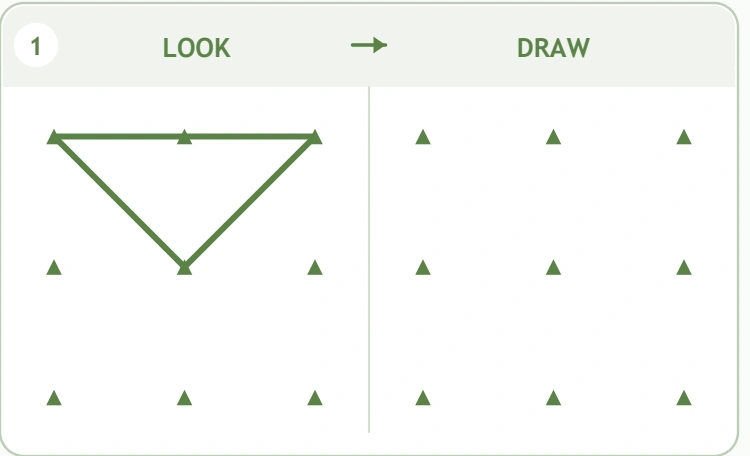
Look at the first model in Triangle Position Copies. Its top edge is wide, while the low corner sits on the middle row. Compare that with the tall downward triangle later on. Both point downward, yet their spans differ. Naming the shape does not replace checking its corners. Adults can use that distinction to keep the activity thoughtful without introducing formal geometry terminology.
Take a tour of the six building plots
| Triangle Position Copies pair | Visible Triangle Town model | Model structure |
|---|---|---|
| 1 | Shallow downward triangle | 9 anchors / 4 bold pieces in Triangle Town |
| 2 | Upper-left right triangle | 9 anchors / 6 bold pieces in Triangle Town |
| 3 | Upper-right right triangle | 9 anchors / 6 bold pieces in Triangle Town |
| 4 | Lower-right right triangle | 9 anchors / 6 bold pieces in Triangle Town |
| 5 | Tall downward triangle | 9 anchors / 4 bold pieces in Triangle Town |
| 6 | Upright triangle | 9 anchors / 4 bold pieces in Triangle Town |
All six Triangle Position Copies fields have nine markers. The little printed triangles indicate locations; children do not need to trace around those tiny symbols. Their pencil lines join corresponding positions to reproduce the larger model. A side may pass through a marker partway along its length, so counting visible point-to-point pieces is different from counting the outline's three sides.
Match three corners before closing the outline: Triangle Position Copies
Begin Triangle Position Copies with a finger point at one corner of a LOOK model. Find that location in DRAW. Repeat for the other two corners, leaving the pencil aside until the child can show where the outline belongs. This rehearsal can make an otherwise vague copying request much clearer.
Connect a pair of chosen locations. Pause to check the next corner, then close the outline when the model closes. Avoid demanding a particular clockwise order. In Triangle Position Copies, a correct triangle can be drawn from several starting points, as long as its position, size and direction correspond to the reference.
Suitable ages depend on the slants: Triangle Position Copies
Preschool and kindergarten children, often around four to six, may enjoy Triangle Position Copies with an adult nearby. Some can name triangles confidently but find diagonal control tiring. Others draw the slants easily while needing help to locate an offset corner. Those are different support needs, and neither requires an entire sheet of repeated correction.
Try a single pair and watch the process. Can the learner compare high and low positions? Can they stop at a selected marker? If not, make larger triangles with strips first. Triangle Position Copies can wait while broad construction play provides a more comfortable scale for exploring three joined edges.
Six kinds of thinking inside a green outline
- Relative position. A top-right corner differs from the centre, even though either could belong to a triangle on another model.
- Shape constancy. Turning an outline changes its orientation without changing its triangle identity.
- Length comparison. The learner notices whether a side crosses one point interval or spans a larger part of the field.
- Visual closure. Returning to the initial corner completes the copied outline, rather than leaving an unintended gap.
- Diagonal movement. A planned destination supports a controlled sloping stroke between the selected markers.
- Explanatory language. Words such as wide, shallow, upright and downward help a child describe the exact model they are copying.
Use Triangle Position Copies to notice these actions individually. The sheet offers practice, not a score that combines language, drawing comfort and attention into one judgement. An accurate spoken description can be valuable even when the learner decides not to finish the pencil version that day.
Cora's roof plan at home, imagined
Imagine Cora making paper roofs for three toy houses. An adult places Triangle Position Copies beside the constructions and asks which printed triangle is broad and shallow. Cora selects the opening model, then notices that its lowest corner does not reach the bottom of the grid.
This possible home scene is invented for illustration. Its teaching opportunity is the comparison between a general roof idea and the exact paper model. Cora can decorate the toy houses freely; on Triangle Position Copies, the adult helps preserve the chosen three point locations. A short conversation may be enough before returning to the construction game.
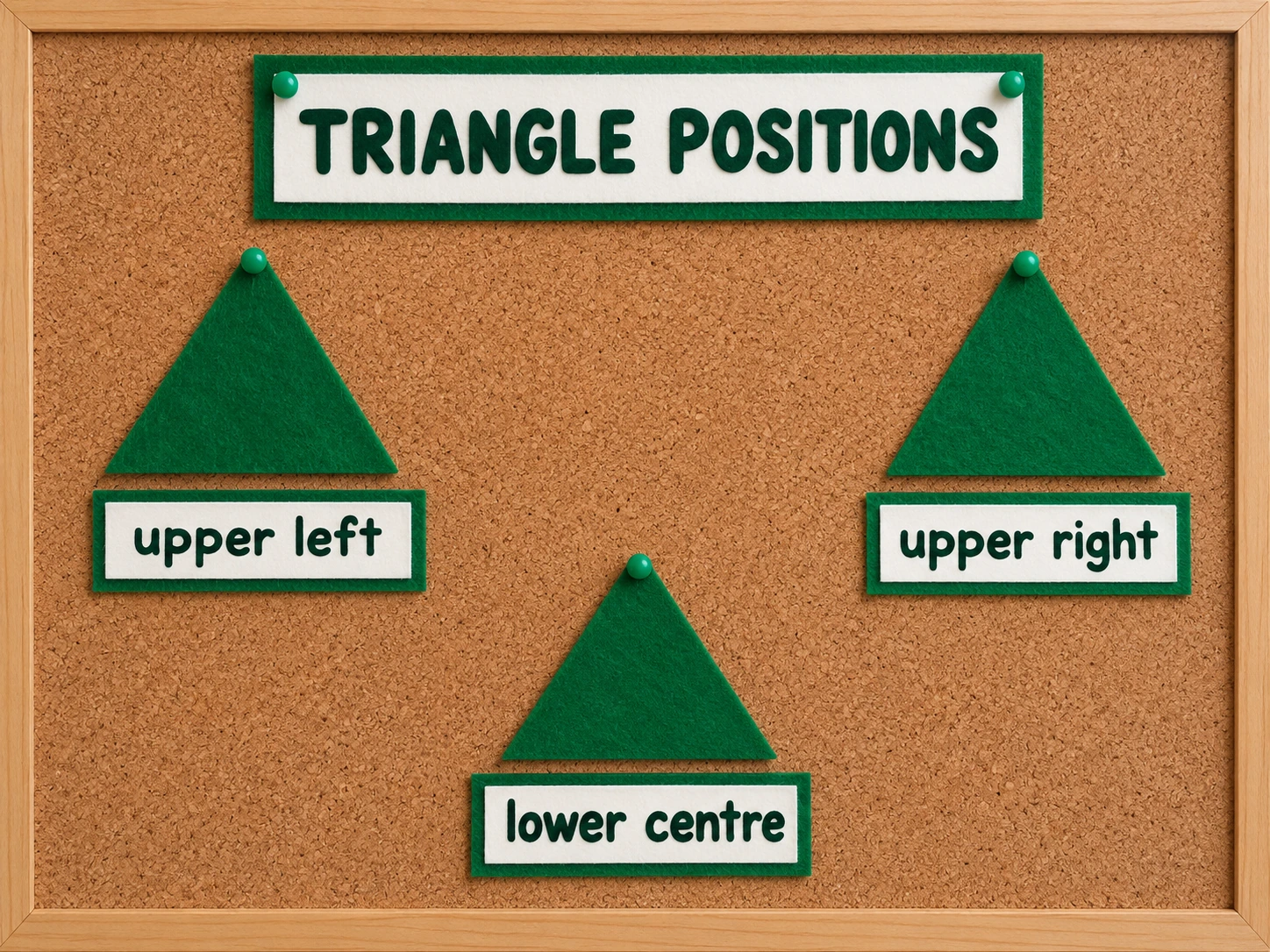
Explore positions together in class
For an imagined classroom activity, offer Triangle Position Copies during a small-group shape workshop. Invite each child to choose a triangle and explain one corner to a partner. A learner might say “the lowest point is in the centre” while another notices a vertical side at the right.
The adult can model a pointing-and-speaking routine before pencils move. Keep each child's sheet separate so partners share observations rather than fill one another's DRAW fields. During Triangle Position Copies, a teacher can observe whether a child preserves the shallow triangle's height. That specific note is more actionable than treating every recognisable triangle as an equally accurate copy.
Separate the demonstration from the practice shapes: Triangle Position Copies
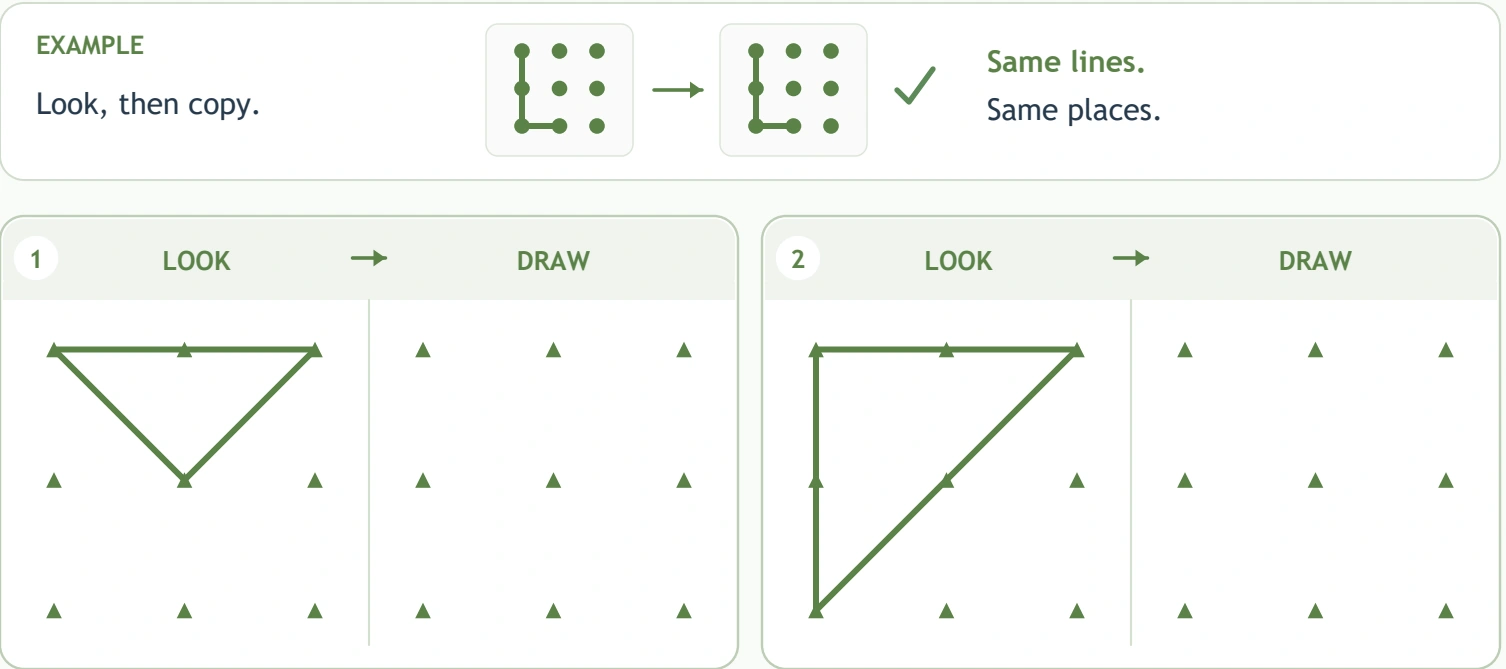
The Triangle Position Copies example shows an L copied between two small grids. It demonstrates correspondence, not the final answer to the first triangle exercise. Draw attention to how a matching point keeps its location when the line moves from one box to the other.
Then return to Triangle Town's larger models. A child should not add the demonstration's L inside every outline. Nor should they draw over the LOOK triangle and count it as the copy. The useful work in Triangle Position Copies happens in the adjacent field, where the child reconstructs the same arrangement through their own endpoint decisions.
Five triangular invitations after the pencil work: Triangle Position Copies
Open a roof-shape shop: Triangle Position Copies
Cut a few broad paper triangles and place them above rectangular blocks. Ask which roof is widest and which is tallest. Sketch a favourite on another sheet, then compare its outline with the corresponding idea in Triangle Position Copies. Keep cutting tasks adult-supported as appropriate.
Make a three-corner puppet stage: Triangle Position Copies
Use a triangular frame as a stage opening. Let a small paper character visit each corner while the child describes its location. The story can include a high lookout, a low resting point and a side entrance, giving position words a playful purpose.
Build an orientation gallery
Rotate one large triangle cutout on a mat. Discuss what changes and what stays the same. Return it to a chosen position and draw it. This extension prepares a useful distinction for Triangle Position Copies: recognise the same shape family while respecting the direction of a particular reference.
Find a shallow and a tall outline: Triangle Position Copies
Look through picture books or household patterns for two triangles with different proportions. Point out why one appears flatter. Children need not measure angles; noticing the relationship between height and width is enough for a meaningful comparison.
Play the missing-side curator: Triangle Position Copies
An adult arranges two sides of a large stick triangle and asks the child which connection would close it. Check the result against a completed stick model. Use a fresh construction rather than changing Triangle Position Copies's printed activities into unfinished puzzles.
When a familiar triangle hides a mismatch: Triangle Position Copies
The most tempting Triangle Position Copies error is drawing a standard upright triangle in every DRAW field. Another is placing all downward tips on the bottom row, even when the model stops at the centre. Ask the child to compare one named corner before erasing anything.
Avoid turning a single misplaced point into a request to redraw the whole page. A faint repair or a second attempt on spare paper may be enough. Match the printed triangle, including its location. Straightness can improve with practice, but changing the corner arrangement changes the actual answer, even if the new shape is beautifully drawn.
Encourage a shape explanation, then offer a pause: Triangle Position Copies
Children may enjoy Triangle Position Copies because the outlines resemble roofs, sails or flags. Let those associations open a conversation, while keeping imagined additions off the exact copying field. A learner who wants a flagpole can add it to a separate creative drawing afterward.
For regular practice, keep a small folder of attempts and revisit one comparison after a few days. Ask what made the shallow triangle different from the tall one. A thoughtful answer can be the day's achievement. Offer a choice of two models, and stop if the child becomes tired or begins drawing randomly just to be finished.
Save a printable copy with the right access: Triangle Position Copies
The original Triangle Position Copies sample is available through the free download choice. Obtain the member edition through an account whose current membership qualifies; choose the clean premium variant. Its PDF keeps the triangles and point fields while removing website watermarks, domain text and promotional ads. The premium file is delivered through the protected member control.
The package card links to the complete thirty-page collection, priced separately at $3. After saving your authorised PDF, use US Letter paper and a 100% or Actual Size print setting. Inspect the preview for full page edges. Give the child room to compare the paired fields rather than shrinking Triangle Position Copies to fit several activities on one sheet.
Other ways to practise looking closely
Compare Triangle Position Copies with Drawing Size Choices. After Triangle Town, try Shape Border Journeys. For Triangle Town, consider Path Copy Thinking.
To balance Triangle Position Copies with construction and conversation, see NAEYC's resources about family play. Adults can find further everyday activity ideas at PBS Parents' Learn and Grow pages. These independent education sites provide optional reading and do not supply additional files within this download.
Popular Worksheets
Printable resources families and teachers are downloading now.
 Free
 Free
 Free
 Free