
Aa Letter Finder: 5 Brilliant Apple-to-Car Discoveries
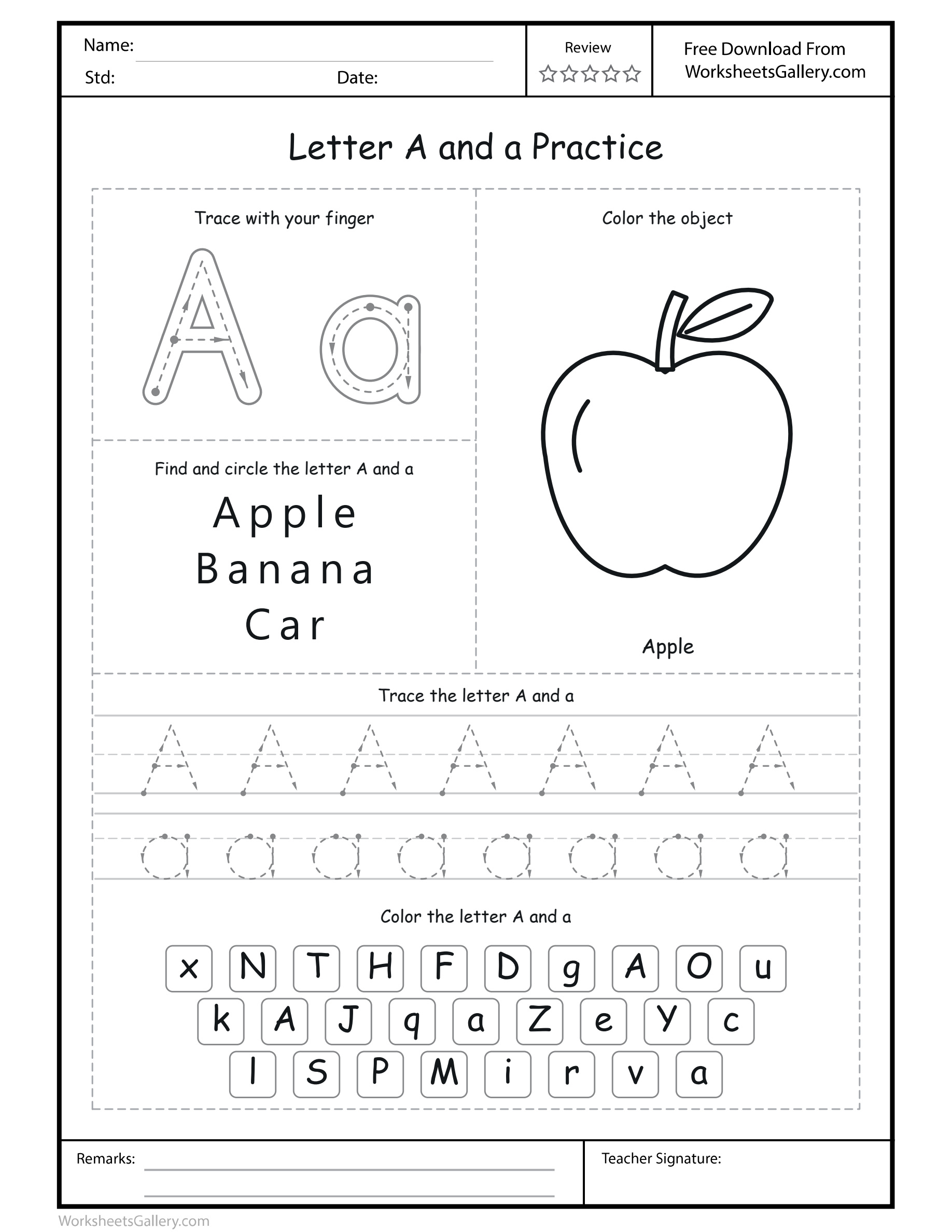
Aa Letter Finder belongs to the 26-page collection. Track all three a letters in Banana while comparing the large A and a models.
Banana hides three lowercase a letters in a word that does not begin with A. That little surprise gives Aa Letter Finder a useful starting point. The sheet places large A and a finger models above a word search, pairs them with an apple to colour, and adds guided handwriting and mixed-letter tiles. Children can inspect the letter family in several settings while an adult reads unfamiliar words. Begin with a careful look at one panel, then choose a small tracing, circling or colouring action that gives the discovery a visible record.
Look beyond the apple's first letter — Aa Letter Finder
Apple provides a clear capital A at its beginning, but the next two words extend the search. Banana has a at positions two, four and six. Car places a between its other letters. In Aa Letter Finder, the target is the printed letter itself, wherever it occurs in the displayed word.
Read Banana aloud for Ari and invite a finger scan from left to right. After he locates the first a, ask whether the rest of the word has been checked. Avoid announcing that the word has three targets before he has had a chance to inspect it. The second and third discoveries can make a repeated scan worthwhile.
Make separate marks for separate occurrences: Aa Letter Finder
The instruction asks for letters to be circled. Drawing one large oval around Banana does not show which of its characters Ari selected. He can point to a target first, then make a circle around that particular letter. A second target needs its own visible decision.
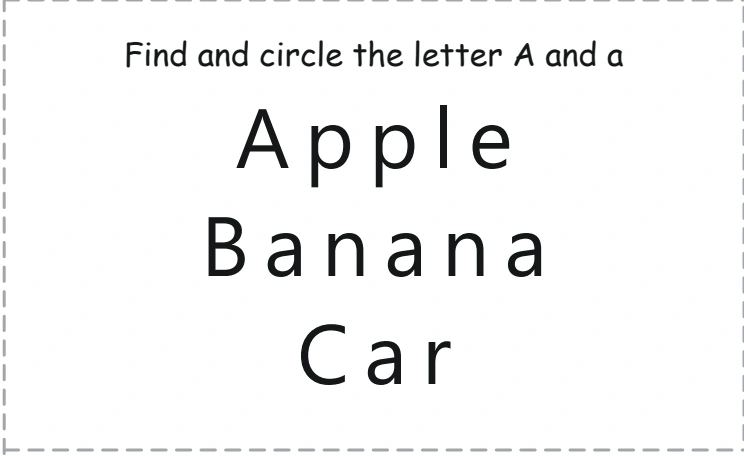
An adult reference for the three printed words: Aa Letter Finder
| Source word | Matching positions from the left | Letters to notice |
|---|---|---|
| Apple | 1 | One capital A |
| Banana | 2, 4, 6 | Three lowercase a letters |
| Car | 2 | One lowercase a inside the word |
There are five A/a occurrences across this Aa Letter Finder word panel. Position numbers in this reference describe where to look; they are not extra answers the child must write on the worksheet. Keep the original word spellings and let the source instruction determine the required marks.
The apple label beneath the object illustration is a separate part of the layout. It can support a conversation about the picture, while the three-word panel supplies the explicit find-and-circle task. Clarify which area you are working in before adding circles across the whole sheet.
A pointed capital and a rounded partner: Aa Letter Finder
The large A model has two sloping sides meeting above a crossbar. The lowercase a model combines a rounded enclosure with a right-side stroke. Aa Letter Finder keeps these different appearances together under one letter family, making it possible to compare features without expecting both forms to share a silhouette.
Use a fingertip before introducing a pencil. Ari can find the printed start dots and follow the arrows on the supplied models. Pointing to the route gives him a way to plan the movement while the letter remains large enough to inspect. Follow this page's visible model rather than imposing a different handwritten style over it.
Transfer the route in small amounts: Aa Letter Finder
The handwriting area contains seven capital guides and eight lowercase guides. Those are available opportunities, not a requirement for a single uninterrupted attempt. Choose one or two forms, inspect their starts and compare the resulting marks with the guides before deciding whether to continue.
A home fruit-stall conversation: Aa Letter Finder
Imagine Ari arranging a pretend fruit stall with his aunt. She writes Banana on a separate card, reads it aloud and asks him to find the same small a shape he saw in Aa Letter Finder. Ari points to the second letter, then checks farther along and discovers another.
His aunt asks how he could show someone else that both were found. Ari places a counter below each position on the spare card, then notices a third matching letter near the end. They compare the complete word with the worksheet and return to its circling instruction.
The imagined stall supplies a reason to look closely at print without requiring Ari to read Banana independently. The adult's written card remains a model. Its movable counters support thinking before the child makes permanent marks on the source.
Six observations to discuss during an Aa visit: Aa Letter Finder
Recognising a target in a longer word: Aa Letter Finder
Aa Letter Finder moves a beyond a familiar initial. Notice whether Ari can locate the same letter after another character. A deliberate scan may reveal understanding that a quick guess at the beginning of each word would miss.
Keeping repeated discoveries separate: Aa Letter Finder
Three a letters belong to Banana. Pointing once to each can make the count of occurrences clear. The learner is counting matching positions within a word, rather than counting how many word labels are printed.
Relating two case forms: Aa Letter Finder
Ari can compare a chosen tile with the large A or a reference. Ask which visible feature led to the match. A spoken letter name is useful, but a gesture towards the crossbar or rounded enclosure can add evidence about recognition.
Planning a trace before moving: Aa Letter Finder
The model's starts and arrows offer a route to inspect. In Aa Letter Finder, a child can rehearse that route with a finger, pause and then attempt a small guide. This separates a plan from the pencil control needed to record it.
Choosing a circle that communicates: Aa Letter Finder
A loose circle may overlap a neighbouring letter even when Ari intended the correct target. Ask him to point out what he selected. The conversation can distinguish an uncertain mark from an uncertain letter decision.
Returning to check the whole sequence: Aa Letter Finder
After a first search, revisit each word from its left edge. A newly noticed a is useful information. Give Ari language for the strategy he used, such as checking the part after his first circle, instead of focusing only on a finished total.
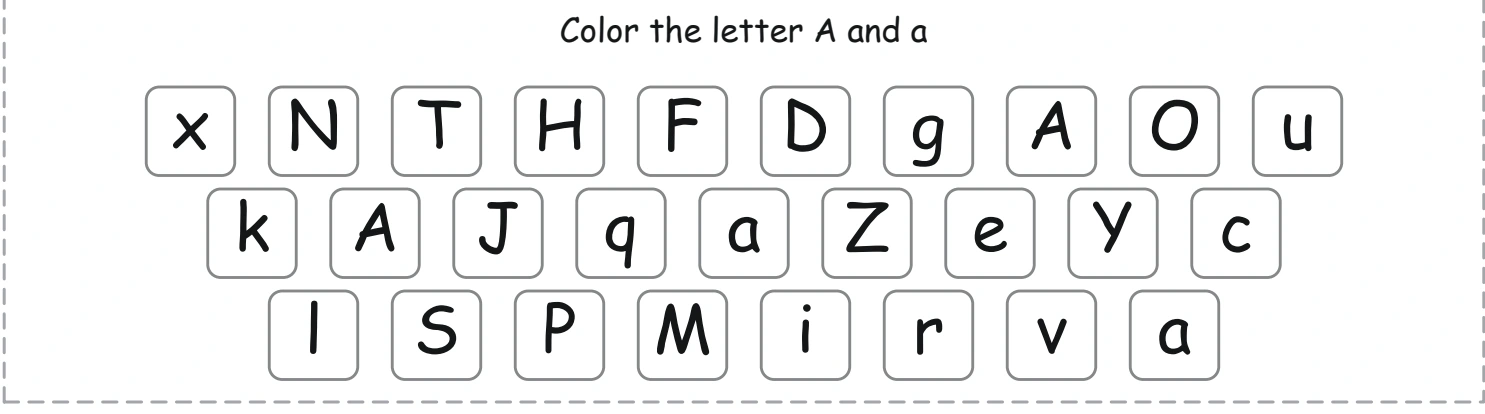
Four target tiles among twenty-seven choices: Aa Letter Finder
The lower field of Aa Letter Finder contains three staggered rows: ten tiles, then nine, then eight. Its matching A/a tiles occupy positions 8, 12, 15 and 27 when counted across the first row, then the second and third. These adult coordinates help verify the actual source arrangement.
For a child, use the printed instruction to colour the target letters. The first row contains a capital A at its eighth tile. The second row has a capital at column two and a lowercase a at column five. The final lowercase a sits at the end of the bottom row.
Check before covering the letter with colour: Aa Letter Finder
Ari can indicate a tile and compare it with the large reference before colouring. A dark fill may make the character harder to inspect afterwards, so encourage a mark that leaves the decision understandable. There is no coded palette or requirement to colour every box in this activity.
A classroom partner checks what remains: Aa Letter Finder
In a hypothetical pair session, one learner explains an Apple or Banana discovery while the other looks for an overlooked target farther along the word. They exchange roles after a label. The teacher reads the word names and keeps attention on the visible A/a forms.
If a child circles only the first letter of every word, the teacher can ask which model matches the first letter of Car. The child may notice that C is not the target and then inspect the interior. This prompt gives a reason to revise the search method without directly pointing to the answer.
At the tile field, partners can discuss one row at a time. Each still makes their own selections on Aa Letter Finder. A clear explanation of one matching tile can be more informative than a partner simply copying another child's coloured boxes.
Five apple-themed extensions with different jobs: Aa Letter Finder
Build a label that another person can check: Aa Letter Finder
An adult writes Apple on a spare card while Ari watches. He points to the capital A and explains why it belongs to the same letter family as a. Keep unfamiliar spelling modelled so the extension stays about the intended letter comparison.
Make the banana's repeated pattern visible: Aa Letter Finder
Write Banana clearly and place a small counter below each a. Remove the counters and let the child rebuild the record. This reinforces separate occurrences while preserving the whole word as the visible source of evidence.
Give a toy a searching job: Aa Letter Finder
A toy car visits the three labels and asks where its a is. Ari can guide it to the appropriate position on Car. The toy's question gives a specific audience to his pointing and explanation.
Draw an apple message: Aa Letter Finder
Invite a free apple drawing on new paper and let Ari dictate a short message about it. An adult can write the words. This creative use of the picture is separate from the worksheet's fixed letter-search answers.
Compare a model with a chosen tile: Aa Letter Finder
Create a large A card and a large a card, then discuss where a copied target tile would belong. The child explains the case match. An adult can include one clearly different letter on the spare example for a manageable comparison.
Make a short visit feel complete: Aa Letter Finder
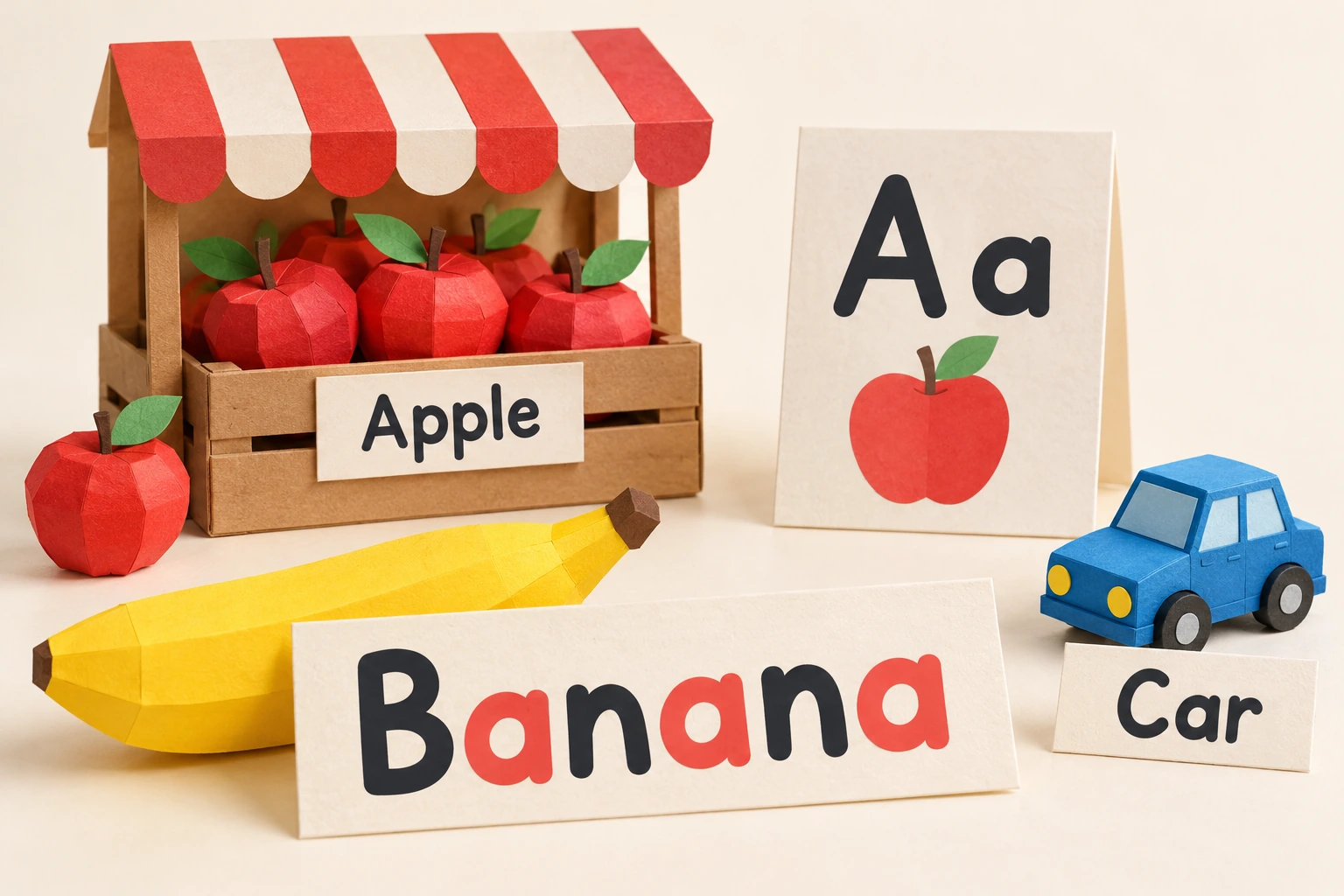
Around ages three to six, Aa Letter Finder offers several ways to participate with adult help. The amount of support may differ across naming, visual search and pencil work. A child can enjoy the apple illustration while still needing every word read aloud.
Useful stopping points include checking all of Banana, tracing one capital with attention to its route or explaining one tile row. Avoid treating the fifteen small handwriting guides as a compulsory daily quota. A clear discovery gives the next visit something specific to revisit.
Typical difficulties are overlooking a later a, circling the whole label, confusing a count of words with a count of letters or filling distractor tiles merely because they remain white. Return to one instruction and one visible example. Ask Ari what his mark is meant to communicate before deciding which part needs another demonstration.
Save the edition intended for printing: Aa Letter Finder
For the premium Aa Letter Finder single sheet, use a qualifying member plan while its access is active. The clean printable omits the website watermark and domain promotion and contains no embedded advertisements. The original supplied PDF remains available through a distinct sample choice.
In the portrait printer preview, retain the complete word panel, both handwriting rows and the last a tile at the bottom right. This apple activity is also included within a $5 collection sold separately under the Alphabet Wordwork Collection title, which combines all twenty-six supplied pages into one clean PDF.
Another useful way to notice print: Aa Letter Finder
Compare Aa Letter Finder with Aa Worksheet. A listening follow-up to Aa Letter Finder is First Sound Choices. For Aa Letter Finder, explore Bb Worksheet.
Parents can explore PBS Parents' ideas for conversations around early print and NAEYC's suggestions for writing with a meaningful purpose. In Aa Letter Finder, celebrate a specific letter discovery, listen to the method used to find it and preserve the whole word as a reference.
Popular Worksheets
Printable resources families and teachers are downloading now.
 Free
 Free
 Free
 Free