
Bb Letter Detective: 4 Delightful Ball-and-Cub Finds
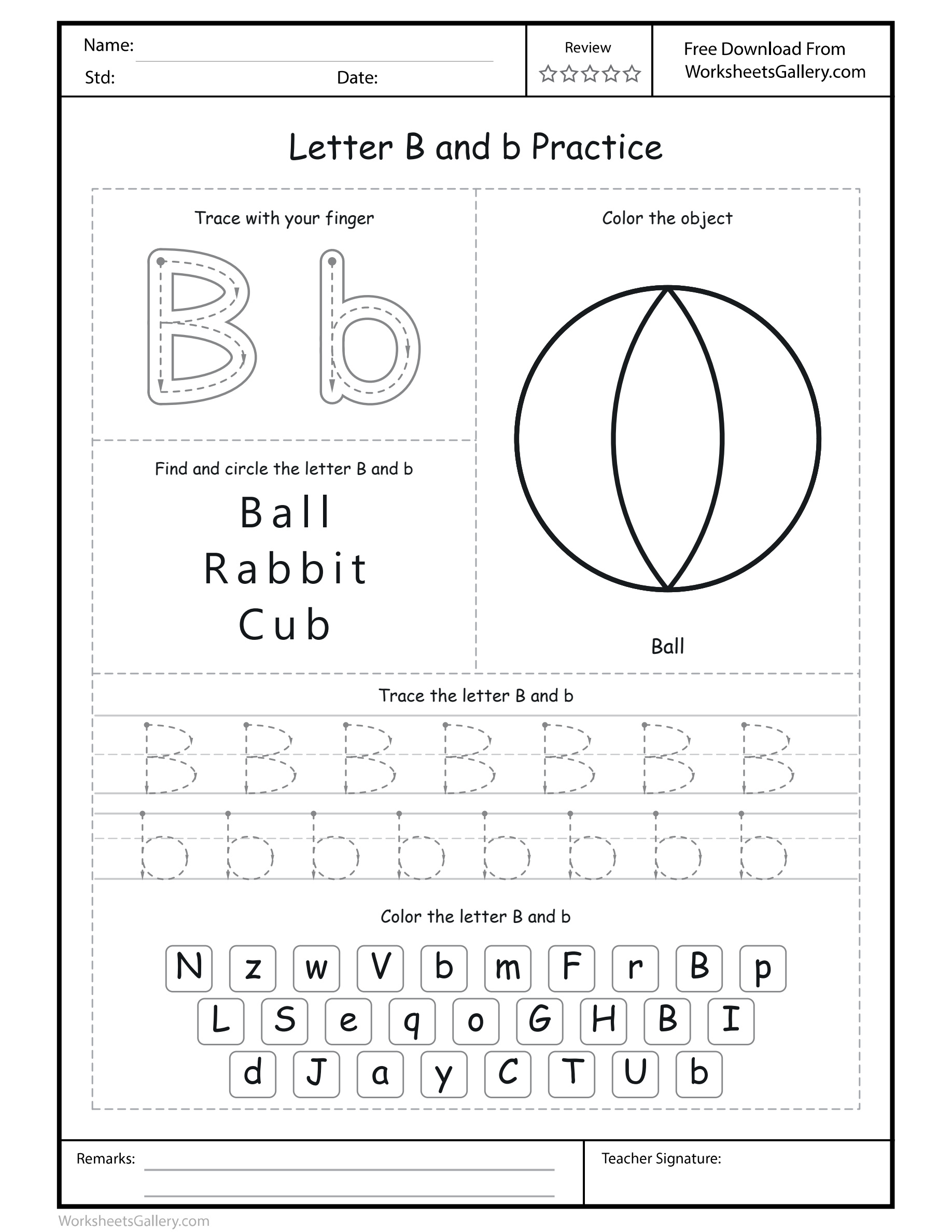
Bb Letter Detective belongs to the 26-page collection. Treat both b letters in Rabbit as separate discoveries and keep each case distinct.
Rabbit contains a pair of b letters standing next to each other. Bea can find one and still have another to notice. Bb Letter Detective uses that close comparison alongside Ball and Cub, large B/b models, an object-colouring picture, guided rows and a shuffled letter field. The page invites a learner to recognise the same letter family while its size, case and position change. Read the word labels together, let Bea point before marking, and use her explanation to decide which panel deserves a longer look today.
Ask the rabbit to show both letters — Bb Letter Detective
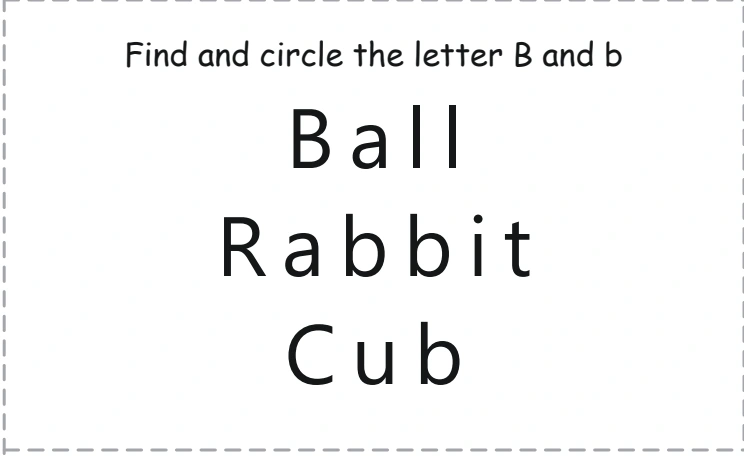
Place attention on Rabbit before asking for pencil marks. An adult can read the word while Bea follows the characters with a fingertip. When she reaches the first b, pause long enough to recognise it, then inspect the character immediately after it.
The two b letters in Bb Letter Detective occupy separate positions. One circle enclosing the whole bb pair may make the intention unclear, especially if Bea meant only the first character. Invite a point to each target and then a separate mark around each chosen letter. The task is to find printed Bs and bs, not to circle every word containing them.
A word is not one letter-sized unit: Bb Letter Detective
Rabbit is one word with two target occurrences. Ball and Cub each contribute one more occurrence in their own positions. Keeping those ideas separate allows an adult to ask a precise checking question: did the learner inspect all the matching characters, or only count the three labels?
The source choices, recorded without guesswork: Bb Letter Detective
| Label to read aloud | Target position | What the learner can point out |
|---|---|---|
| Ball | 1 | Capital B begins the word. |
| Rabbit | 3 and 4 | Two lowercase b letters are adjacent. |
| Cub | 3 | The lowercase b comes last. |
This Bb Letter Detective reference describes four printed targets across the three words. The position numbers are adult coordinates for discussion. Bea need not add them to the sheet. Her required response in this panel is a circle identifying each matching letter.
An adult may explain what cub means before beginning. Naming the word supports participation, while its last letter supplies the print evidence. Do not require Bea to invent a sentence or spell Cub independently before she is allowed to find its b.
A tall stem gives lowercase b a useful landmark: Bb Letter Detective
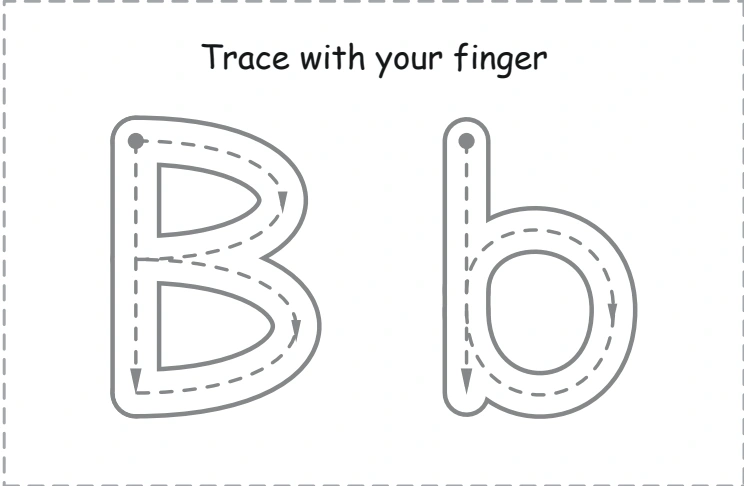
The supplied lowercase model rises into a tall upright with its rounded part beside the lower stem. The capital B has two bowls beside its straight side. In Bb Letter Detective, these large forms can be revisited whenever a smaller printed choice looks uncertain.
Bea can point to the long stem, describe the side carrying the bowl, or follow the model's indicated route with a finger. These observations give a comparison more substance than saying that any rounded shape must be b. The surrounding letter field includes distractors, so the complete arrangement matters.
Let the actual model set the route: Bb Letter Detective
Printed start dots and arrows show how this sheet presents its tracing path. Follow those cues while discussing the form. Another handwriting programme may use different verbal directions, but the visible guide remains the reference for the child's current trace.
A classroom exchange between an explainer and a checker: Bb Letter Detective
Imagine a teacher giving Bea and a partner one word to discuss at a time. Bea points to the first b in Rabbit and explains how its stem and bowl match the large reference. Her partner checks the remainder of the word and notices the next b.
They swap roles for Cub. The teacher asks the listener to describe where the target sits instead of merely announcing that a response is correct. Last, inside and beginning become useful words because someone else needs to follow the explanation.
Each learner then records their own circles on Bb Letter Detective. This keeps the cooperative conversation from becoming a copying exercise. A child who needs help controlling a small circle can first indicate the intended character, letting the teacher hear the recognition decision before commenting on the mark.
Five signs worth noticing during the search: Bb Letter Detective
A repeated match is still inspected: Bb Letter Detective
The second b in Rabbit looks familiar immediately after the first. Notice whether Bea actually points to it as another occurrence. The close pair gives her a reason to keep looking after an apparently successful discovery.
A letter remains identifiable at the word's edge: Bb Letter Detective
Cub places b at the end rather than the beginning. Bb Letter Detective lets an adult see whether the learner transfers recognition across positions. Point to the complete label while reading it so that the final character stays connected to its word.
Case differences are described through features: Bb Letter Detective
A capital B and a lowercase b share a name but differ visibly. Invite Bea to show the two bowls on the capital and the single lower bowl on its partner. A small comparison can clarify which case reference supports her choice.
The mark follows a deliberate decision: Bb Letter Detective
Pointing before circling separates the target selection from the drawing action. If a circle touches a neighbouring character, ask what Bea meant to include. The answer can reveal a recording slip without dismissing accurate recognition.
A check can change the first attempt: Bb Letter Detective
Bea may find the second b only after a partner asks what remains. Her Bb Letter Detective revision can show that the search became more complete. Describe the new observation and the checking strategy instead of treating the original omission as the whole story.
Count the tile rows before using adult coordinates: Bb Letter Detective
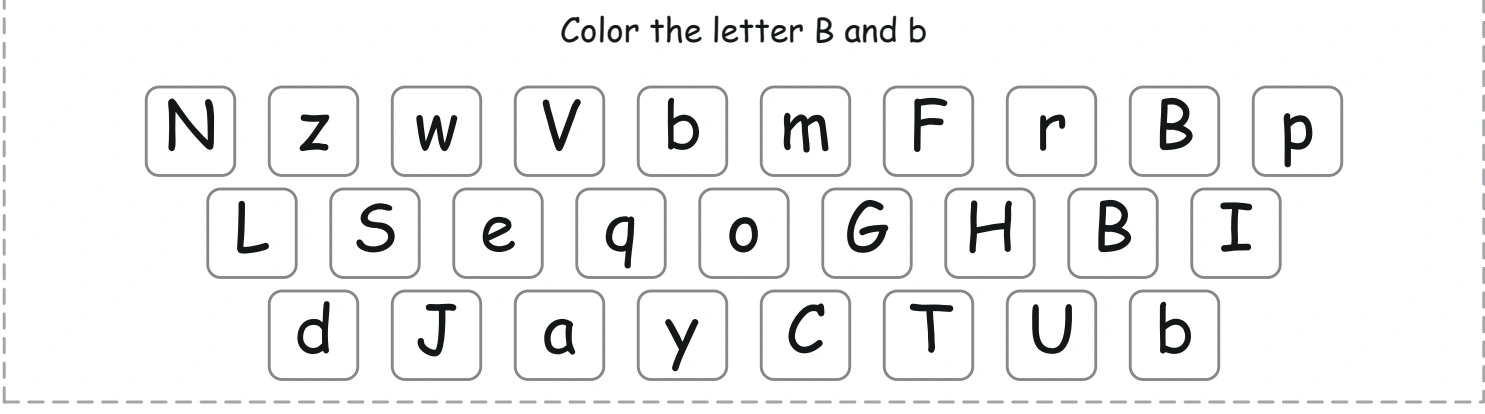
The bottom field has twenty-seven letters in staggered rows of ten, nine and eight. The B/b targets occur at positions 5, 9, 18 and 27 when reading the rows in that order. For Bb Letter Detective, those locations identify two capitals and two lowercase choices.
The first row has b in column five and B in column nine. The second row's B is at column eight. The third row ends with b. These coordinates are useful when checking a completed page, but they should not replace Bea's comparison with the actual letter models.
Colour the chosen letters, not every available box: Bb Letter Detective
Read the panel's instruction again before starting. The remaining tiles are alternatives, not unfinished colouring obligations. Bea can choose a colour for the matching targets while keeping the printed character visible enough to explain why that tile was selected.
A home ball shelf with a named visitor: Bb Letter Detective
For a hypothetical home session, Bea's grandfather places a soft ball beside a toy rabbit. He writes Ball and Rabbit on separate cards and reads both aloud. Bea checks the cards for the B/b family before returning to the worksheet's word panel.
The rabbit becomes a listener: it asks whether its name has one b or more. Bea points to each occurrence on the model card. Her grandfather leaves the whole spelling visible, so she does not have to remember an unfamiliar sequence while inspecting its letter shapes.
They finish by comparing the picture of the ball with their toy. Bea chooses the worksheet ball's colours herself. Its curved internal lines divide the illustration into regions, but the source does not prescribe a coded palette or demand a realistic finished result.
Put a manageable amount of handwriting beside the search: Bb Letter Detective
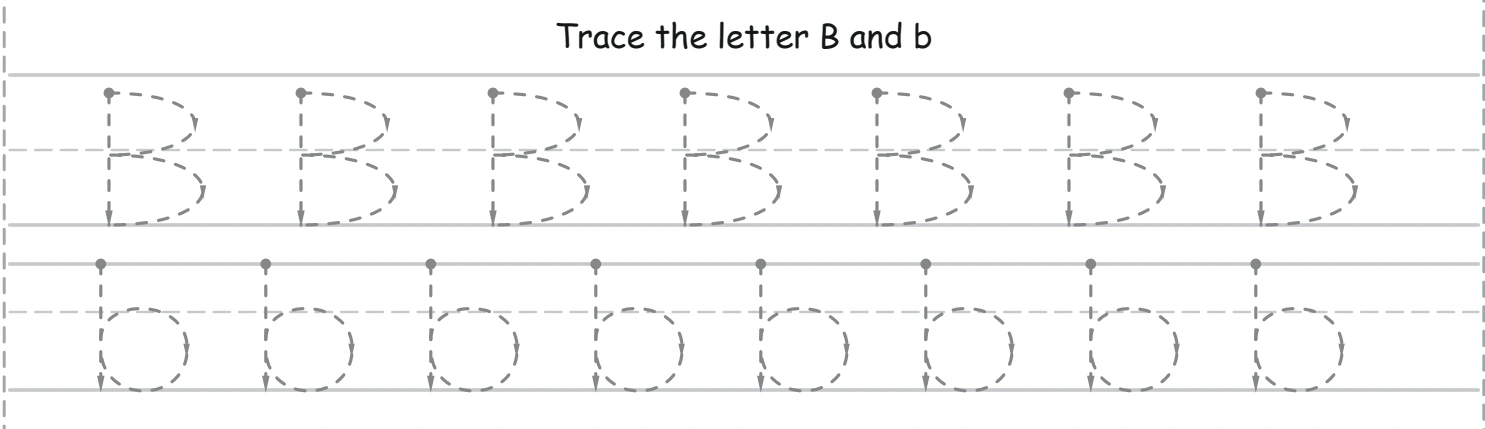
Seven capital B guides appear above eight lowercase b guides. Before tracing, choose a small part of that area and inspect its start. Bea can rehearse the route with her finger, then try one pencil form while the large reference remains available.
After a trace, ask which part followed the intended path and which part she wants to inspect again. A repeated capital bowl, a stem or a curve can be discussed separately. Completing every guide quickly would provide less useful information than a smaller, deliberate attempt.
Comfort can determine the stopping point: Bb Letter Detective
A stable page, familiar drawing tool and room to move the hand can support the activity. If Bea wants a break, keep a note of one observed strategy or discovery. Returning to that specific idea gives the next Bb Letter Detective visit a purpose beyond filling another row.
Four games for a Bb checking partner: Bb Letter Detective
1. Give the rabbit two counters: Bb Letter Detective
Write Rabbit clearly on a spare card. Bea places one counter beneath each b and explains whether another match remains. Removing and replacing the counters makes the record revisable before any worksheet circle is drawn.
2. Make a beginning-and-end pair: Bb Letter Detective
Show Ball and Cub on separate model cards. Ask the child to indicate where the target sits in each. An adult reads the words, allowing the game to focus on letter position rather than an unexpected reading test.
3. Let a toy choose a distractor: Bb Letter Detective
On a fresh small example, the toy points to a different printed letter and calls it b. Bea compares it with the supplied model and describes one mismatch. Keep the alternatives clear enough that the explanation feels inviting rather than tricky.
4. Send a ball-picture message: Bb Letter Detective
Invite a ball drawing and let Bea dictate a short message to a family member. An adult records her words, then offers a modelled label where she can locate B or b. This creative extension gives the picture a new audience.
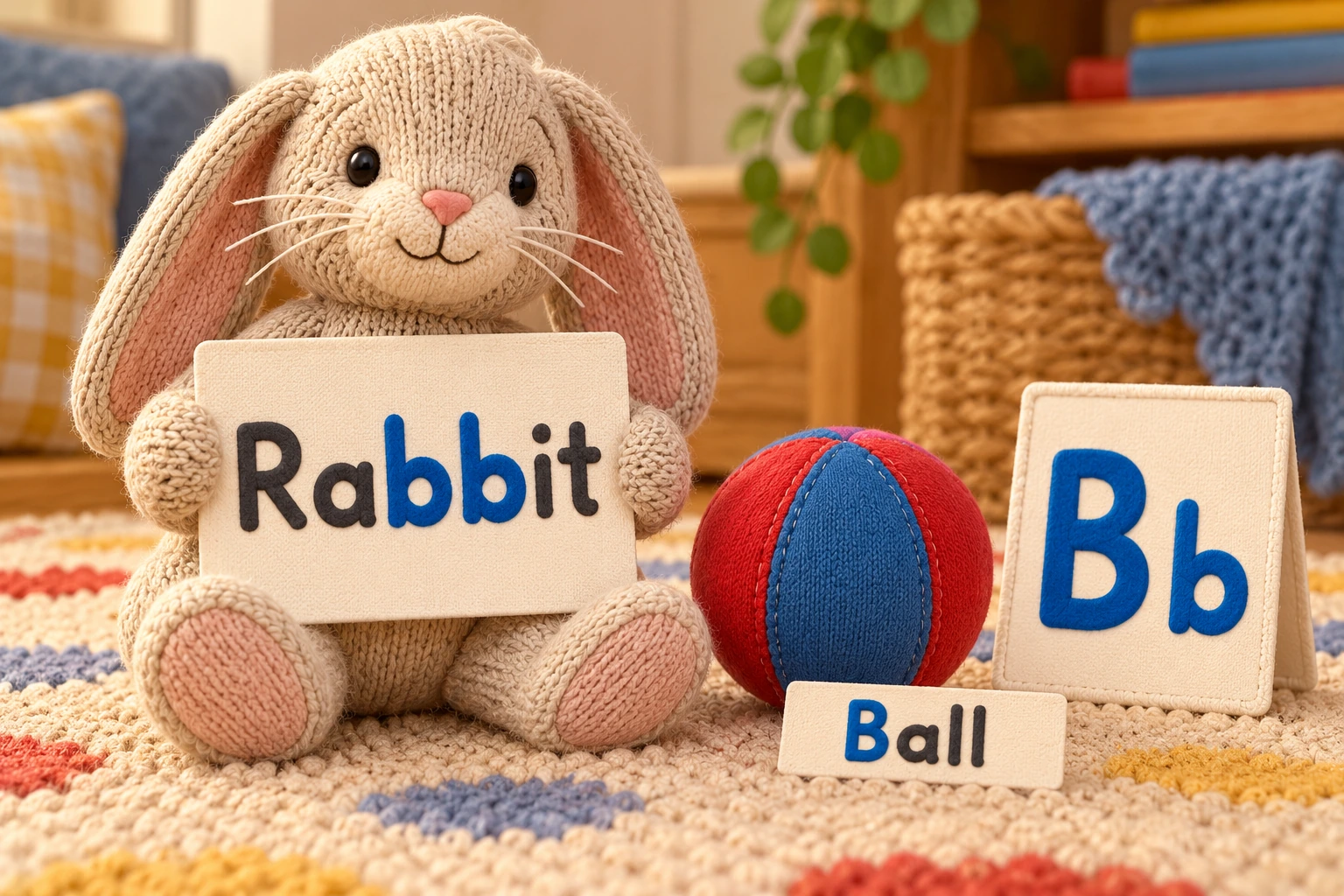
The blue bb pair belongs inside one Rabbit label.A knitted rabbit holds Rabbit with both b letters blue, alongside a matching blue Bb card and named cloth ball.
Adjust support to the panel rather than the birthday: Bb Letter Detective
When introducing Bb Letter Detective to children aged three to six, adapt the adult involvement to each panel. Some will begin with naming and finger movement; others will be ready for the full word and tile search. Spoken explanation can remain available throughout.
Common mix-ups include treating the bb pair as one letter, overlooking the final b in Cub, selecting a tile by its curve alone or colouring every distractor. Return to the specific form and current instruction. Ask Bea to show her intended target before increasing the amount of pencil work.
Print the ball page with its full field intact: Bb Letter Detective
The clean Bb Letter Detective premium PDF is delivered through an eligible membership that is currently active. Website watermark and domain promotion are absent from that edition, which carries no embedded ads. The original upload remains a separately selectable sample.
Before printing in portrait format, check that both handwriting rows and the final lowercase b tile fit within the page. For a complete A–Z set, the related Alphabet Wordwork Collection offers all twenty-six supplied clean sheets in one PDF for a separate $5 purchase.
Continue with a different letter question: Bb Letter Detective
Compare Bb Letter Detective with Bb Worksheet. A listening follow-up to Bb Letter Detective is First Sound Choices. For Bb Letter Detective, explore Cc Worksheet.
Families looking for further shared-print ideas can visit PBS Parents' literacy conversations and activities. NAEYC's resource about supporting purposeful writing at home offers another route into the child's own messages. With Bb Letter Detective, value the separate b discoveries, the feature used to identify each one and the check that explains a revision.
Popular Worksheets
Printable resources families and teachers are downloading now.
 Free
 Free
 Free
 Free