
Arrow Outline Practice: 3 Powerful Direction Copies
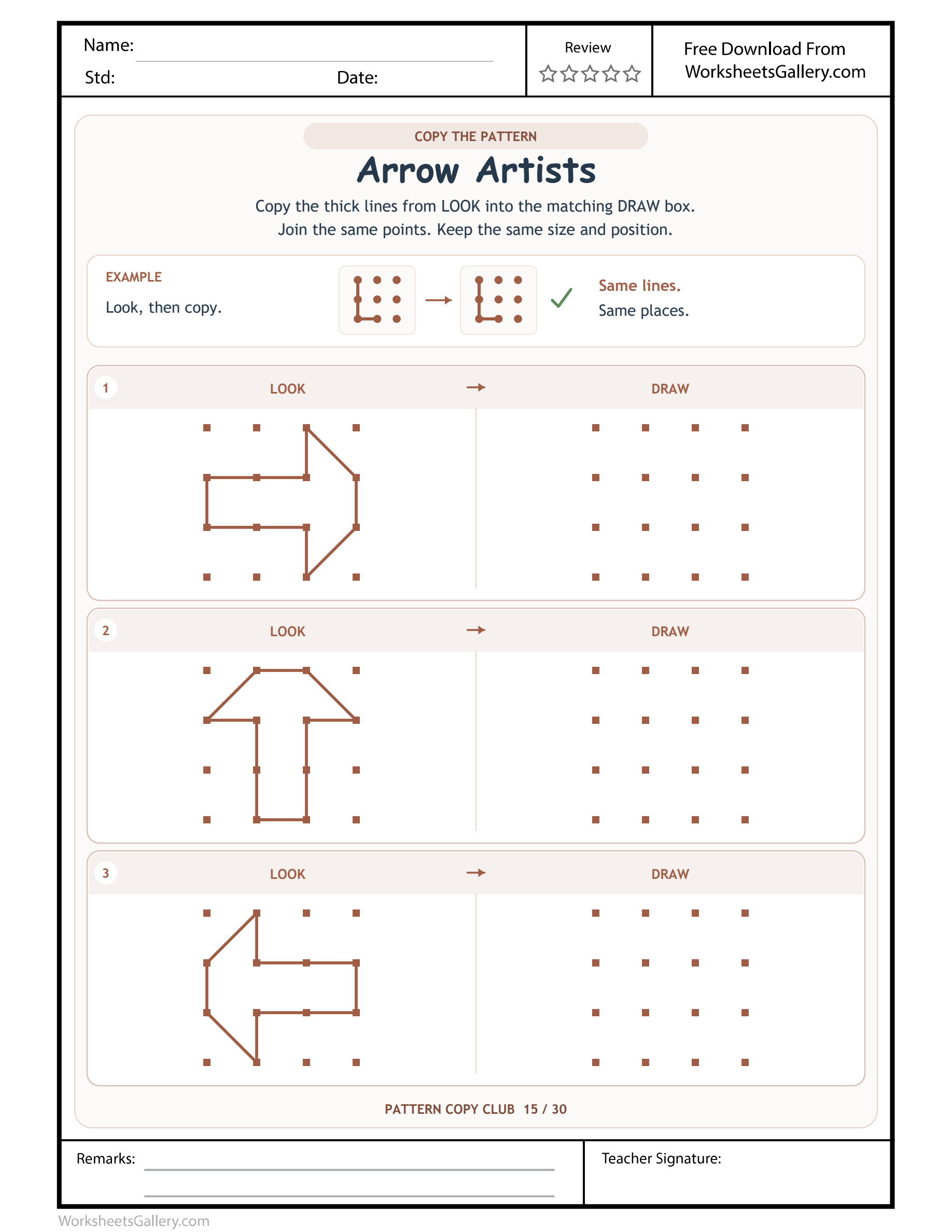
Arrow Outline Practice: Reproduce right, up and left arrow outlines while preserving the width of each shaft.
Direction is only one part of an arrow's shape. Arrow Outline Practice asks children to copy three outlined arrows while preserving their broad heads, narrower shafts and inward corners. Right, up and left models sit on matching sixteen-point fields in the Arrow Artists source sheet. A completed example introduces copying before the larger practice panels begin. Use this printable when a learner can follow short straight and sloping lines and is ready to compare an entire boundary, rather than replace a detailed arrow outline with one quick pointing stroke.
Follow the boundary, not an imagined travel route — Arrow Outline Practice
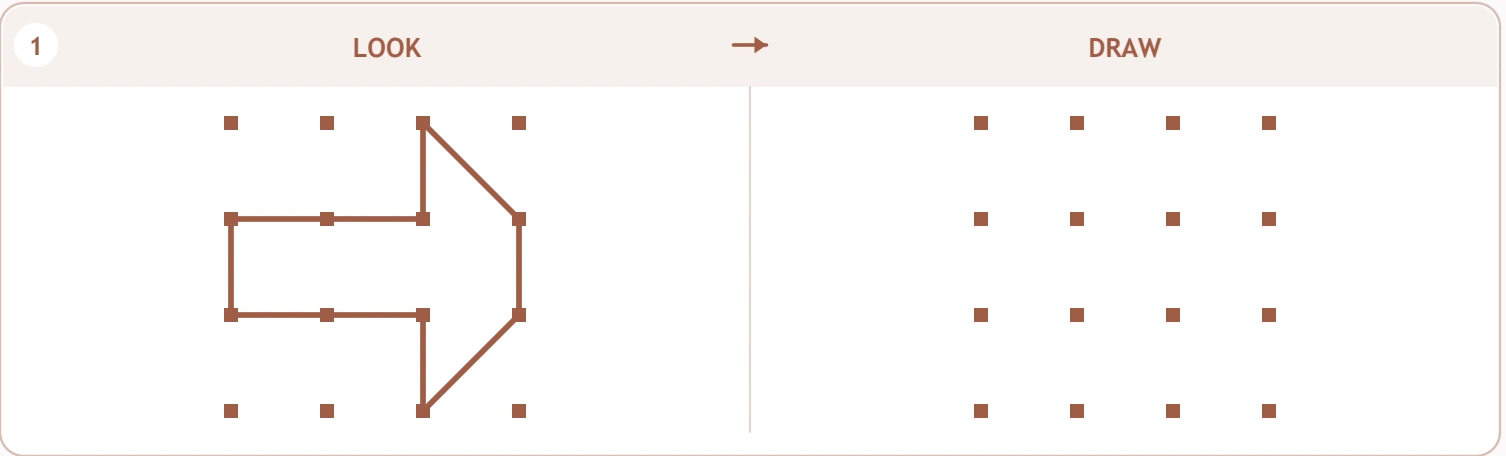
An arrow often tells us where to go, but Arrow Outline Practice asks for its outline. The child does not follow a sequence of arrow commands or draw a single line toward the right. Each model has a closed boundary that changes direction around a shaft and an arrowhead.
Point to the arrow's tip, then inspect the little inward corners where the head meets the narrower body. Those shoulders distinguish the outline from a simple triangle. Keep the shaft narrow where the model narrows. In Arrow Outline Practice, losing an inward corner can turn the intended arrow into a much wider or simpler shape.
Three pointing directions on a larger field: Arrow Outline Practice
| Arrow Outline Practice pair | Visible Arrow Artists model | Model structure |
|---|---|---|
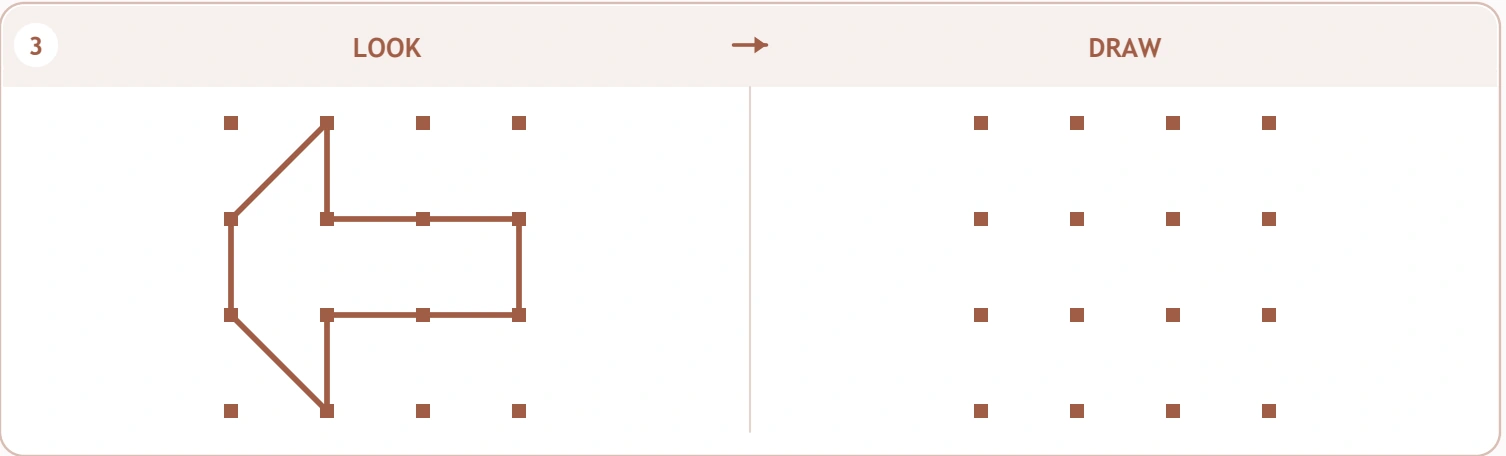
| 1 | Right-pointing outlined arrow | 16 anchors / 10 bold pieces in Arrow Artists |
| 2 | Upward outlined arrow | 16 anchors / 10 bold pieces in Arrow Artists |
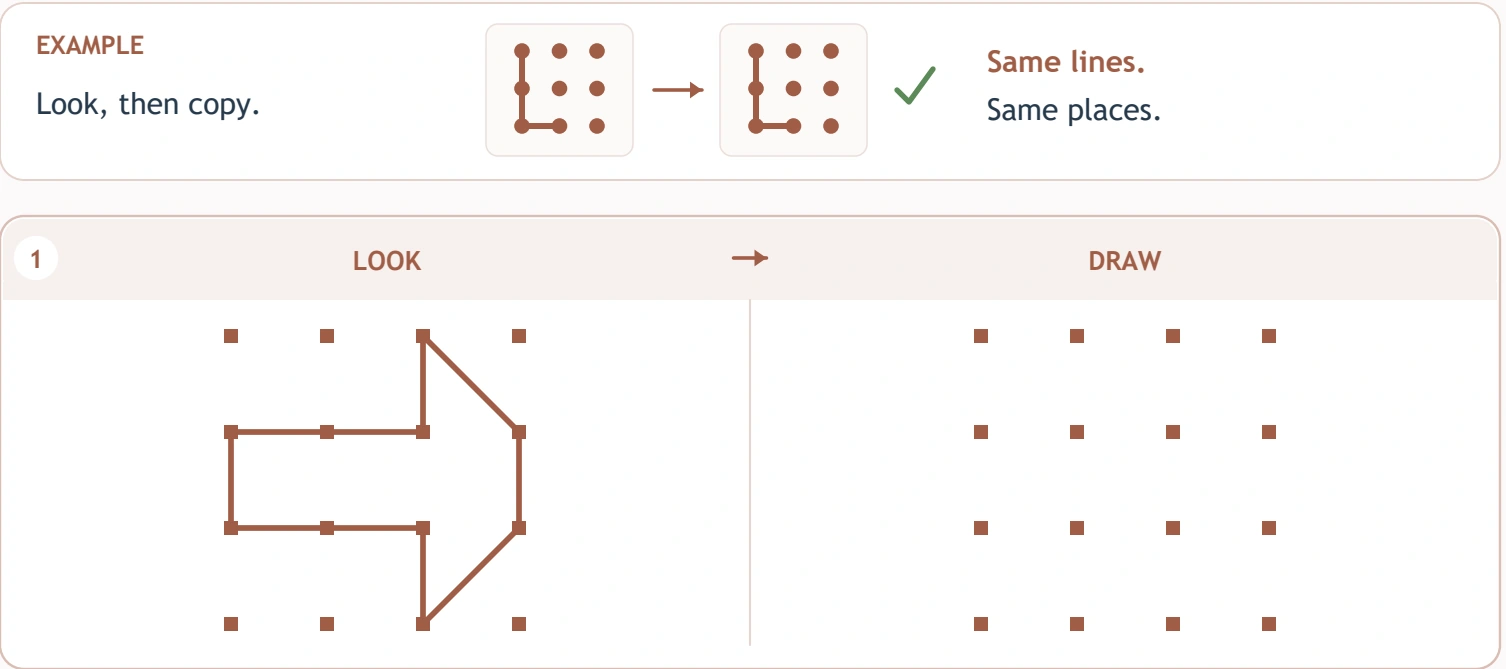
| 3 | Left-pointing outlined arrow | 16 anchors / 10 bold pieces in Arrow Artists |
Each Arrow Outline Practice practice field has four rows and four columns of square markers. The point-to-point segment totals describe the printed outline, including straight pieces that pass through intermediate anchors. They are an adult reference, not a demand for ten pencil lifts or a compulsory starting point.
Name the tip and the shoulders first: Arrow Outline Practice
Before drawing Arrow Outline Practice, ask the child which way the model faces. Then find the point at its tip and the two places where the wider head narrows into the shaft. Locate those landmarks in DRAW. They give the learner a plan more useful than simply remembering “draw an arrow.”
Copy a manageable section of the boundary and compare it before continuing. A child may start at the tail, tip or a shoulder, provided the finished outline corresponds to the source. The page does not print a stroke-order code. Pencil lifts are allowed when they support a careful restart at the intended anchor.
Make room for a four-by-four comparison
The sixteen-marker field in Arrow Outline Practice supplies more possible landing places than a smaller nine-point grid. Children must inspect which row and column a corner belongs to, rather than always choosing the nearest outside point. Read the source's LOOK and DRAW labels aloud and show the small L demonstration before choosing an arrow.
Keep the paper flat and the reference visible. An adult can point to a model feature without placing the child's pencil for them. If a particular slant feels awkward, demonstrate a similar large movement on spare paper. That support preserves the child's own endpoint choices in Arrow Outline Practice's answer field.
A suitable challenge for an interested learner
Preschool and early-primary children, often approximately four to seven, may explore Arrow Outline Practice with help. Recognising left and right in conversation can support the task, but a child can begin by pointing to the direction rather than naming it fluently. Comfortable short strokes and willingness to inspect corners are useful starting signs.
The three arrows need not be finished together. Try one shoulder and its adjoining shaft section first. If the outline feels too crowded, build a large arrow from strips before revisiting the page. Arrow Outline Practice should be an attainable comparison, not a test of whether the child can keep drawing despite fatigue.
Six observations along an arrow boundary: Arrow Outline Practice
- Orientation matching. A copied arrow faces the same way as its reference instead of being reflected or turned upright.
- Width comparison. The shaft stays narrower than the head, preserving a distinctive part of the silhouette.
- Inward-corner awareness. A child notices the shoulders instead of smoothing the outline into a larger triangle.
- Grid location. Several possible markers are available, so each corner requires a particular spatial choice.
- Boundary planning. The learner groups a few connected edges and checks them before continuing around the shape.
- Direction language. Right, left, upward, tip and tail give a child precise ways to discuss what they intend to draw.
These Arrow Outline Practice opportunities connect looking, movement and explanation. They are not a prediction of later handwriting or a fixed measure of spatial ability. Discuss the observed decision, especially when a child finds the correct shoulder but needs another attempt to make a steadier line.
Otis's sign shop at home, imagined
Imagine Otis setting up cardboard signs for a toy garage. An adult offers Arrow Outline Practice; Otis copies the right-facing arrow as a triangle because the point seems like its most important feature. They compare the model's narrower shaft and find the inward shoulder together.
This fictional home scene shows a useful distinction between a sign's meaning and its exact boundary. Otis can invent simple direction signs elsewhere. For Arrow Outline Practice, the adult helps preserve the supplied outline. Copying one shoulder accurately may be enough before the toy garage reopens and the remaining arrows are saved for another day.
A classroom conversation about facing and shape: Arrow Outline Practice
In an imagined class workshop, a teacher places large arrows facing different directions on a display. Children point to each tip, then compare head and shaft. Back at Arrow Outline Practice, learners choose one model and explain a distinctive corner before drawing on their individual sheets.
The adult watches whether a child retains the shaft width when the arrow turns upward or leftward. A note about that transfer is more useful than recording only that the child knew a direction word. The Arrow Outline Practice copying task remains about corresponding geometry, even when children use different spoken labels to explain it.

Five sign-shop extensions: Arrow Outline Practice
Assemble a broad-head arrow
Build an arrow from large strips with a clearly narrower shaft. A partner copies the outline using another set. Change one shoulder and compare the result. The physical version makes the inward corners of Arrow Outline Practice easier to notice without more small pencil work.
Run a direction delivery desk
Place right, up and left signs beside toy destinations. Let the child explain where each sign points, then swap their positions. This is a movement game beyond the worksheet; it does not create a hidden instruction sequence inside the printed arrow models.
Inspect a missing shoulder: Arrow Outline Practice
An adult draws an arrow beside a physical reference but leaves one inward corner out. Ask which part changed the shaft's width. Invite a suggested repair and then reverse roles. Keep the game about shared inspection rather than catching an error.
Curate outlines and pointing strokes: Arrow Outline Practice
Compare a thick outlined arrow with a simple line-and-tip sign. Discuss how both may communicate a direction while looking different. Return to Arrow Outline Practice and identify which kind of drawing its model requires. The distinction protects accuracy without dismissing the child's simpler symbol.
Invent a sign for a story town: Arrow Outline Practice
After an exact arrow copy, design an original sign on spare paper and give it a finished label with adult help. The child can add colours, symbols or a new direction. Separating this invention from Arrow Outline Practice keeps both kinds of mark-making welcome.
Troubleshoot a stretched or simplified arrow: Arrow Outline Practice
Common Arrow Outline Practice mix-ups include drawing only the point, widening the shaft, skipping an inward turn or rotating every model into the same direction. Compare the tip and shoulders before looking at less distinctive straight edges. Those landmarks often reveal where the boundary first changed.
Preserve the outline's proportions as well as its direction. A wobbly edge reaching the correct corner can show a useful plan. If repeated corrections crowd the small field, discuss the intended shape on a larger spare sheet. A child does not need to erase the entire arrow repeatedly to demonstrate that they understand the repair.
Keep another sign-shop visit inviting: Arrow Outline Practice
Arrows can feel purposeful because children see them in books, games and public spaces. Let those associations start a conversation about Arrow Outline Practice, then narrow the paper task to one printed outline. The learner can choose whether to revisit a right-facing shoulder or inspect how the upward model changes the arrangement.
“You kept the narrow part when the arrow changed direction” recognises a particular decision. A short return after a break can be enough. Rotate Arrow Outline Practice with block play and free sign design, and save a dated attempt only when the child enjoys comparing it with a later drawing.
A boundary-check routine to use again
Invite the child to show one section they trust, then compare a nearby corner. Asking about a known part first can make a repair feel like continued investigation. In Arrow Outline Practice, the adult and child can both point to the source while explaining which marker a line should reach.
When the learner proposes a different shape, acknowledge its usefulness for an invented sign and clarify the current copying goal. This keeps creativity available without making the exact model optional. The child can decide to try the repair, explain it orally or return to the remaining outline on another day.
Download and print the three-arrow page: Arrow Outline Practice
The free control provides the original Arrow Artists sample. For the clean premium Arrow Outline Practice PDF, log into a membership account with eligible active access and choose the separate premium file. Its page contains no website watermark, domain name or promotional advertisements, while the arrow models and sixteen-point fields remain preserved.
Find the complete set through this worksheet's related collection card, sold separately at $3. Save your authorised PDF before printing on US Letter. Review the full portrait preview with 100% scaling or Actual Size selected. Keeping Arrow Outline Practice's original spacing makes the small shoulders and nearby alternative anchors easier to compare.
Find another way to plan a line
Compare Arrow Outline Practice with Drawing Size Choices. After Arrow Artists, try Shape Border Journeys. For Arrow Artists, consider Path Copy Thinking.
For hands-on companions to Arrow Outline Practice, adults can read NAEYC material on family play. The PBS Parents learning-and-growing pages offer more everyday activity ideas. These independent education links are optional resources and do not indicate that either site supplies or endorses this PDF.
Popular Worksheets
Printable resources families and teachers are downloading now.
 Free
 Free
 Free
 Free