
Cozy Campsite Coloring: 5 Delightful Scene Choices
$5 collection companion: Cozy Campsite Coloring. Build a personally chosen night scene without treating imaginative colours as mistakes.
A night scene does not have to begin with a black crayon. Cozy Campsite Coloring gives children an outlined tent, a bear, trees and a sky to colour in ways they choose themselves. The moon and stars suggest an evening setting, but the worksheet does not prescribe a palette or ask for a colour-code answer. This is an adult-supported preschool or kindergarten art invitation with room for personal decisions. Talk about a shape, offer a comfortable material and let the child decide which part of the campsite deserves attention first.
An outline is an invitation to make decisions — Cozy Campsite Coloring
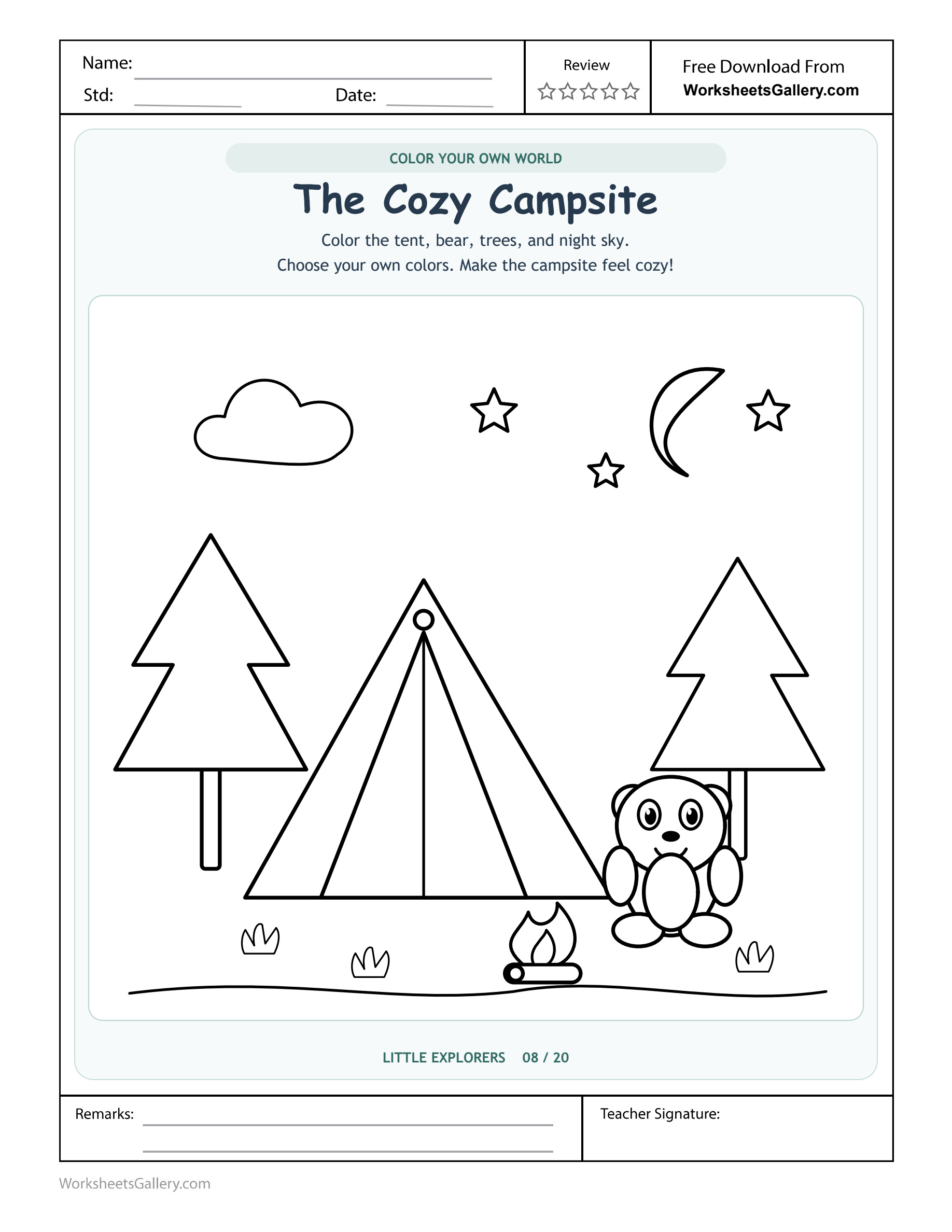
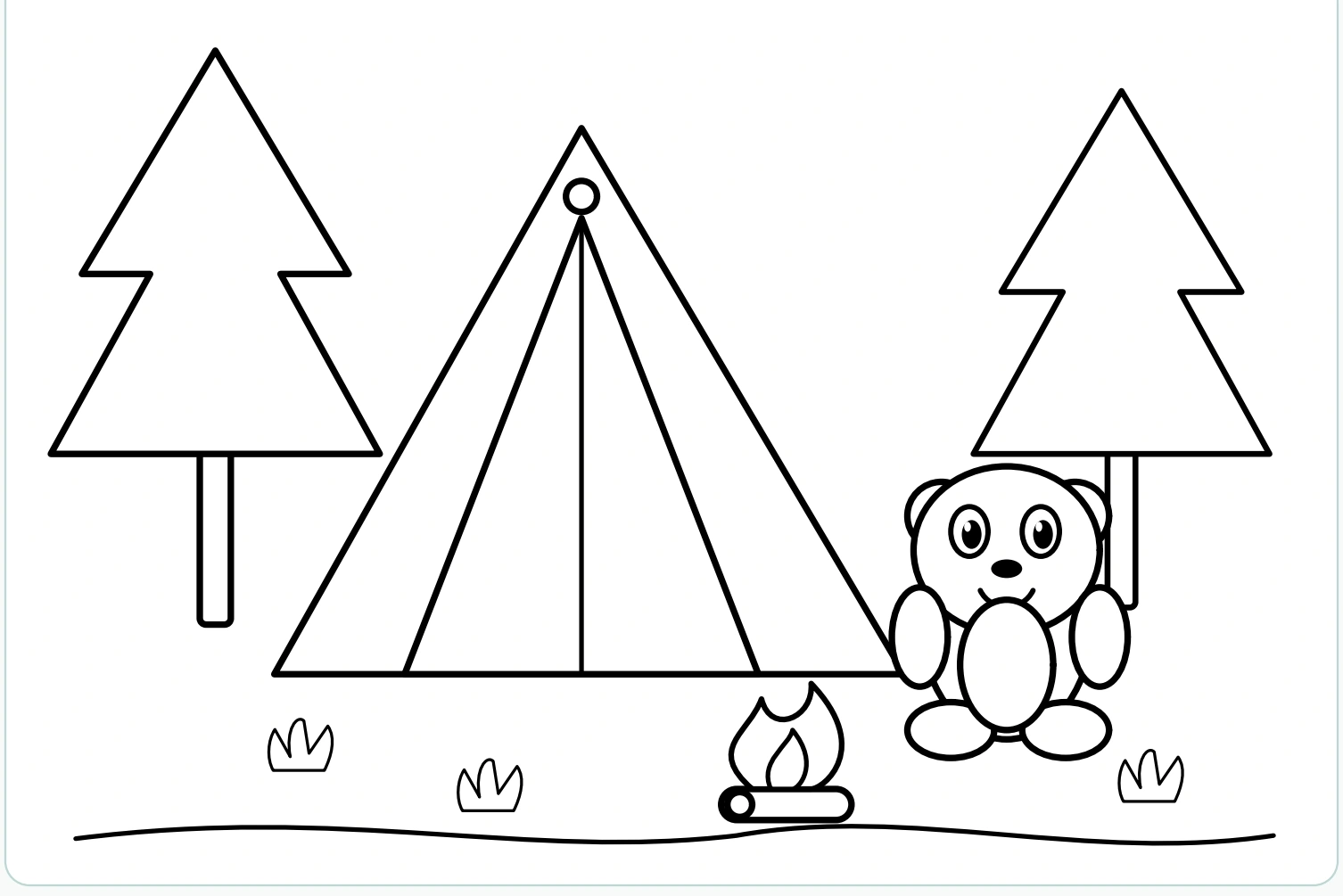
The Cozy Campsite Coloring illustration includes a large tent in the middle of a woodland foreground, a small bear beside it, trees, ground shapes and a drawn campfire. Above them are a cloud, moon and stars. These outlines provide a setting that a child can recognise without having to invent the whole scene from an empty sheet.
Recognition does not remove authorship. Hugo can choose a tent colour, decide how the sky feels and leave one area uncoloured intentionally. The adult's role is to make materials and conversation available. A finished sample is not an answer key that every learner should reproduce.
Before colouring Cozy Campsite Coloring, invite Hugo to point to a region that interests him. He may want to begin with the bear's face or a large part of the tent. Those choices offer different amounts of space. Asking which area feels manageable can be more useful than always directing children to start with the largest shape.
Five choices the child can genuinely own: Cozy Campsite Coloring
| Decision | What the source leaves open | One adult prompt |
|---|---|---|
| Palette | There is no compulsory set of colours. | Which colours do you want near each other? |
| Starting area | The scene has no required colouring order. | Where would you like to begin? |
| Mark texture | A child can try broad fills or smaller strokes. | How do you want this part to look? |
| Amount completed | A session can finish before every region is filled. | Is there a place you want to save for later? |
| Story | The picture does not dictate the bear's experience. | What is happening at your campsite? |
These choices keep Cozy Campsite Coloring centred on a child's interpretation. They do not require Hugo to explain every mark while he is making it. Some children want conversation; others prefer a quiet period of colouring followed by a short description. Offer both possibilities without treating silence as a missing part of the artwork.

Prepare a small, usable colouring space
Provide the printed page on a stable surface and a manageable selection of materials. A huge mixed pile can make choosing more complicated than it needs to be. Hugo can ask for another colour later. Let him test an unfamiliar tool on spare paper before using it inside the scene.
Read the Cozy Campsite Coloring invitation together and make clear that the colours are his to choose. An adult can name the moon or tent if those objects prompt questions. Naming the shapes supports the conversation without directing the palette.
One region can be a complete first visit: Cozy Campsite Coloring
The tent offers broad triangular areas, while the bear and sky shapes contain smaller curves and corners. A child may colour a single chosen region and still have made a purposeful picture decision. Ask what they want to do next rather than announcing that the sheet must be filled completely before it can be enjoyed.
If Hugo changes his mind about a colour, discuss what he wants to try. He might layer another shade, keep the unexpected mark or move to a different region. The printed task does not require removing every sign of an earlier decision.
Five observations beyond whether the page looks neat: Cozy Campsite Coloring
Selecting an intended region: Cozy Campsite Coloring
In Cozy Campsite Coloring, the child can identify the tent, a tree or a particular sky shape before adding colour. Notice whether Hugo can show the area he means. This gives a mark context even when its boundary is still difficult to follow.
Adjusting movement to the area: Cozy Campsite Coloring
A broad tent panel and a small star invite different movements. The child may change stroke length or turn the paper to reach a corner comfortably. Observe the approach without expecting every space to have an identical finish.
Naming a personal choice: Cozy Campsite Coloring
“I want the tent blue” gives Hugo a clear role in the picture. Cozy Campsite Coloring creates an opportunity to hear that decision and respect it. A colour selected because it is a favourite can be as intentional as one chosen to resemble a familiar object.
Connecting picture and story: Cozy Campsite Coloring
The bear, tent and night sky offer subjects for a brief imagined account. A child might describe a visitor arriving or a cloud drifting past. The story can be spoken, acted out or left unwritten; this sheet does not contain a required sentence-completion task.
Recognising a satisfying stopping place: Cozy Campsite Coloring
Hugo may decide that the tent is finished while the sky needs another day. Cozy Campsite Coloring lets an adult notice that reflection instead of judging the attempt solely by coverage. A saved intention can provide a meaningful starting point on the next visit.
At home, let a surprising sky become part of the story: Cozy Campsite Coloring
Imagine Hugo selecting orange for the sky in Cozy Campsite Coloring. His parent starts to reach for a dark blue crayon, then asks what Hugo imagines. He describes an evening when the campsite still feels bright. The parent listens and lets the colour decision remain his.
They talk about which tent panel he wants to colour next. When a small mark crosses a tree edge, the adult asks what area he intended only if Hugo seems bothered by it. A conversation about the region can support his plan without turning the page into a sequence of corrections.
At the end, Hugo explains one part he likes and chooses whether to save the bear for later. The picture remains his record of that day's decisions. Reopening it can involve telling the story again, adding a new colour or simply noticing a choice that still feels satisfying.
In the classroom, compare choices without ranking them
For a hypothetical art table, give children individual Cozy Campsite Coloring copies and offer a shared set of colouring materials. Invite each child to choose a starting region. An adult can model asking for a material and returning it to a place another learner can reach.
When children look at one another's work, encourage descriptive comments: “Your tent has two colours” or “You left that cloud light.” Avoid deciding that one palette is more correct because it resembles the adult's example. The source intentionally allows personal colours.
A teacher might note that a learner named an intended area before colouring, requested another shade or explained a plan to return to the stars. Such observations describe the particular art experience. They are more useful than a general ranking of whose campsite looks best.
Keep a model picture in its proper role: Cozy Campsite Coloring
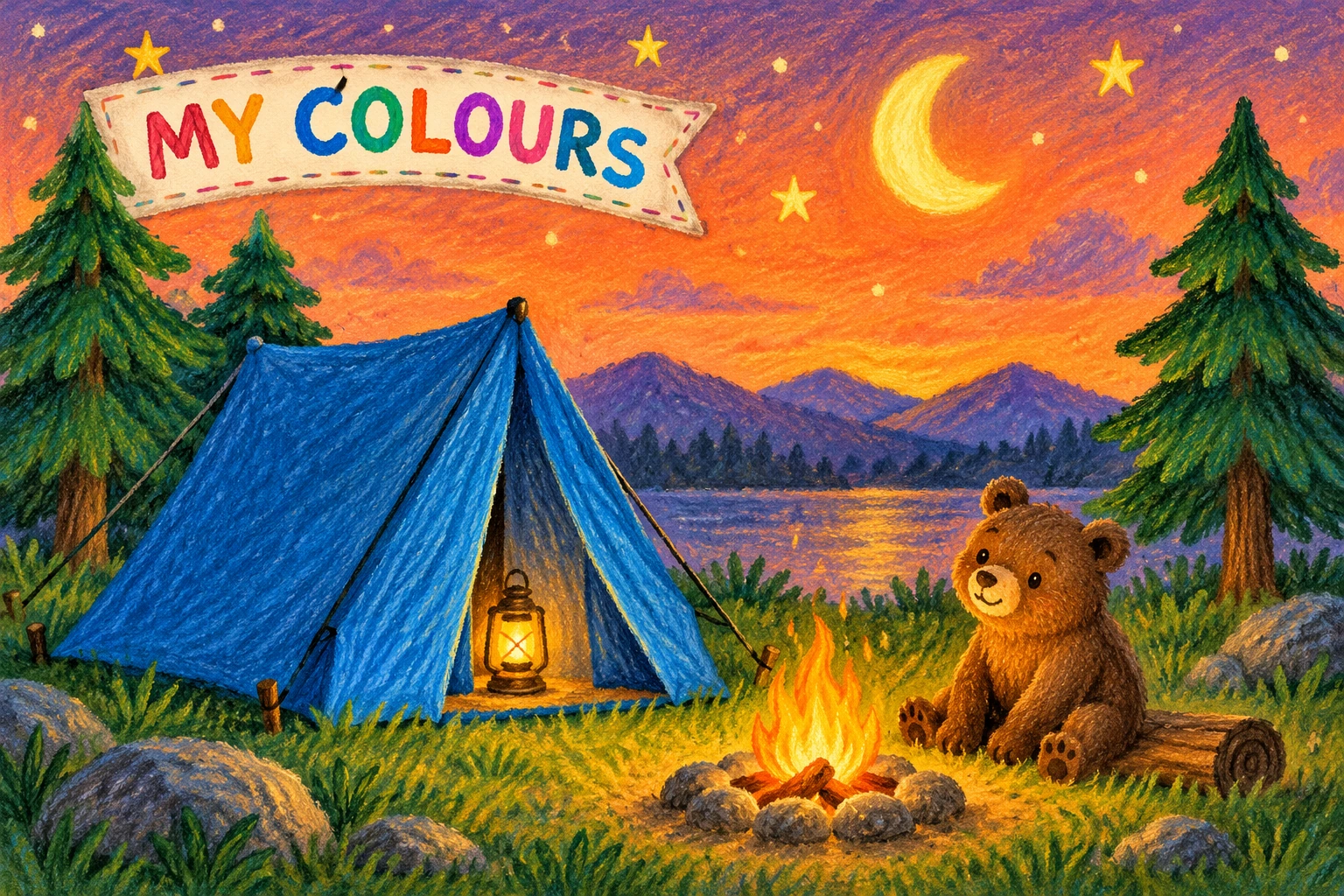
The additional illustration beside Cozy Campsite Coloring shows a completed blue tent against a warm sky with the words MY COLOURS. It demonstrates that a recognisable night scene can use expressive colours. It is one interpretation, not the required finished appearance of the source page.
Ask what the child notices about the example and what they would choose differently. Hugo might like the orange sky but prefer a green tent, or want a simpler background. A useful model opens possibilities rather than closing them to a single arrangement.
Real objects can inspire without becoming rules: Cozy Campsite Coloring
Children may draw on experiences of tents, trees or storybook bears. An adult can listen to those associations while leaving the artwork open. There is no need to correct an imagined colour merely because a photograph of a real object would look different.
Six ways to continue the campsite idea: Cozy Campsite Coloring
A palette conversation
Choose a few colour swatches on spare paper and place them beside a tent sketch. Talk about which combinations feel inviting to the child. The aim is to name preferences, not to establish a hidden adult ranking of suitable campsite colours.
A different sky on another sheet: Cozy Campsite Coloring
Draw a cloud, moon or star outline separately and try a second palette. Compare the two experiences without requiring the source picture to be recoloured. This keeps experimentation available after a child has decided that the first page is finished.
A bear's spoken postcard
Pretend the bear is describing the campsite to a friend. Invite one spoken sentence or dictate a short message for an adult to write. The extension adds language play without making extra writing a condition for completing Cozy Campsite Coloring.
A region finder: Cozy Campsite Coloring
Ask a partner to point to the area described in a short clue, such as “the space beside the tent.” The child can create the next clue. Keep the clues about visible locations rather than guessing which colour an adult has in mind.
A texture sampler: Cozy Campsite Coloring
On spare paper, try light strokes, overlapping marks and a solid patch. Ask which texture the child might choose for a tree or sky. Using a sampler lets them explore materials without feeling that every experiment must succeed inside the original outline.
A small picture exhibition: Cozy Campsite Coloring
Let Hugo choose a place to display his finished scene and dictate a title. He can point to one decision he wants a visitor to notice. A displayed title gives the work an audience while preserving the child's own account of what matters in it.
Gentle support when colouring becomes tiring: Cozy Campsite Coloring
Cozy Campsite Coloring can suit many supported learners around four to six, with different preferences for tools, space and conversation. A child may enjoy a few broad regions before wanting a break. Let their interest and comfort guide the size of the session instead of assuming that a full sheet should take a fixed amount of time.
Common difficulties include trying to match an adult model exactly, selecting a colour only because it was praised on someone else's page, losing track of the intended region or feeling that an accidental mark has ruined the whole scene. Return to the child's plan. Ask what they want to keep, change or explore next.
For a return visit, remember a specific intention: Hugo wanted to add a second tent colour or describe the bear's evening. That invitation connects regular practice to an idea he already owns. The aim is a welcoming art experience with purposeful marks, not a compulsory pile of completely filled pages.
Obtain a clean campsite to colour: Cozy Campsite Coloring
The uploaded Cozy Campsite Coloring original has an independent sample option. For the clean campsite PDF, use a qualifying membership while its plan is active. The premium edition omits the website watermark, domain wording and embedded advertisements. Use the separate controls to choose the edition you intend to save.
Inspect the portrait print preview before making a copy. Keep the moon, tree tops, tent, bear and lower ground line visible inside the paper edges. The campsite joins nineteen other supplied activities in the $5 Little Explorers clean collection PDF, with its own purchase control.
A next invitation for an interested artist: Cozy Campsite Coloring
After Cozy Campsite Coloring, explore Picture Detail Tracing beside Cozy Campsite Coloring, Small Mark Stories after Cozy Campsite Coloring, Garden Hidden Pictures beyond Cozy Campsite Coloring. Keep each new instruction separate from Cozy Campsite Coloring.
For additional family ideas, browse NAEYC's early mark-making suggestions or explore PBS Parents activities connecting pictures and language. With Cozy Campsite Coloring, value a personal palette, a chosen region and an explanation the artist wants to share.
Popular Worksheets
Printable resources families and teachers are downloading now.
 Free
 Free
 Free
 Free