
Helper Robot Invention: 4 Brilliant Part Possibilities
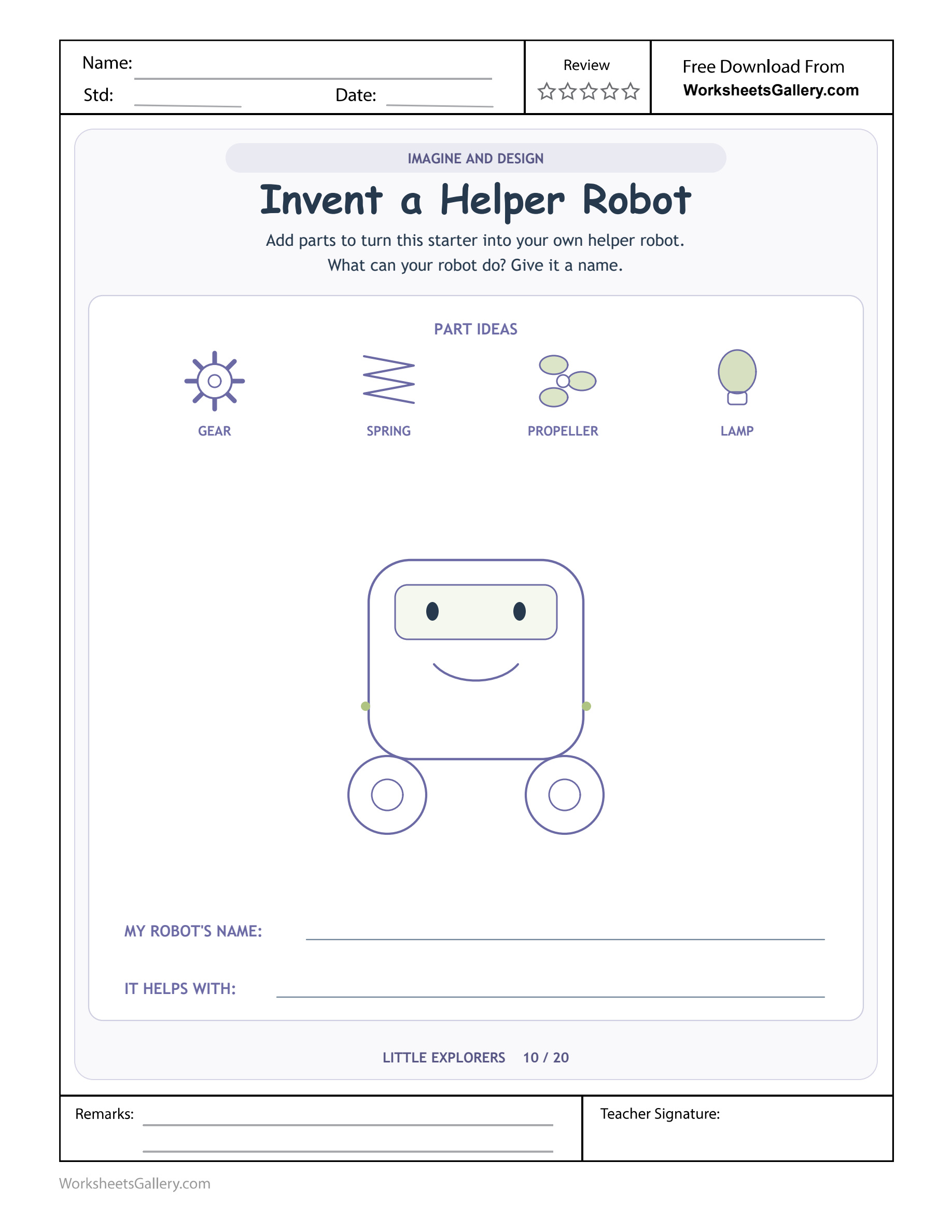
$5 collection companion: Helper Robot Invention. Choose additions for a starter robot and explain a named helper with a practical job.
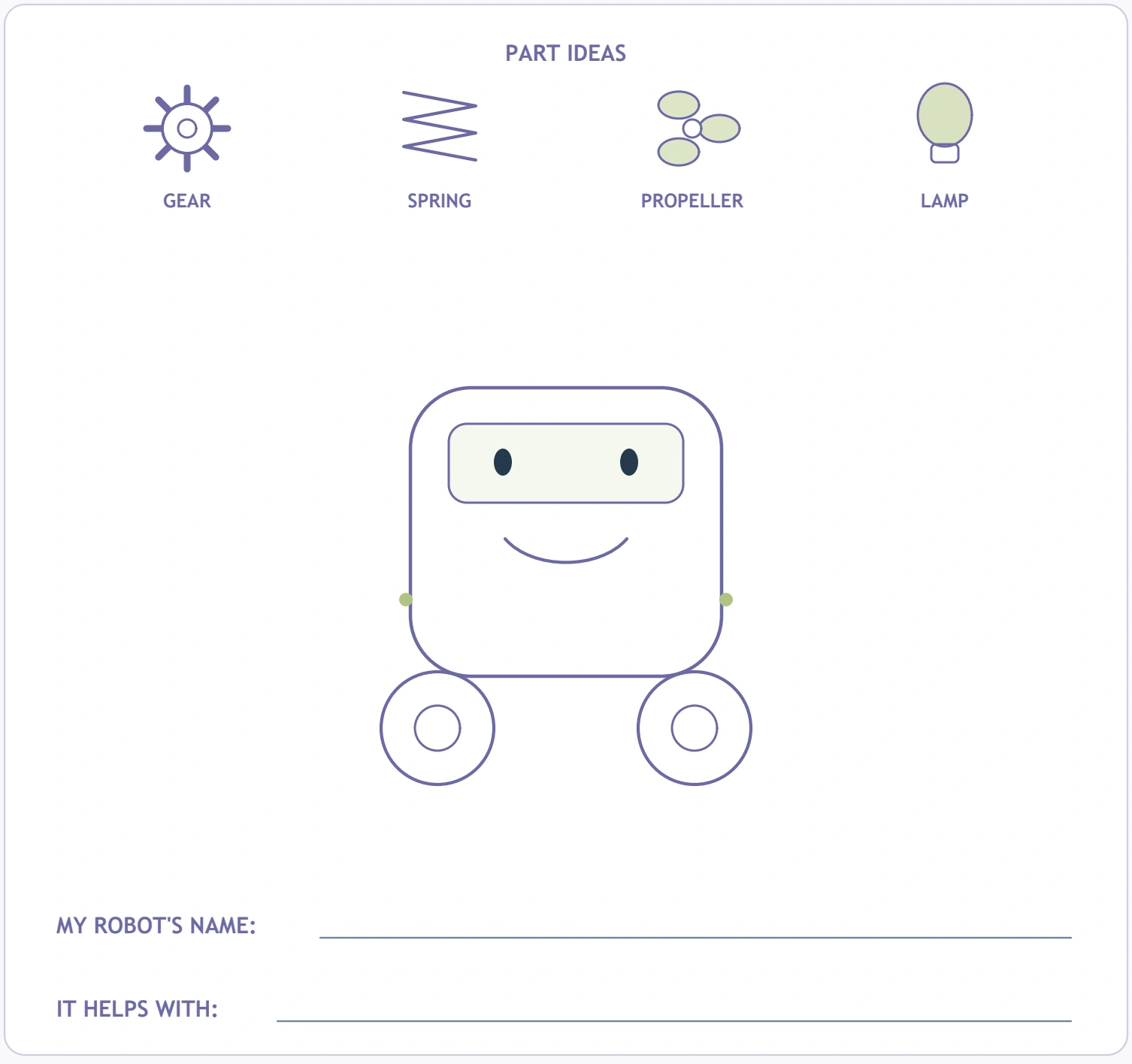
What job would a robot do if you could design its useful parts yourself? Helper Robot Invention begins with a friendly starter body and two wheels, then leaves the important invention decisions to the child. A small bank of part ideas offers a gear, spring, propeller and lamp without prescribing one finished machine. Children add features, choose a name and explain what their robot helps with. This supported preschool or kindergarten drawing activity welcomes spoken explanations as well as marks on paper. The interesting outcome is a design with a purpose that its young inventor can describe.
Let a job lead to a part — Helper Robot Invention
Before opening the drawing materials, ask Jalen about a small imaginary job he would like a helper to do. He might want a robot to light a reading corner, carry pretend parcels or find a toy in a story. The job can be playful; it gives the added parts something to communicate.
In Helper Robot Invention, a lamp could suggest a reading light, while a spring might inspire a reaching or bouncing idea. There is no requirement to use every supplied part suggestion. Invite Jalen to explain why a chosen addition belongs on his robot rather than treating the idea bank as a list of four compulsory items to copy.
A child may also invent a part absent from the bank. Listen to the intended function before judging the drawing's appearance. A broad mark described as a scoop can communicate an idea even when it does not resemble an adult's polished illustration of a mechanical tool.
What the supplied starter already provides: Helper Robot Invention
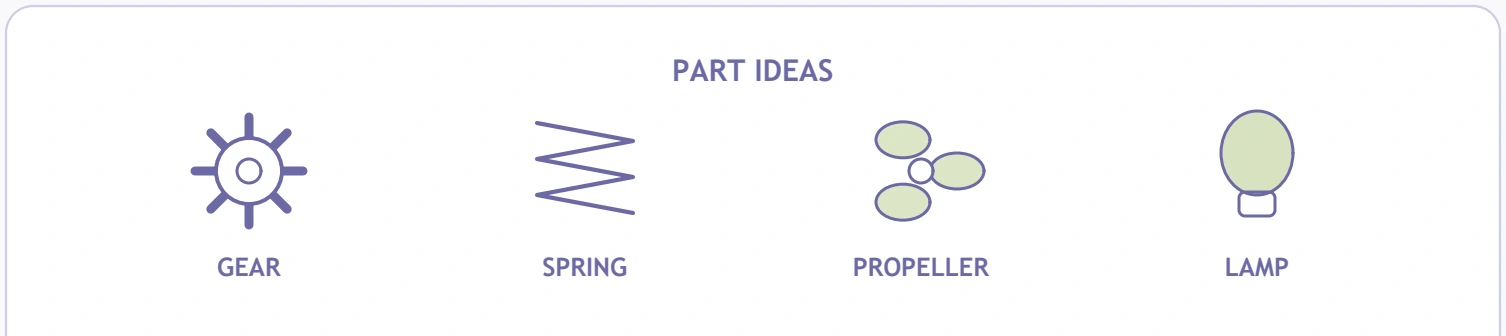
The Helper Robot Invention page includes a rounded friendly body with a face and two outlined wheels. These features give the child a recognisable beginning. They do not establish all the arms, tools, decoration or mechanisms that the finished helper must possess.
Below the invention space are two prompts: the robot's name and what it helps with. A child can dictate these to an adult if writing the explanation would interrupt the design conversation. Make it clear whose words are being recorded. The adult's spelling support need not replace the child's chosen name or purpose.
An open task still has a clear invitation: Helper Robot Invention
The source asks for additions that turn the starter into a helper robot. If Jalen only colours the supplied body, ask whether there is a part he wants to add for its job. This keeps the printed invitation visible without dictating the answer. A small purposeful addition can be enough to start a rich explanation.
Four ideas to examine, rather than four answers to copy
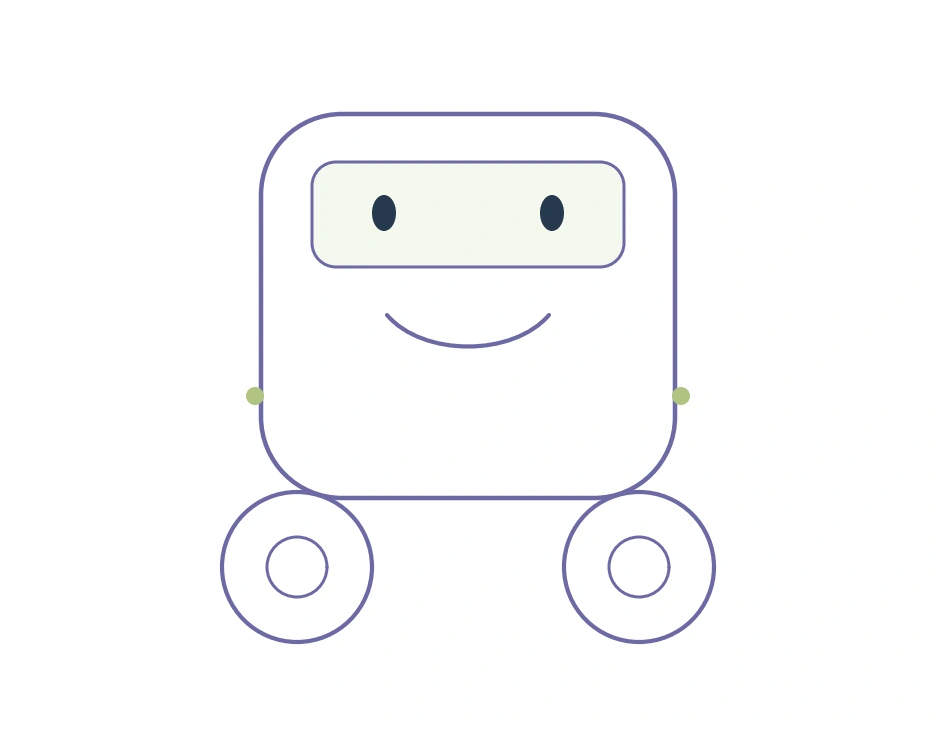
| Suggested part | A possible imagined use | A question for the inventor |
|---|---|---|
| Gear | Moving a pretend turning mechanism | What would this part turn on your helper? |
| Spring | Reaching or returning in a playful design | Where would the spring help the job happen? |
| Propeller | Moving air or suggesting an imaginative flying idea | How does this addition relate to the job you chose? |
| Lamp | Lighting a place in the robot's story | What does the robot need to illuminate? |
These are conversation starters for Helper Robot Invention, not technical construction plans or fixed solutions. The printed drawings do not require children to build a working machine. A clear connection between a pictured part and a stated purpose gives the design something to discuss.
Let an unusual explanation develop: Helper Robot Invention
If Jalen says his propeller finds lost socks, ask how that works in his story. He may describe blowing them into a basket or hovering above the washing pile. An adult can help clarify the account without replacing the imaginative idea with a more conventional robot job.
Six things the invention can make visible: Helper Robot Invention
A purpose expressed in the child's words: Helper Robot Invention
Helper Robot Invention invites an explanation of what the helper does. Notice whether Jalen can name a job or demonstrate it with a gesture. A spoken purpose can guide later additions even before the drawing is detailed.
A feature chosen for a reason
A part becomes more than decoration when the child connects it to the job. Ask about one addition and listen to the reason. The point is not whether the adult would have made the same design choice.
A plan revised during drawing
Jalen might move an imagined lamp from one side to another or decide that a scoop is more useful than a claw. Helper Robot Invention has room for that development. An evolving explanation need not be treated as forgetting the original plan.
Marks used to communicate
The child can point to a shape and say what it represents. The adult can record a short dictated label on separate paper if helpful. The drawing's communicative role matters alongside its visible outlines and colouring.
Vocabulary attached to a visible example
Part names such as spring and propeller may be unfamiliar. Point to the suggested picture while naming it, then ask what Jalen notices. This gives new words a concrete reference without requiring a vocabulary test before invention begins.
Ownership of a finished idea
A chosen name and purpose make the helper recognisably the child's creation. Invite Jalen to introduce it to someone else. Helper Robot Invention gives that introduction a visible drawing to refer to, rather than asking for an unexplained finished product.
At home, a reading helper takes shape: Helper Robot Invention
Imagine Jalen deciding that his robot will help a toy bear see a book. His parent asks which suggested part might communicate light. Jalen chooses a lamp and points to where he wants to add it to the starter body.
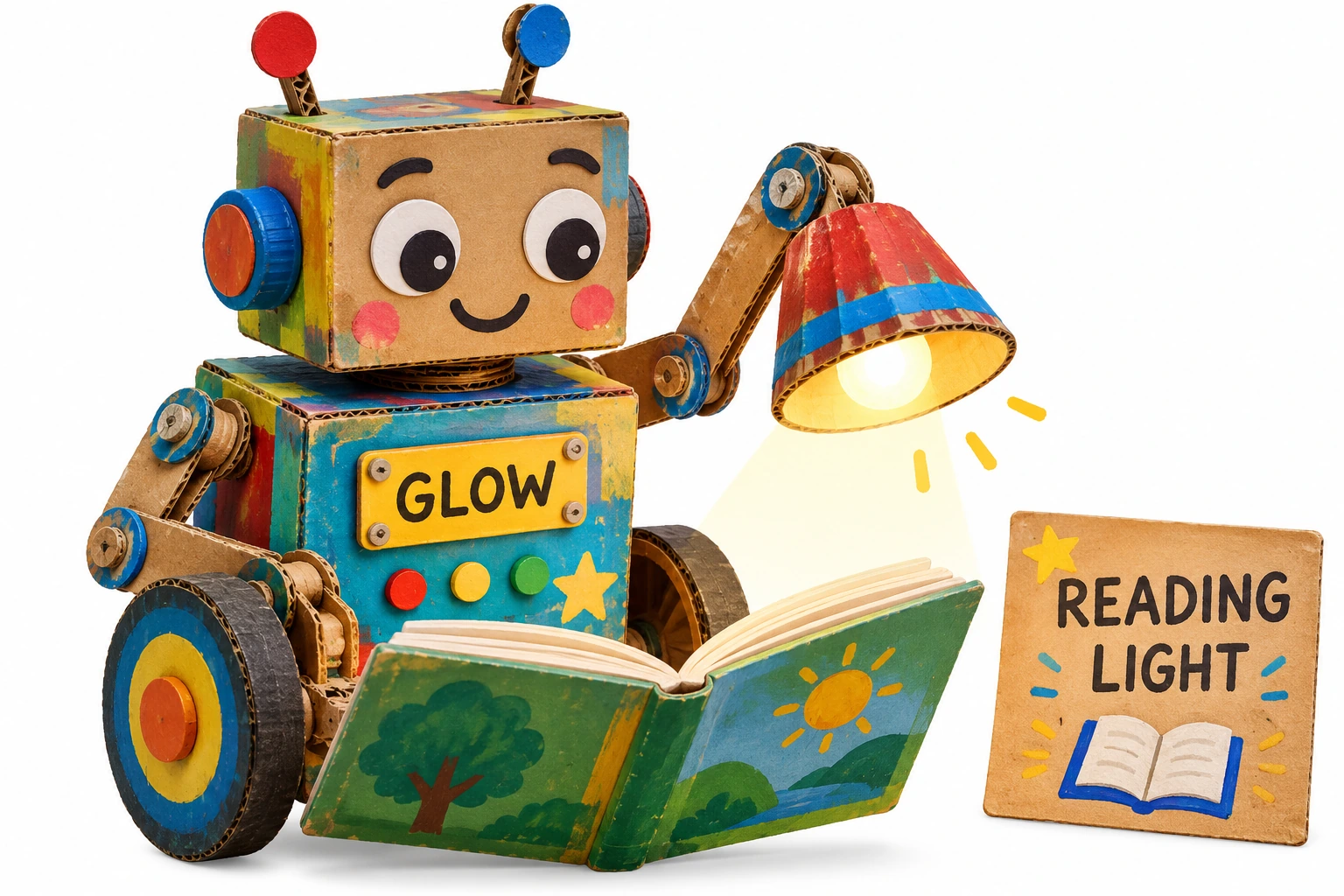
As the drawing develops, he decides to name the helper Glow. The adult writes that dictated name if Jalen wants support, then asks what the line about helping should say. “It lights the bear's book” retains his particular purpose instead of replacing it with a broad adult statement about robots being useful.
When the Helper Robot Invention picture is ready to discuss, Jalen points from the added lamp to the part of his story it affects. The supporting illustration beside this article shows another named reading-light robot. He can compare it with his own invention without being expected to copy its body, colours or exact arrangement.
A classroom design conversation before display
For a hypothetical classroom invitation, the teacher asks children to choose a helper job before adding parts to Helper Robot Invention. Partners can listen to the initial idea and ask one question about how a proposed feature relates to it. The listener's role is to understand, not to award the best invention.
An adult can keep a note of the child's explanation while the drawing is being made. That note may preserve an intention that is hard for another person to infer from the marks alone. Later, the child can confirm whether the explanation still fits or whether the plan changed.
Before displaying the pictures, invite each inventor to choose what a visitor should notice. Some will point to a working part, others to the name or a newly imagined job. The collection of drawings can show different responses to the same starter without ranking them by realism or decoration.
Questions that support authorship: Helper Robot Invention
Ask about something Jalen has already indicated: “What does this arm do?” or “Where would the light point?” A question tied to the drawing gives him a specific place to explain. A long series of unrelated questions can interrupt the act of making.
For Helper Robot Invention, avoid taking over a part because the adult can draw it more accurately. Offer a separate demonstration if requested, then let the child decide what to use. If Jalen wants the adult to write a label, he can dictate the word while retaining the design decision.
A name need not be a spelling challenge: Helper Robot Invention
An invented robot name may be unfamiliar, playful or difficult to spell. Listen to how the child wants it said. The source prompt is a place to name the creation, not a requirement to independently produce conventional spelling before the invention is accepted.
Five further design games
Match a part to a spoken job
Name a pretend task and lay out quick drawings of two possible tools. Ask which one the child would choose and why. More than one reasonable explanation can be discussed. This isolates the purpose-to-feature relationship explored in Helper Robot Invention.
Give one robot another assignment: Helper Robot Invention
On separate paper, imagine the same helper doing a different job. Ask whether a part would stay useful, need changing or be replaced. The child can describe the redesign without redrawing the whole original body.
Introduce a tiny invention: Helper Robot Invention
Choose a household object as a pretend robot prop and give it an imaginative name. Invite a brief introduction: what it is called and what it helps with. This oral game lets the child practise communicating a design before using more drawing materials.
Let a visitor ask a question: Helper Robot Invention
An adult or toy character examines the completed picture and asks about one feature. The inventor points and explains. Keep the visitor curious rather than doubtful, so that the exchange supports clearer communication rather than defending the picture against criticism.
Draw a second possible solution: Helper Robot Invention
Suggest another way the chosen job might be accomplished and invite the child to sketch it on spare paper if interested. Compare the two possibilities. The extension shows that Helper Robot Invention can lead to several designs rather than one ideal answer hidden in the adult's mind.
When ideas, drawing and writing develop differently: Helper Robot Invention
Helper Robot Invention offers a supported invention activity for ages four to six, with room for different levels of drawing detail and spoken explanation. A child may describe an elaborate helper while making only a few marks, or enjoy adding shapes before deciding what they do. Listen to the relationship between the explanation and the picture.
Common difficulties include assuming that all four suggested parts are compulsory, copying an example without choosing a purpose, treating the name line as a spelling test or asking the adult to redraw every unusual mark. Return to the source invitation: add parts, name the robot and explain its help. Provide support for the recording while leaving the idea with the child.
For a later visit, invite Jalen to introduce the invention again or choose one part he might change. A specific new job can create a reason to redesign. There is no need to demand daily copies of the same robot simply to make drawing look like a regular exercise.

Save a clean starter for the next invention: Helper Robot Invention
Members on a qualifying active plan can download the clean Helper Robot Invention edition. Website promotion, including the domain and watermark, has been removed from this ad-free printable. The original uploaded sheet remains a distinct sample option for inspection.
Preview the complete portrait page before printing. Keep the optional parts, full starter body, wheels and both explanation lines visible. The related Little Explorers collection costs $5 USD and brings the invention sheet together with nineteen different activities in one clean PDF, purchased through the collection's own access control.
More reasons to draw an explainable idea: Helper Robot Invention
After Helper Robot Invention, explore Picture Detail Tracing beside Helper Robot Invention, Grid Drawing Growth after Helper Robot Invention, Picture Step Recipes beyond Helper Robot Invention. Keep each new instruction separate from Helper Robot Invention.
Adults can read NAEYC's advice about supporting children's early written expression or explore PBS Parents' picture-and-language activity ideas. With Helper Robot Invention, celebrate a purpose the child chose, an addition that expresses it and a name that belongs to the inventor's own story.
Popular Worksheets
Printable resources families and teachers are downloading now.
 Free
 Free
 Free
 Free