
Flower Ring Copywork: 4 Joyful Hub Designs to Explore
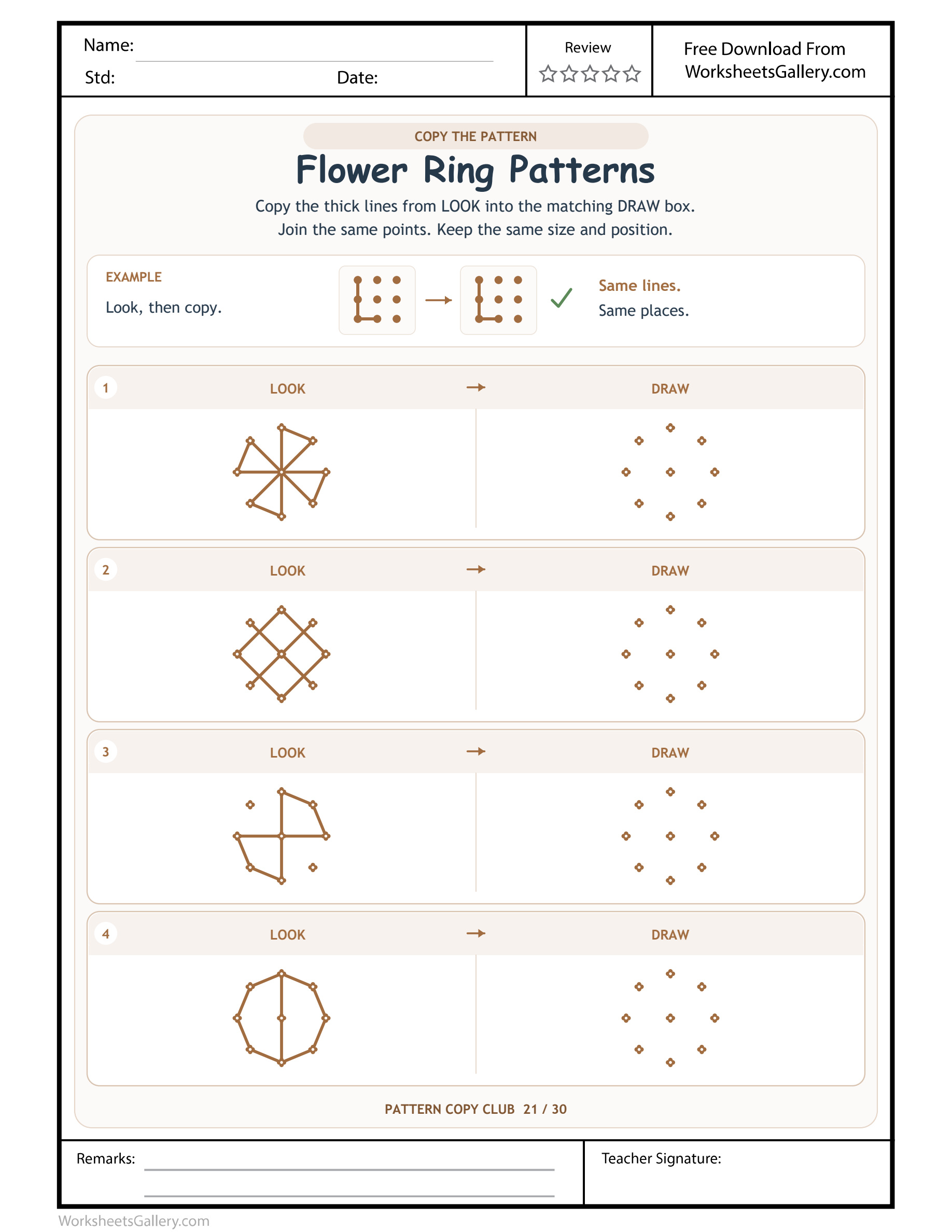
Flower Ring Copywork: Distinguish the hub from outer ring points across pinwheel and crossed-petal models.
Petals in this activity are angular line arrangements, not curved flower outlines to trace. Flower Ring Copywork presents four models around a central hub and eight surrounding points. A child looks closely at each reference, then recreates its selected connections in the neighbouring field. Flower Ring Patterns includes crossing diamonds, opposed petal-like shapes and a ring with a divider, so familiar flower ideas must give way to the actual printed geometry. The completed example establishes the copying format. Offer this page when a learner enjoys comparing how several straight lines can share a centre.
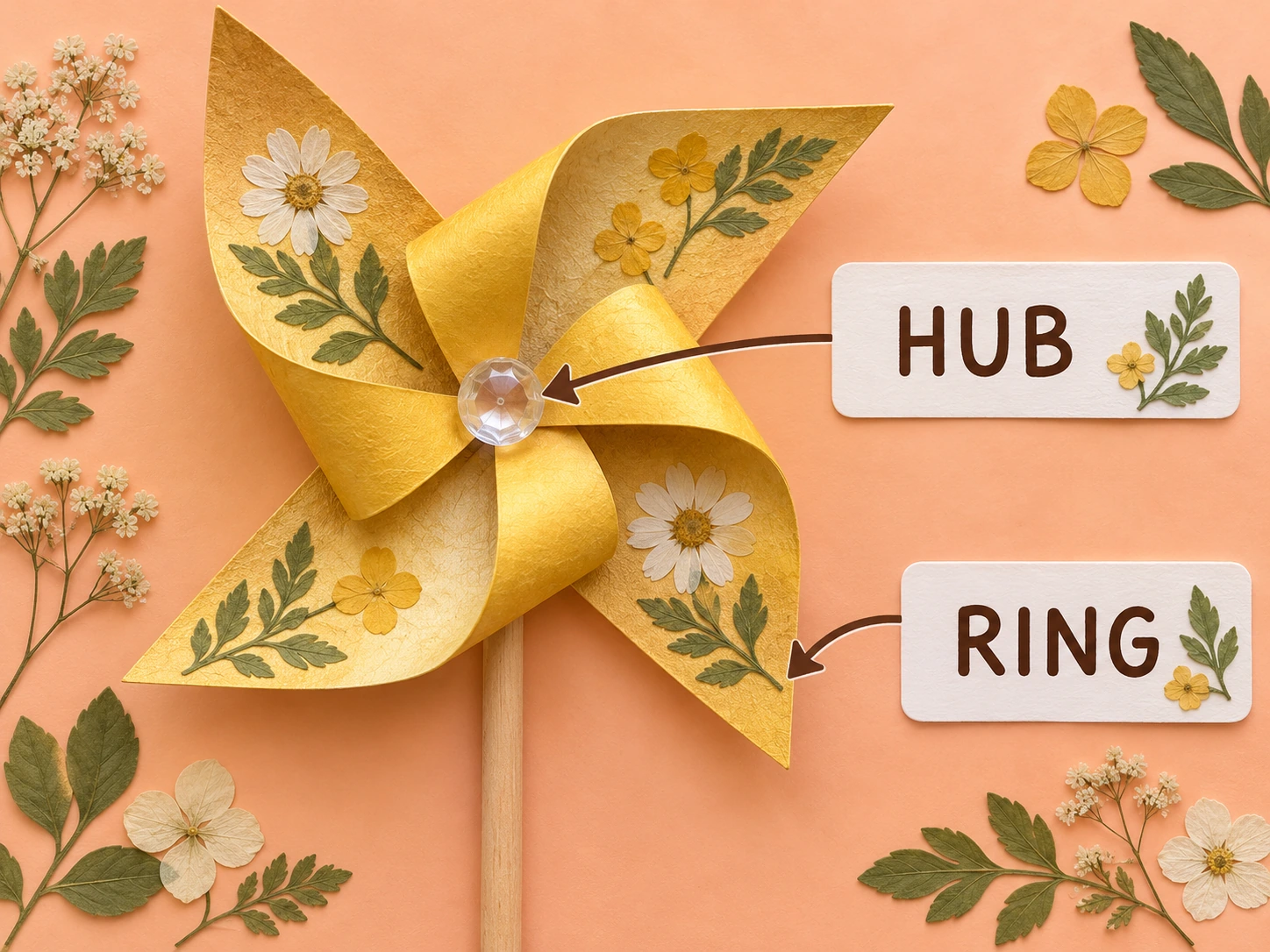
Begin with the hub, then inspect its neighbours — Flower Ring Copywork
The centre of Flower Ring Copywork's circular arrangement provides a useful landmark. Show the learner that outer markers occupy positions around it, rather than forming ordinary rows across a square grid. Choose one bold line and identify which markers it connects. Some cross the centre; other connections belong farther out.
A child may see petals immediately, but the source contains four different designs. The name of a picture cannot supply all its connections. Let the visible model decide which points are joined. Keep the reference close and available as the child compares each new section.
Four ways to organise the ring: Flower Ring Copywork
| Flower Ring Copywork pair | Visible Flower Ring Patterns model | Model structure |
|---|---|---|
| 1 | Four small pinwheel triangles around the hub | 9 anchors / 12 bold pieces in Flower Ring Patterns |
| 2 | Crossing diamonds using outer and inner points | 9 anchors / 8 bold pieces in Flower Ring Patterns |
| 3 | Two opposed angular petals | 9 anchors / 8 bold pieces in Flower Ring Patterns |
| 4 | Outer ring divided vertically through the hub | 9 anchors / 10 bold pieces in Flower Ring Patterns |
The Flower Ring Copywork fields each contain nine anchors: one hub plus eight outer positions. Their segment totals refer to supplied bold pieces. A line crossing another line does not automatically create another printed marker, and counting the pieces is not a requirement for completing the page.
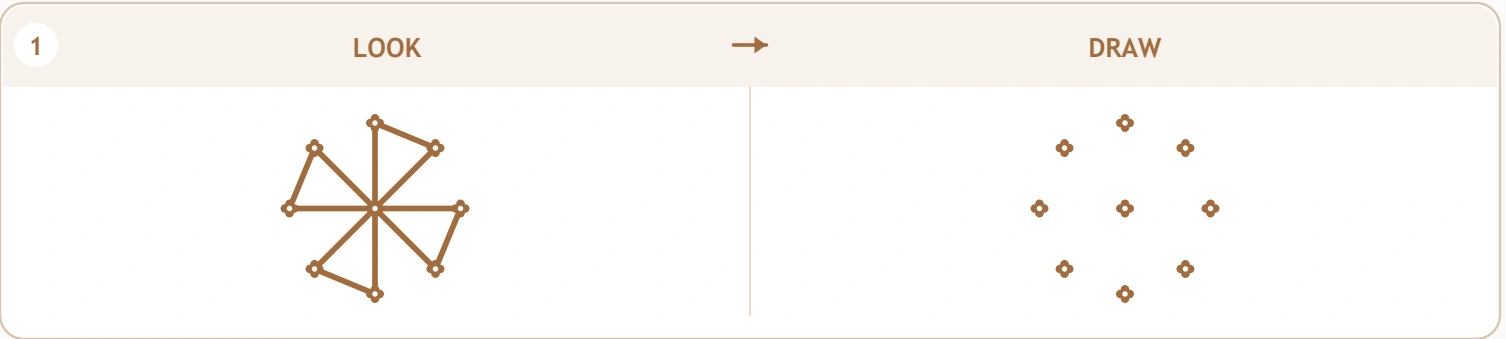
Why a pinwheel need not be made symmetrical: Flower Ring Copywork
The first Flower Ring Copywork design suggests four angular pinwheel sections. Its particular orientation matters. A learner who adds a missing-looking edge or rotates a section to make a preferred flower may change the reference even while producing an attractive result.
Invite the child to point out one connection between the hub and an outside point, then another between two outside positions. Compare where each lives around the ring. Copy a small group, pause and inspect it. The worksheet does not demand a continuous stroke through every part, and pencil lifts can help separate different groups of lines.
Six learning possibilities in a circular field: Flower Ring Copywork
- Radial position. Children compare markers around a centre rather than relying entirely on row-and-column language.
- Hub recognition. The central point becomes a stable reference when several nearby lines compete for attention.
- Shape grouping. Small angular sections can be considered as petals, diamonds or opposing parts without replacing their actual edges.
- Visual restraint. Learners practise leaving an unsupplied connection absent, even when a more regular pattern seems tempting.
- Aimed movement. Straight pencil motions begin and end at selected anchors, with pauses for changes of direction.
- Relational talk. Opposite, beside, around and through provide language for discussing a chosen connection.
These possibilities make Flower Ring Copywork useful for observation, not for diagnosing a child's abilities. An accurate point choice may coexist with an unsteady stroke. Adults can acknowledge the spatial decision while offering a broader drawing surface when fine movement is tiring.
Uma's pretend flower-making bench: Flower Ring Copywork
Imagine Uma arranging coloured sticks around a large tabletop centre. An adult places Flower Ring Copywork beside the construction and asks Uma to find two opposing parts in one printed model. Uma builds a broad version first, then chooses a single small connection to copy on paper.
This imagined home exchange uses the flower theme as an invitation to compare positions. It is not a report of a measured result. Uma may invent a new blossom with the remaining sticks, while the worksheet copy stays tied to its particular reference. Both forms of making can have a place at the same table.
A classroom discussion about competing connections: Flower Ring Copywork
For a possible classroom use of Flower Ring Copywork, a teacher asks pupils to identify a line that passes through the centre and one that does not. Learners explain with a finger or a short phrase. Their own pages remain visible throughout, and classmates need not choose the same model.
The teacher may show two large stick constructions that differ by one outside connection. Invite children to explain which corresponds to a selected reference. Then return to a manageable paper section. In this hypothetical setting, an observation about noticing the hub is more useful than comparing who completes four patterns first.
A practical entry point for young model readers: Flower Ring Copywork
Children around four to seven, from supported preschool activity into early primary work, may be interested in Flower Ring Copywork. The unusual ring layout can require more explanation than a familiar square dot field. Begin by asking the learner to locate the centre and a chosen neighbouring point without a pencil.
If the crowded crossings are hard to inspect, make a large model with movable pieces. Allow pointing, describing or copying only one portion. The whole page need not fit one sitting. Return to Flower Ring Copywork when the learner can comfortably distinguish a connection between outside points from a line that uses the central hub.
Four flower-shop games beyond the printed designs: Flower Ring Copywork
Take an order for opposing petals: Flower Ring Copywork
Create a large ring arrangement with two opposite angular parts. A pretend customer describes which parts they want, and the child builds a matching order. Keep the supplied arrangement visible. The exchange connects position words to a playful purpose without making extra rules for Flower Ring Copywork.
Turn a paper frame, then compare it: Flower Ring Copywork
Make one broad pinwheel construction on a movable card and rotate the card. Discuss what stayed connected and which positions changed relative to the table. Explain that the printed page remains fixed during copying. This investigation can reveal why a turned version is not automatically the same answer.
Sort hub lines from outside lines: Flower Ring Copywork
Offer a few adult-made ring models. Ask a child to identify connections that touch the centre and connections that stay on the outside. They may sort with spoken labels or pointing instead of writing. Relate one observation to Flower Ring Copywork's chosen design.
Invent a blossom with a different rule: Flower Ring Copywork
Use loose sticks to make an original flower-like pattern. The child explains a self-chosen rule, such as keeping two opposite parts alike. A partner can recreate it while looking. Welcome this new design on another surface, preserving the supplied geometry when returning to the worksheet.
Copying through a crossing without adding a point: Flower Ring Copywork
Where bold lines overlap in Flower Ring Copywork, the eye may pause at the crossing. Check whether a printed anchor is actually present there before treating it as a new destination. A line intersection and a marker are different pieces of visual information, even when they appear close together.
Adults can demonstrate by pointing to the ends of one printed segment and following it across another. Keep the explanation short. The learner need not name intersection geometry formally; recognising which two points the chosen line connects is enough for the next drawing decision.
Correct a petal by comparing its ends: Flower Ring Copywork
Common Flower Ring Copywork changes include rotating an angular part, adding extra symmetry, joining every outer point or overlooking a short divider. Ask which endpoint first differs from LOOK. A local comparison offers a more usable clue than saying the flower has the wrong shape.
Matching can include leaving an attractive extra line undrawn. If the child wants a fuller flower, offer spare paper for that idea. Keep the exact-copy request clear without treating invention as a mistake in every context. A crowded answer field can wait while the adult and child discuss the intended connection on a larger model.
Make a small discovery worth returning to: Flower Ring Copywork
The repeated hub can give Flower Ring Copywork a reassuring place to restart, while each model provides a different arrangement to investigate. Let the learner choose a detail that seems interesting. A child may enjoy the idea that the same nine points can support several pictures without requiring every possible connection.
Praise an observable comparison, for example “You noticed that this line stayed outside the centre.” Offer another brief visit later in the week alongside gardening stories, flower construction and open-ended painting. Repeated invitations might involve one thoughtful section at a time rather than repeated full-page completion or pressure to work faster.
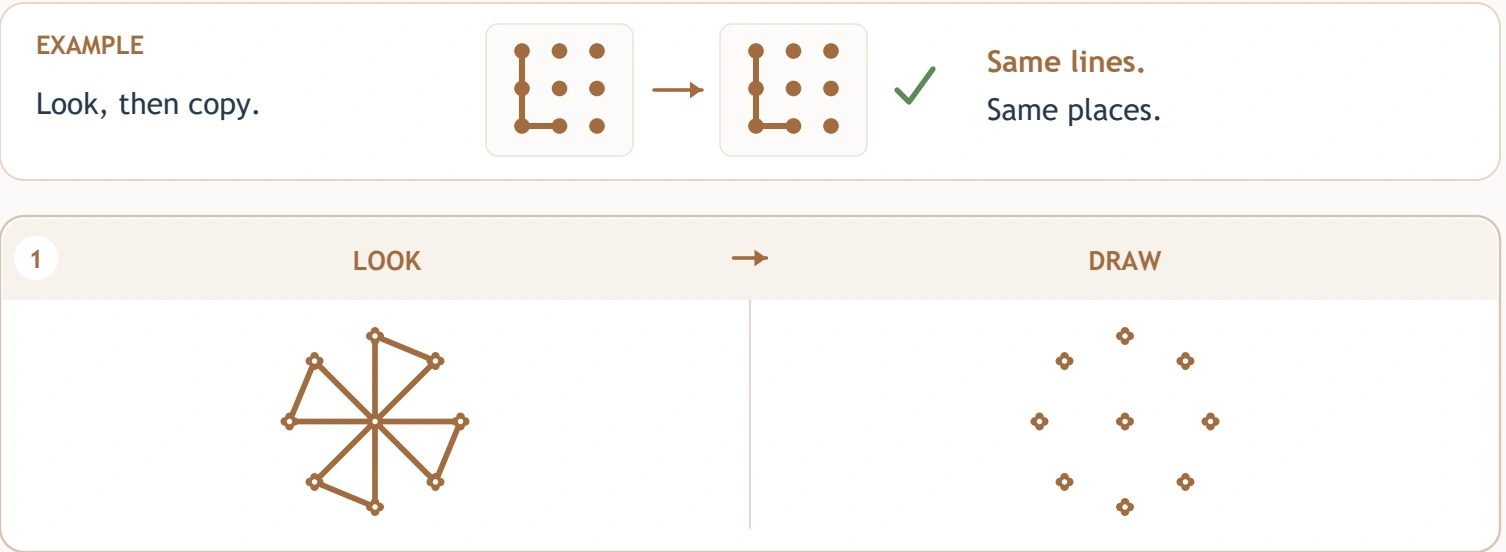
Keep the ring clear when you print: Flower Ring Copywork
Choose the free Flower Ring Patterns file to obtain the supplied original. The clean Flower Ring Copywork PDF is a separate premium download for an account holding qualifying membership that is currently active. Website watermark, domain text and promotional advertisements are removed from that edition; all activity connections and student fields remain intact.
For every worksheet in one clean PDF, the native related-package card opens the thirty-sheet collection priced for $3. Download whichever edition your present access permits. Use US Letter paper with scaling fixed at 100%, or select Actual Size. Inspect the border and central markers in print preview so Flower Ring Copywork's close connections remain at their intended spacing.
More visual comparisons and independent reading: Flower Ring Copywork
Compare Flower Ring Copywork with Drawing Size Choices. After Flower Ring Patterns, try Shape Border Journeys. For Flower Ring Patterns, consider Path Copy Thinking.
Adults using Flower Ring Copywork may also find ideas in NAEYC's play resources for families and PBS Parents' activity collection. These popular educational sites provide optional reading beyond the printable; neither supplies an endorsement, an answer key or extra purchased pages here.
Popular Worksheets
Printable resources families and teachers are downloading now.
 Free
 Free
 Free
 Free