
Gem Grid Sketching: 6 Amazing Open-Line Copies
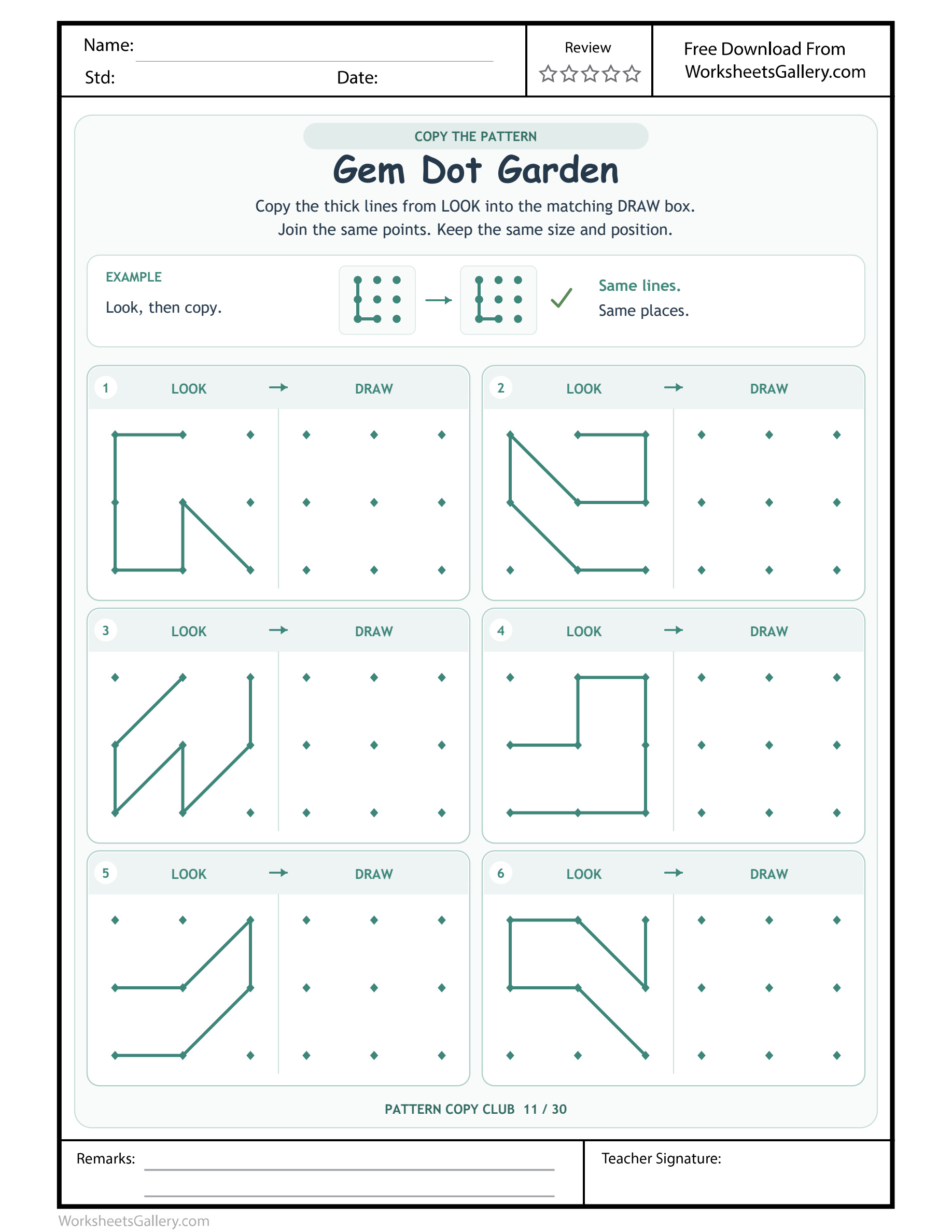
Gem Grid Sketching: Keep angular gem-grid patterns open where the model leaves a gap.
Unfinished-looking lines can be exactly right. Gem Grid Sketching uses six green angular models with deliberate open ends, short frames and sloping branches on nine-point fields. Children inspect each LOOK pattern and copy its actual connections into the matching DRAW area. The Gem Dot Garden source includes a completed demonstration before the independent work. This printable invites a useful kind of restraint: leave a space when the model leaves a space. A learner can enjoy the gem-like markers while practising careful comparison, controlled pencil landings and spoken descriptions of where a line stops.
Resist the urge to close the shape — Gem Grid Sketching
Several Gem Grid Sketching models hint at boxes or diamonds without completing those outlines. A child may see a familiar possibility and add an edge automatically. Begin by asking where the printed line ends, rather than what finished object the pattern might become.
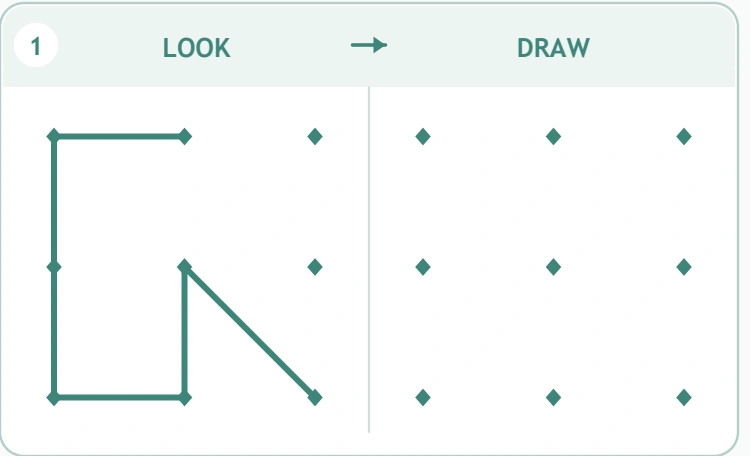
The first model in Gem Grid Sketching combines a left-side frame with a lower diagonal branch. Another turns inward beside a right-hand frame; later designs contain paired slants or disconnected-looking parts. An intentional opening belongs in an accurate copy. The child does not need to make the design more balanced, enclosed or decorative than its reference.
An adult's map of the six comparisons: Gem Grid Sketching
| Gem Grid Sketching pair | Visible Gem Dot Garden model | Model structure |
|---|---|---|
| 1 | Left frame and a diagonal lower branch | 9 anchors / 6 bold pieces in Gem Dot Garden |
| 2 | Open upper box with a lower slant | 9 anchors / 7 bold pieces in Gem Dot Garden |
| 3 | Two close rising zigzags | 9 anchors / 6 bold pieces in Gem Dot Garden |
| 4 | Inward step around a right frame | 9 anchors / 7 bold pieces in Gem Dot Garden |
| 5 | Paired lower horizontals meeting slants | 9 anchors / 5 bold pieces in Gem Dot Garden |
| 6 | Top bend followed by a falling diagonal | 9 anchors / 6 bold pieces in Gem Dot Garden |
These Gem Grid Sketching segment counts describe the printed model, including short portions that share one straight direction. They are not instructions to visit every green marker. Some locations remain unused, and a pencil may lift between parts. Keep the original field available for comparison rather than asking the child to reconstruct the drawing after the model is hidden.
What counts as a successful open line?: Gem Grid Sketching
A useful Gem Grid Sketching copy keeps the model's chosen endpoints, direction changes and gaps. The line may wobble a little as a young hand learns to travel between points. First compare where it landed. If the destination is correct, recognise that spatial choice before offering another attempt at a steadier stroke.
Conversely, a very neat line can still be an extra connection. Invite the child to point to the source stroke that matches it. This turns review into a discussion of evidence. There is no need to decide that the whole Gem Grid Sketching attempt is unsuccessful because one branch was extended beyond its intended stopping point.
Start from a distinctive endpoint: Gem Grid Sketching
Choose one Gem Grid Sketching pair and point to a clearly visible open end. Find its corresponding marker in DRAW. Identify the next destination before drawing the first stroke, then pause to compare that short section. At a bend, inspect the new direction rather than continuing along the nearest available row.
The child can start elsewhere if that produces the same arrangement. There is no printed stroke-order sequence to enforce. Some designs are easier when divided into a frame-sized piece and a branch-sized piece. A deliberate pencil lift can support that plan, especially when connecting the pieces would add a line the source does not show.
Keep the paper invitation small enough
For preschool and early school learners, approximately four to seven, Gem Grid Sketching can offer a manageable visual puzzle when short slants are comfortable. Being able to name a gem or diamond does not establish readiness by itself. Notice whether the child can locate a matching point and stop a short line deliberately.
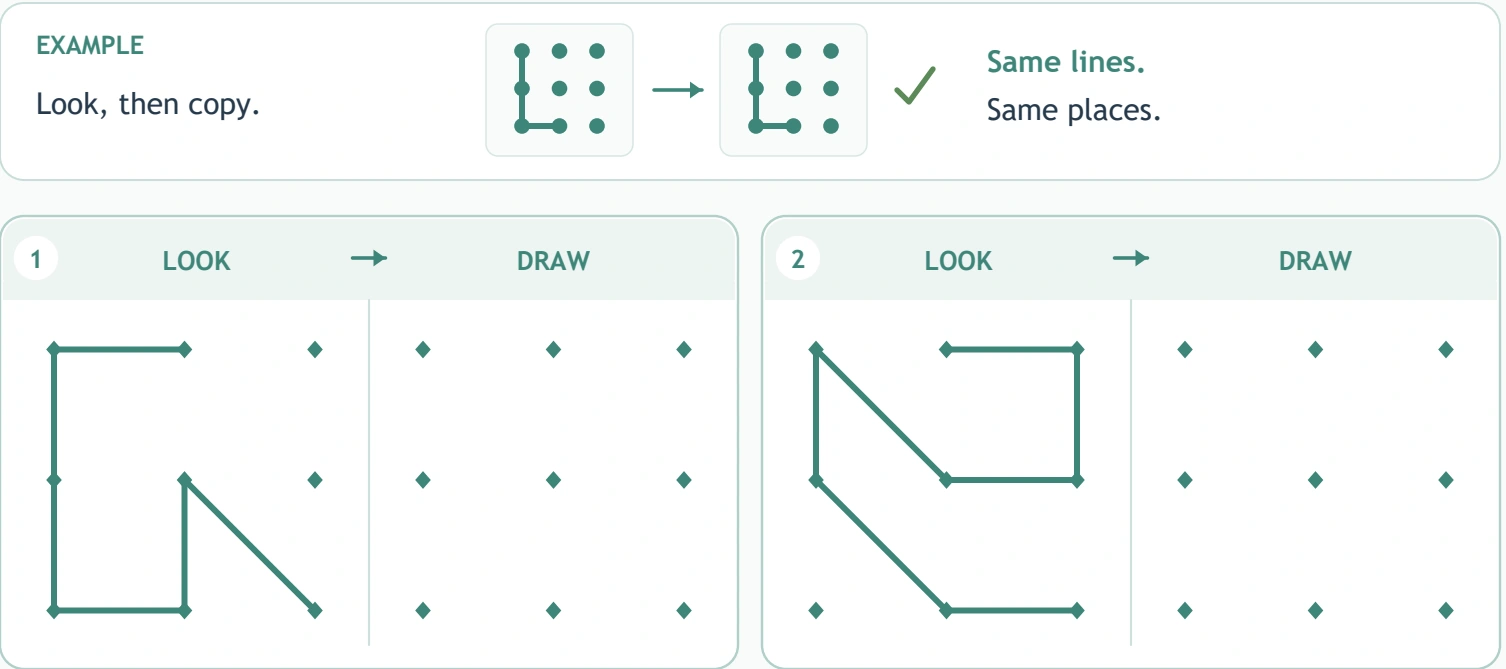
Offer one pair first. Explain LOOK and DRAW orally, and use the completed L example to show transfer between corresponding locations. If the child is already tired from other small-hand work, postpone Gem Grid Sketching and build a large open shape with strips. A useful invitation should fit the learner's present attention as well as their age.
Five practical benefits to observe: Gem Grid Sketching
- Stopping on purpose. The hand ends a stroke at the intended marker instead of continuing because another point is nearby.
- Separating recognition from copying. A familiar-looking outline does not justify adding an imagined missing side.
- Tracking direction changes. A child compares the location of each bend rather than making a general angular scribble.
- Planning separate components. Pencil lifts preserve gaps and give the learner time to choose another starting anchor.
- Explaining a small mismatch. Words such as open end, branch and inward turn let the adult and child discuss one feature calmly.
These Gem Grid Sketching opportunities combine motor planning, spatial attention and language. They are not a promise of a particular learning rate. A child who can explain why a gap remains has made a thoughtful observation, even if the pencil version is still partial or the next connection needs adult support.
Kian's sculpture shelf at home
Imagine Kian bending a soft craft cord into an open angular shape with a family member. The adult places Gem Grid Sketching nearby and asks which printed design also has an open end. Kian chooses one model but draws an extra closing edge in its partner field.
This fictional home example illustrates how a familiar shape can invite an unnecessary addition. The adult compares the cord's open ends with the selected paper model and asks which gap should stay. Kian can create an enclosed shape later on spare paper. In Gem Grid Sketching, the next useful step is a single matched stopping place, not a complete fresh page.

A class can investigate the spaces: Gem Grid Sketching
In an imagined classroom session, a teacher asks children to inspect Gem Grid Sketching for a place where the line deliberately stops. Each learner points to one open end and explains it to a partner. The conversation begins with the gap rather than the overall picture name.
Children then copy on individual sheets, using their chosen endpoint as a landmark. The teacher observes whether a learner preserves that opening after looking away to DRAW. A note about stopping accurately can inform a future lesson. Avoid treating the six Gem Grid Sketching models as a speed test or asking partners to repair each other's paper with their own pencils.
Four games for an open-shape studio: Gem Grid Sketching
Make a doorway that stays open: Gem Grid Sketching
Construct an angular frame from broad paper strips with one side deliberately absent. Place a completed physical reference beside it and ask a partner to recreate the same gap. Relate the construction to Gem Grid Sketching, then allow the child to invent a different frame freely.
Play the stopping-point narrator: Gem Grid Sketching
Move a toy along a short stick path. The child announces where it stops and explains why the next nearby stick is not part of the chosen route. This movement story provides a larger version of respecting an endpoint without adding a written code to the worksheet.
Curate an open-and-closed exhibition: Gem Grid Sketching
Gather several string or strip shapes and sort them according to whether their ends meet. Discuss one example that looks almost closed. Children can choose names for the constructions without being required to complete them. Bring the comparison back to one Gem Grid Sketching model if the child is interested.
Run a branch repair counter: Gem Grid Sketching
An adult copies a simple strip model with one branch extended too far. The child identifies the extra portion and suggests a repair. Swap the roles so the adult also has to inspect carefully. Keep the game cooperative; spotting a difference can be interesting rather than embarrassing.
Common habits that change these models
In Gem Grid Sketching, joining all markers in a row can accidentally add a long baseline. Closing a near-diamond, shifting a branch by one column, or reflecting a side frame also changes the selected pattern. Point to a distinctive source feature before asking the child which mark they intended.
A gap is information, not unfinished work. If an answer field becomes crowded after several corrections, use spare paper for a similar large example. Repeatedly darkening the same mistaken line may make the intended course harder to see. The learner can discuss a better endpoint now and try a clean pencil copy at another time.
Return for one clearly named decision: Gem Grid Sketching
The abstract designs in Gem Grid Sketching may resemble tunnels, gems, garden paths or sculptures. Let a child explain their own association, while keeping free invention outside the exact copy until it has been compared. The model can be accurate without receiving the same name from every learner.
On another day, choose a single open end to inspect again. Praise a new strategy, such as glancing back before closing a frame. “You left the space you noticed” gives feedback about a decision. Short, willing returns to Gem Grid Sketching can alternate with construction and story play, without a requirement to finish every practice pair on a schedule.
A short adult-child conversation to try: Gem Grid Sketching
Ask, “Which line will you copy next?” Let the child point rather than answer quickly. Follow with, “Where does it stop in the model?” Only after that comparison should the pencil move. This small dialogue can keep Gem Grid Sketching from becoming a string of guessed connections.
When the child disagrees with an adult's interpretation, examine the printed pattern together. Refer to the same source segment and its two endpoints. Modelling that shared inspection shows how to settle a drawing question through visible information, rather than expecting the learner to accept a correction they cannot yet understand.
Download the garden's line models: Gem Grid Sketching
The free option offers the uploaded Gem Dot Garden sample. The clean Gem Grid Sketching premium file is separate: use an account with eligible active member access, then request its premium PDF. Website watermarks, domain names and promotional ads are removed from the member edition while the original exercise structure is preserved.
For the complete thirty-sheet series, follow the native package card to the $3 collection. Save the authorised PDF, choose US Letter paper and inspect your printer's Actual Size or 100% preview. Keep the full page at its intended scale. Then begin Gem Grid Sketching with one open end the child can find and describe comfortably.
Another way to compare a visual model: Gem Grid Sketching
Compare Gem Grid Sketching with Drawing Size Choices. After Gem Dot Garden, try Shape Border Journeys. For Gem Dot Garden, consider Path Copy Thinking.
For broader play ideas to accompany Gem Grid Sketching, see play-related family material from NAEYC. Families can also explore PBS Parents resources on learning through everyday activities. These education links are independent reading suggestions and do not add files to this worksheet download.
Popular Worksheets
Printable resources families and teachers are downloading now.
 Free
 Free
 Free
 Free