
Little Triangle Markers: 6 Brilliant Line Designs
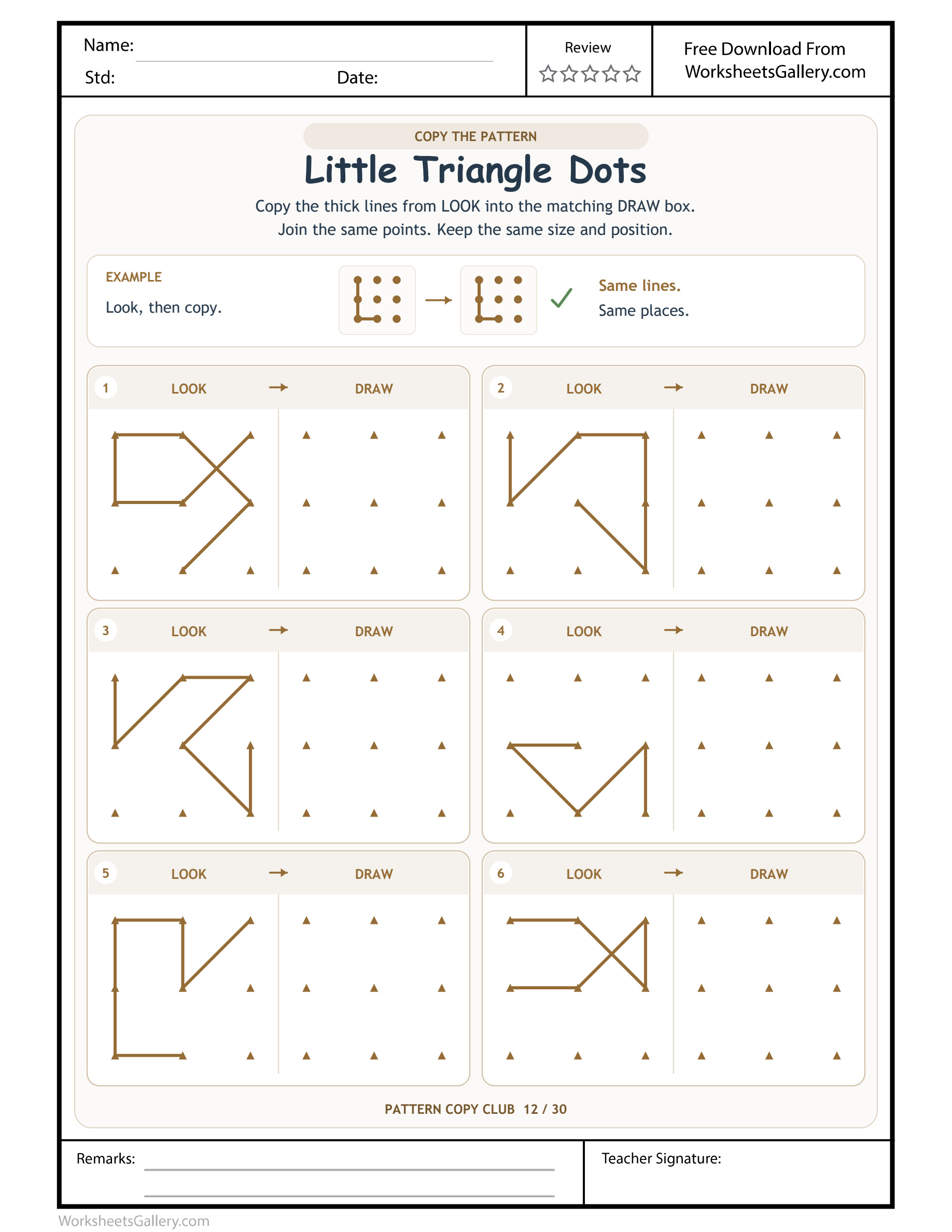
Little Triangle Markers: Treat triangular markers as point locations while copying the larger lines between them.
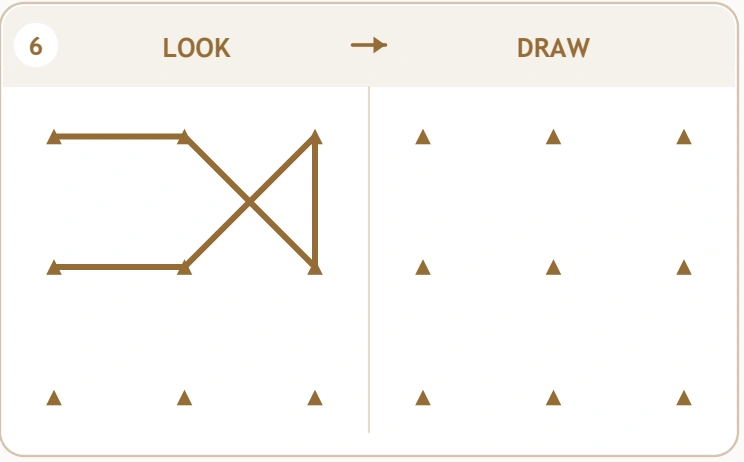
Tiny triangles can be destinations rather than pictures to draw. Little Triangle Markers places triangular markers beneath six amber line models, each beside a matching field for the child's own copy. The larger designs include frames, crossing diagonals, open branches and angular turns. A worked example introduces the relationship between LOOK and DRAW. Use this printable to practise an important visual distinction: the small marker tells you where a stroke belongs, while the bold line tells you which locations to connect. The worksheet does not ask children to outline or colour every miniature triangle.
A marker and a model do different jobs — Little Triangle Markers
The Little Triangle Dots source uses nine small triangular anchors in each field. Little Triangle Markers asks the learner to copy the larger bold arrangement between them. A child who begins tracing around each tiny triangle has noticed the symbols but needs the task explained more clearly.
Point to a marker, then follow one bold line leading to another location. Find both partner markers in DRAW. Use the triangle as a place to land. This short comparison separates the two visual jobs without requiring the child to learn a technical term before trying the activity.

Six amber designs worth a close look: Little Triangle Markers
| Little Triangle Markers pair | Visible Little Triangle Dots model | Model structure |
|---|---|---|
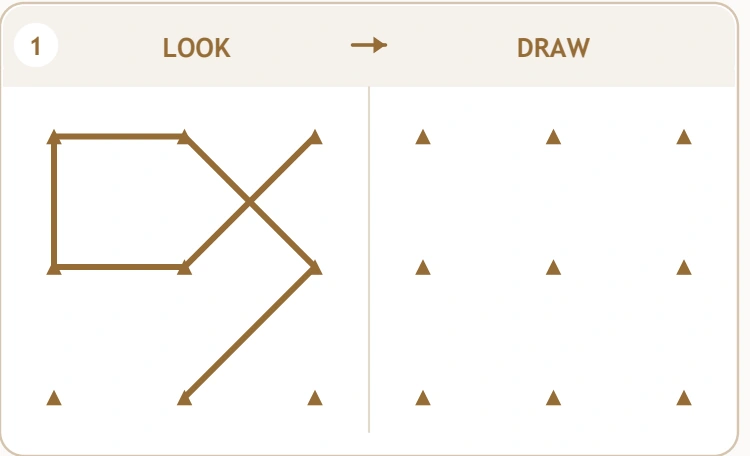
| 1 | Small upper box crossed by diagonal arms | 9 anchors / 6 bold pieces in Little Triangle Dots |
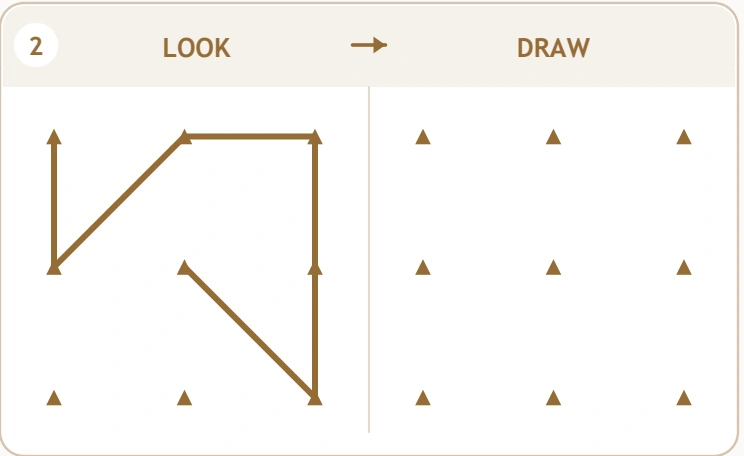
| 2 | Right frame with two opposing slants | 9 anchors / 6 bold pieces in Little Triangle Dots |
| 3 | Two long diagonals and short vertical ends | 9 anchors / 6 bold pieces in Little Triangle Dots |
| 4 | Crossing diagonals above a lower triangle | 9 anchors / 4 bold pieces in Little Triangle Dots |
| 5 | Left upright with an upper zigzag | 9 anchors / 6 bold pieces in Little Triangle Dots |
| 6 | Forked right-hand triangle and a low slant | 9 anchors / 5 bold pieces in Little Triangle Dots |
The Little Triangle Markers models vary in their connections despite sharing the same nine-point layout. A little upper box in one panel gives way to slants and open arms in another. Ask the learner to inspect the new reference before copying, rather than carrying the previous arrangement into the next field.
Choose a line with two clear endpoints
At the beginning of Little Triangle Markers, select a short segment the child can follow easily. Locate its starting triangle and destination triangle in LOOK, then identify their counterparts. Make the connection and stop. A second glance can decide the next part rather than a guessed continuation through nearby markers.
Some bold strokes cross. The intersection may not carry a triangular anchor, and the model may continue straight through it. Follow the original line to its actual endpoint before drawing. Little Triangle Markers offers a chance to distinguish a crossing from a bend without turning the sheet into a lesson about angle measurements.
A practical age range for this distinction: Little Triangle Markers
Interested children in the later preschool period or first primary classes, can explore Little Triangle Markers with an adult. The useful starting signs are comfortable short strokes and willingness to compare two nearby fields. Naming a triangle alone does not mean the small-scale copying will be easy.
Offer one model or even one connection first. If the child keeps outlining the markers, try large triangular cards on a mat with a cord between two of them. Once the roles are clearer, return to Little Triangle Markers. Building, pointing and drawing can support the same idea at different scales.
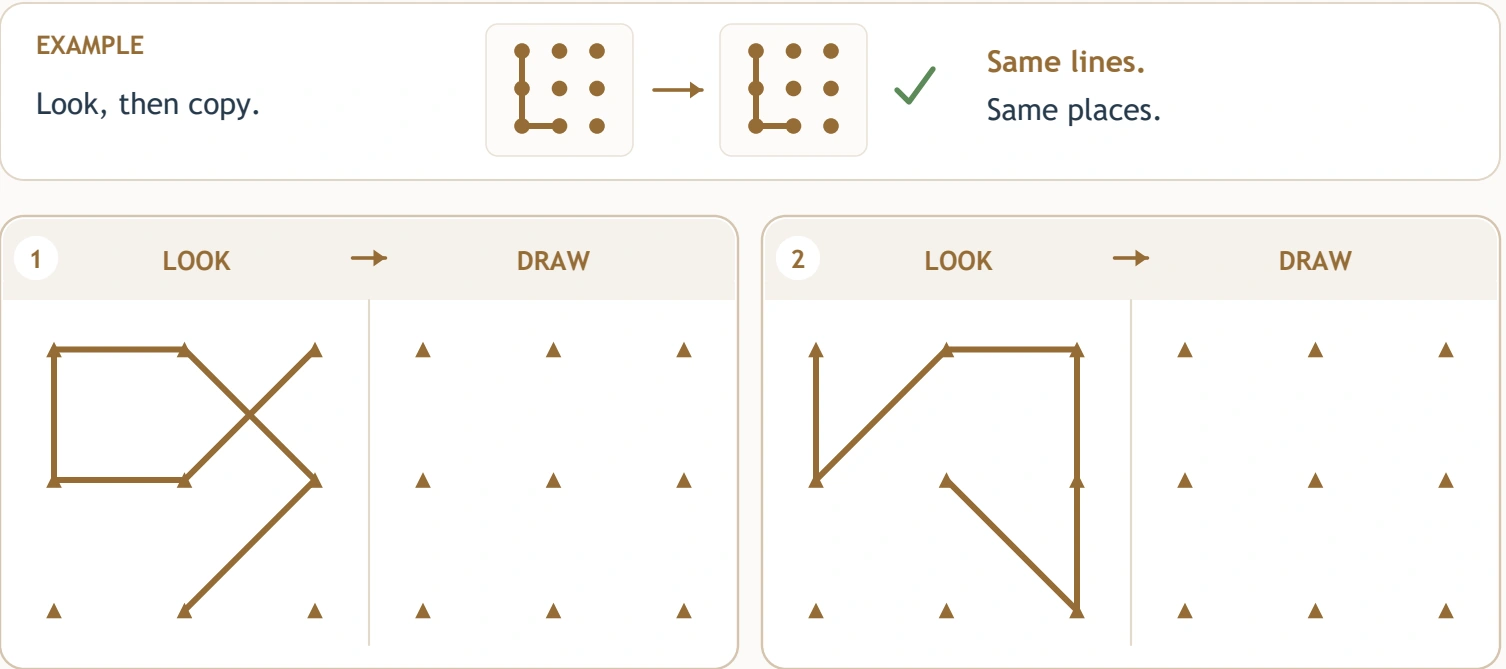
Read the demonstration as a transfer example: Little Triangle Markers
The small completed L shows how corresponding positions work. It does not supply the first practice answer, and its dot style differs from the triangular practice markers. Explain that the same copying principle can operate with different point symbols.
Keep Little Triangle Markers flat enough for the learner to glance between sides. Read the LOOK and DRAW words aloud, then let the child choose a starting place. The model should remain visible. Covering it would introduce a memory exercise, while drawing directly over it would avoid the transfer that gives this page its purpose.
Seven small skills in the triangle-marker task: Little Triangle Markers
- Symbol-role awareness. The child separates a location marker from the larger target drawing.
- Endpoint matching. A chosen triangle has a corresponding place in the partner field.
- Diagonal control. A planned slant travels between specific anchors rather than wandering toward a vague area.
- Visual selection. Unused markers stay unused when the model does not connect them.
- Crossing inspection. An overlap can be followed without adding a turn or a new destination.
- Part-by-part planning. A frame and an attached branch can be copied as manageable groups of strokes.
- Useful explanation. Words such as marker, model, open end and crossing make a child's decision easier to discuss.
During Little Triangle Markers, these are opportunities to practise, not seven demands to complete at once. A child may show strong position awareness while needing help with hand control. Recognise the accurate choice before suggesting a new way to attempt the movement.
Lola's sign-making table at home
Imagine Lola arranging triangular cardboard signs for a toy town. An adult sets out Little Triangle Markers; Lola begins colouring the little anchors because they resemble the signs. The adult points to a bold stroke and asks which two sign locations it reaches.
This home example is imagined rather than an account of results. Lola can decorate the toy signs freely after the comparison. For Little Triangle Markers, the adult helps choose one connection and leaves the other markers alone. A single successful distinction between the symbol and the line can make a sensible stopping point before more drawing is offered.
A classroom lesson in two visual jobs: Little Triangle Markers
For an imagined class session, a teacher places a large triangle token beside a long strip. The group discusses how one can mark a place and the other can join places. Children then inspect Little Triangle Markers and point to examples of those roles on their own sheets.
Each learner copies a chosen small part while the teacher watches whether the triangular markers guide the endpoints. Partners can describe a source line without drawing for one another. A note about distinguishing marker from model offers a specific follow-up. The amount completed across the six Little Triangle Markers panels can vary between children.
Six sign-studio games after copying
Connect two big signs: Little Triangle Markers
Place large triangular cards at several locations on a mat. Use a cord to join two selected cards, then ask a partner to recreate that connection on another mat. The physical task makes Little Triangle Markers's marker role visible without adding tiny tracing work.
Give a traveller one clear destination: Little Triangle Markers
Move a toy toward a named card while the child explains where it should stop. Add another nearby card and ask whether it belongs to the chosen journey. Keep this an invented game rather than pretending the worksheet includes a secret route code.
Separate tiny and large triangles
Arrange a small triangular marker beside a large three-sided strip outline. Discuss which is being used as a location and which is the object of attention. The same shape family can serve different jobs, a distinction that is useful when returning to Little Triangle Markers.
Make a model museum label: Little Triangle Markers
Let the child choose a completed stick arrangement and describe its unusual branch. An adult writes a finished label using the child's words. The language can remain informal, such as bent wing or open roof, as long as the exact copy still follows the reference.
Follow a crossing strip: Little Triangle Markers
Cross two paper strips and trace each separately with a finger. Talk about whether their ends meet at the overlap. This larger comparison can clarify why a long Little Triangle Markers slant should not automatically turn where another line crosses it.
Invent a different marker alphabet
On spare paper, use circles or stars as locations and connect a few into an original design. A partner copies it. Changing the marker shape while preserving the line pattern makes the distinction between anchors and model especially clear.
Correct the job, not the whole child: Little Triangle Markers
If a learner traces tiny triangles during Little Triangle Markers, show the intended connection again without treating the response as careless. The symbols are visually appealing, so the misunderstanding is understandable. A large off-page demonstration can explain more than repeating “copy the pattern” several times.
Other common errors are joining every marker, closing an open branch or following a nearby triangle that is not on the model's line. The bold drawing selects the connections. Compare one source segment with its copy. A small repair or an oral explanation can be enough when the paper has already become crowded with attempts.
Make another visit feel purposeful: Little Triangle Markers
The unusual triangular points may make Little Triangle Markers interesting to revisit. Offer a specific choice: inspect an open arm, try a frame or compare a crossing. Let the child decide the amount and accept a pause before pencil work becomes uncomfortable.
“You used the little triangle to find your landing” recognises a clear strategy. Keep a dated attempt if the learner wants to compare it later. Alternate Little Triangle Markers with sign-making, construction and free art so exact copying remains one enjoyable kind of drawing rather than the only way a child is allowed to make marks.
Save the file with the complete point fields: Little Triangle Markers
The free option supplies the original Little Triangle Dots sample. A clean Little Triangle Markers premium PDF is available separately through eligible active membership access: log into the appropriate account and request the member variant. That edition omits promotional website branding and domain text while retaining the practice markers and bold designs.
The related collection card leads to the entire thirty-sheet set, priced at $3 as a separate product. Save your authorised PDF and review the printer preview on US Letter paper. Choose Actual Size, or use 100% scaling, so Little Triangle Markers's small symbols retain their intended spacing. The full-page preview image is for browsing; the PDF is the printable activity.
Continue noticing what visual marks do: Little Triangle Markers
Compare Little Triangle Markers with Path Copy Thinking. After Little Triangle Dots, try Drawing Size Choices. For Little Triangle Dots, consider Shape Border Journeys.
For hands-on ideas surrounding Little Triangle Markers, adults can visit the NAEYC family collection on play. Another useful planning source is PBS Parents' everyday learning ideas. These outside educational resources are optional companions and do not form part of the worksheet purchase or member file.
Popular Worksheets
Printable resources families and teachers are downloading now.
 Free
 Free
 Free
 Free