
Snowflake Spoke Copies: 4 Joyful Centre Studies
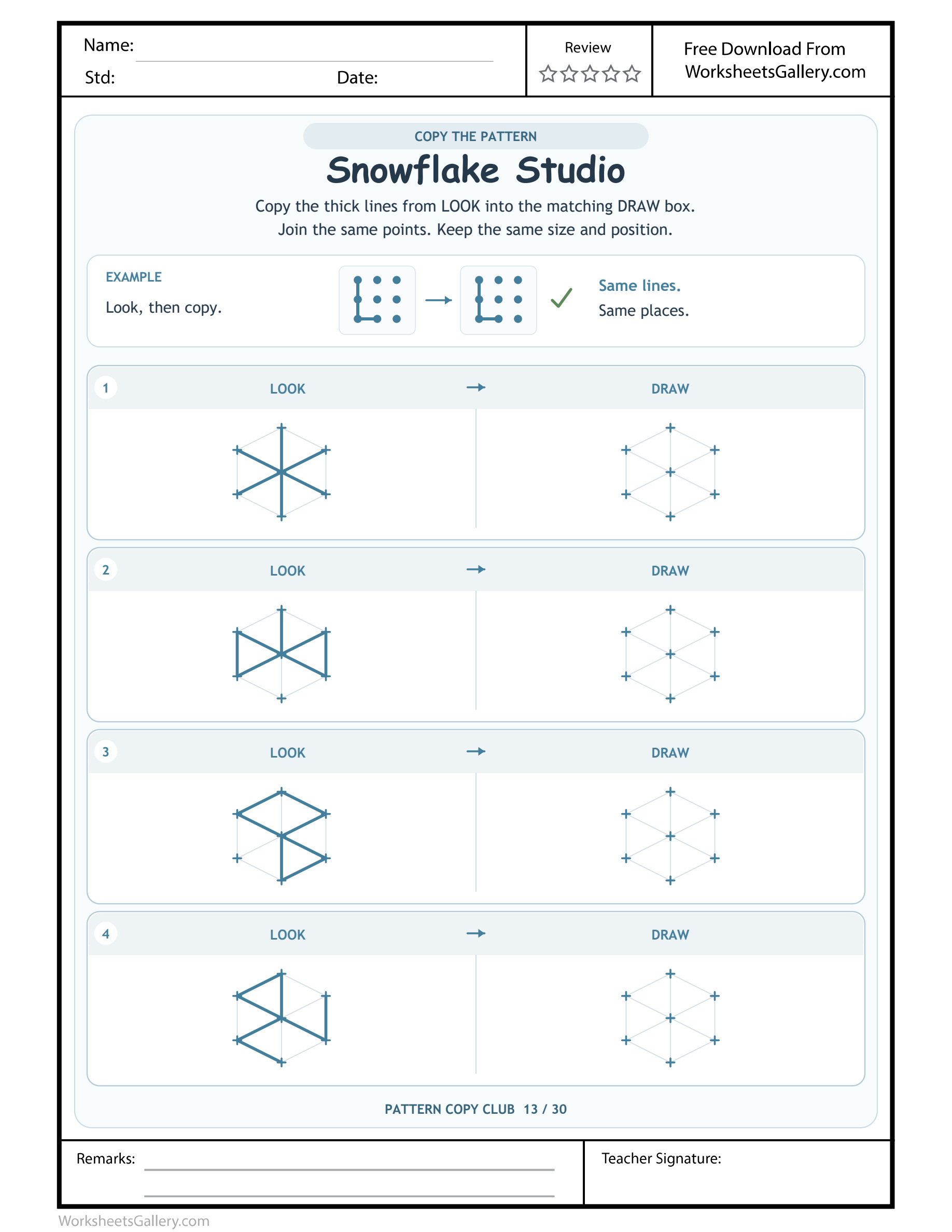
Snowflake Spoke Copies: Copy selected spokes and side segments without completing an imagined symmetrical snowflake.
Winter-looking lines invite children to notice what is present as well as what is absent. Snowflake Spoke Copies offers four blue spoke-and-angle models on seven-point fields, with a pale full scaffold beneath each pair. Children copy the selected bold strokes from LOOK into DRAW. The Snowflake Studio source begins with a completed example and changes the heavy-line arrangement in every panel. This printable is useful when a child enjoys radial designs but needs a reason to check the reference carefully, rather than add matching arms simply because a snowflake seems as though it should be symmetrical.
The title suggests winter; the model supplies the answer — Snowflake Spoke Copies
A child may expect every Snowflake Spoke Copies design to look like a balanced six-armed snowflake. The first model has six spokes, but the later patterns select different side connections and angular groups. The sheet asks for those particular printed arrangements, including any unused scaffold edges.
Discuss the winter association as a way into the activity, then inspect the actual lines. A missing-looking arm may be intentionally absent. If the learner wants to invent a fully symmetrical snowflake, provide another sheet for that creative task. Snowflake Spoke Copies keeps its purpose in matching the visible model, not improving it to fit an expectation.
Where the seven points sit
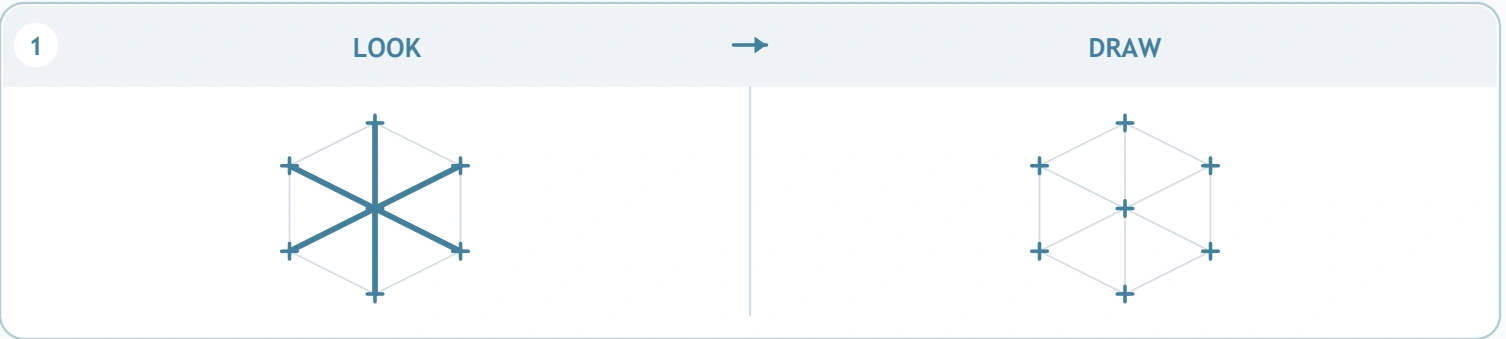
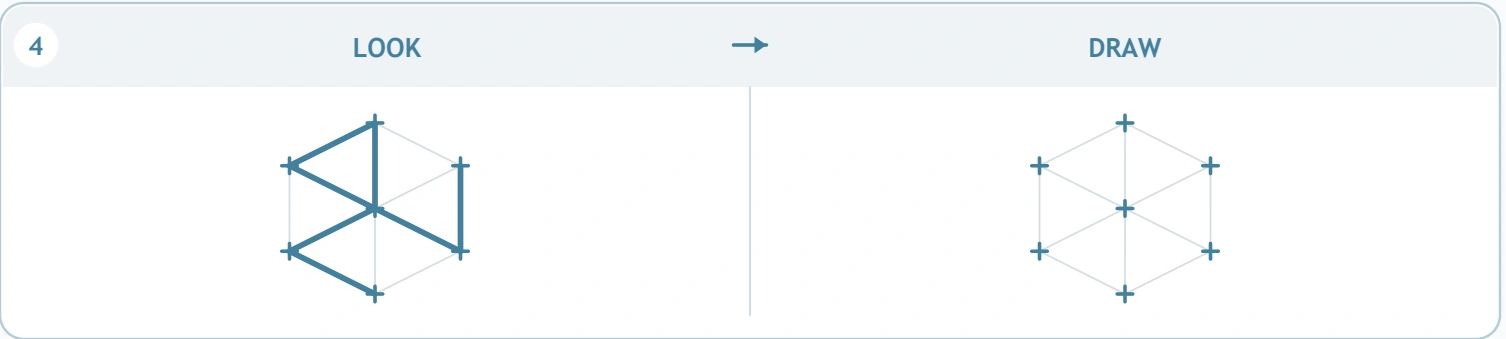
The Snowflake Spoke Copies field has six surrounding anchors and one central anchor. Their arrangement differs from a square grid: a top point, a bottom point and sloping side positions frame the middle. The small cross-like markers identify locations, while the bold blue segments indicate which locations belong together in each copy.
Both LOOK and DRAW retain a light complete network. Children can use it to locate corresponding places, but they should not automatically trace all of it. On Snowflake Spoke Copies, a pale edge remains background support until the bold model selects it. Confirm that distinction orally before asking for a dense group of strokes.
Inspect the four winter structures: Snowflake Spoke Copies
| Snowflake Spoke Copies pair | Visible Snowflake Studio model | Model structure |
|---|---|---|
| 1 | Six spokes through the centre | 7 anchors / 6 bold pieces in Snowflake Studio |
| 2 | Crossed diagonals with side uprights | 7 anchors / 7 bold pieces in Snowflake Studio |
| 3 | Two angular lobes sharing the centre | 7 anchors / 7 bold pieces in Snowflake Studio |
| 4 | Left angular lobes beside a right upright | 7 anchors / 7 bold pieces in Snowflake Studio |
The Snowflake Spoke Copies counts exclude pale guide lines. They identify the separate bold point-to-point pieces in the model rather than a prescribed number of hand movements. A child can connect several pieces smoothly or pause at a shared centre, provided the resulting copy preserves the intended endpoints and directions.
Start at the hub when it clarifies the picture
For the opening Snowflake Spoke Copies model, locate the central cross and compare its position in DRAW. Choose one surrounding destination and draw the spoke between the pair. Return to LOOK for the next selected direction. The first model's regularity can help establish the centre without assuming that later designs repeat it.
In another panel, an outside edge or angular lobe may provide a clearer starting part. Let the child choose a manageable group, then inspect how it relates to the centre. The activity has no numbered drawing route or compulsory one-stroke rule. Looking back and lifting the pencil are practical parts of copying.
Who may be comfortable with this visual field?: Snowflake Spoke Copies
Children in the preschool-to-early-primary range, often four to seven, can explore selected Snowflake Spoke Copies models with support. More important than the age is whether the learner can distinguish pale guides from heavy strokes and attempt a short line between chosen anchors. The later angular patterns may demand more attention than the first six-spoke model.
Offer only a few connections at first. If the field feels busy, use a large radial arrangement of strips to discuss centre and outer points. Snowflake Spoke Copies can be revisited once that larger comparison is comfortable. A child does not need to know how real snowflakes form to take part in this drawing task.
Six useful observations in a winter copy
- Radial position. The child distinguishes a shared centre from the surrounding endpoints.
- Selective tracing. Pale guide edges remain light unless the model includes them as bold segments.
- Direction planning. Each spoke or slant has a chosen destination, rather than radiating randomly from the middle.
- Comparison over expectation. A learner respects an asymmetrical selection instead of adding an imagined balancing arm.
- Junction control. Several strokes can meet at one anchor without spreading into nearby locations.
- Specific explanation. Words such as spoke, hub, outer edge and angular lobe help describe the printed structure.
Use Snowflake Spoke Copies to notice a strategy, not to make a broad judgement from one page. A child may point to the correct outer anchor while still finding the small pencil movement difficult. Recognise the sound choice, then decide together whether another attempt would feel helpful.
Milo's winter craft at home, imagined: Snowflake Spoke Copies
Imagine Milo making a paper snowflake collage with an adult. They place Snowflake Spoke Copies beside the craft and inspect a later model. Milo wants to add a matching arm on the other side because the collage has balanced branches. The adult asks whether the proposed arm is bold in LOOK.
This invented home scene illustrates the difference between a seasonal idea and an exact reference. Milo can make the collage as symmetrical as desired, then copy the selected worksheet connections separately. One preserved gap in Snowflake Spoke Copies can be a meaningful achievement, even if the remaining winter patterns are saved for another visit.
A classroom workshop about selected spokes: Snowflake Spoke Copies
For an imagined class use of Snowflake Spoke Copies, a teacher creates a large pale guide on a board and overlays a few dark strips. Children identify which connections are selected. The teacher then removes a strip and asks how a matching copy would need to change.
On individual worksheets, learners choose a small group of bold lines to transfer. The adult observes whether a child checks the model before adding another spoke. Record that action specifically. A learner who completes fewer Snowflake Spoke Copies segments but preserves the correct selection may be using a more useful strategy than someone who rapidly darkens the entire network.
Five snowflake-studio invitations: Snowflake Spoke Copies
Build a removable spoke wheel: Snowflake Spoke Copies
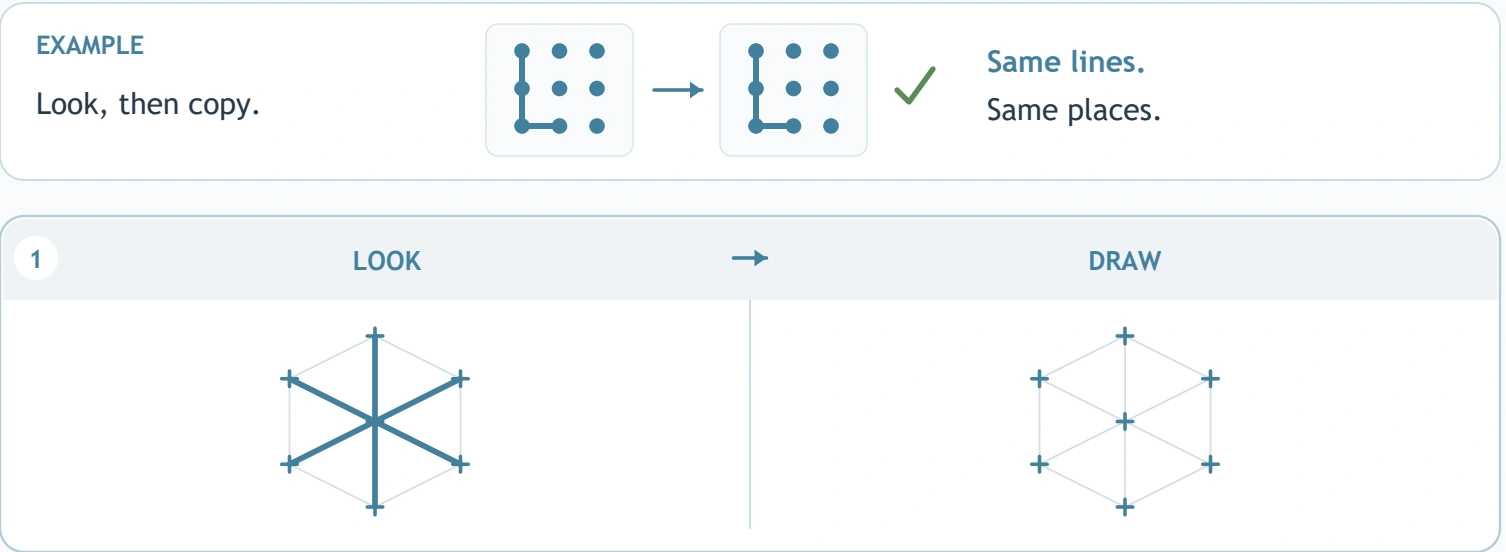
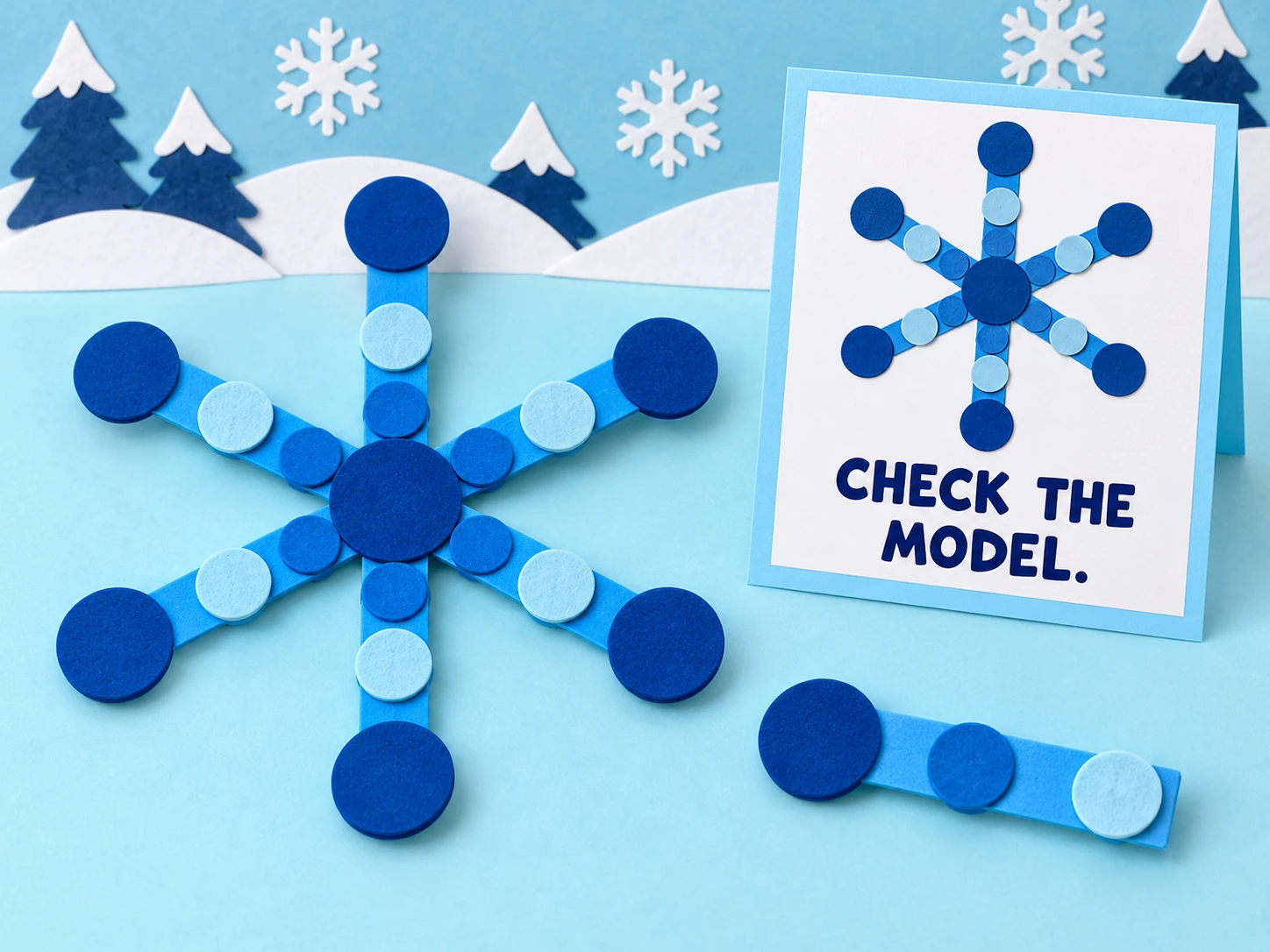
Place broad strips around a central disc. Remove one or two while leaving a visible reference nearby. A partner copies the selected set using another disc and strips. This gives the selection task in Snowflake Spoke Copies a larger physical form.
Tell the winter inspector's story: Snowflake Spoke Copies
Let a toy inspector visit a construction and ask which outer point a branch reaches. The child narrates the reply. Keep the character's questions focused on locations rather than speed, then relate one answer to a chosen Snowflake Spoke Copies model.
Compare balanced and unbalanced art: Snowflake Spoke Copies
Arrange two abstract strip designs, one balanced and one intentionally uneven. Discuss how both can be complete designs. This conversation can reduce the urge to add symmetry to a copying model that does not show it.
Make a guide-and-design overlay
Draw a light large scaffold on spare paper and place darker removable strips over selected connections. A partner recreates only the strips on another scaffold. The guide remains useful even where no dark line is added, just as in Snowflake Spoke Copies.
Invent a winter badge
After one accurate model comparison, design a new radial badge elsewhere. Give it a completed spoken or adult-written label. The child can enjoy invention and decoration while understanding that the printed worksheet asks for a particular set of connections.
Correct the selection before discussing neatness: Snowflake Spoke Copies
A common Snowflake Spoke Copies error is making every pale edge equally dark. Another is adding a symmetrical partner to an angular lobe or drawing a spoke through the centre to an unintended opposite point. Check whether the proposed line is selected in LOOK and compare both of its endpoints.
The centre is a landmark, not permission to add every ray. If a misplaced stroke is difficult to erase cleanly, explain the intended connection on spare paper or choose a fresh pair. Avoid filling the field with repeated dark corrections that make the pale guide harder for the child to interpret.
Plan a return around a single change
The winter appearance of Snowflake Spoke Copies can make repeated inspection pleasant, but returning need not mean finishing the sheet. Choose one useful question for the next session: which edge stays pale, where a lobe meets the centre, or how the final upright differs from the first radial model.
“You checked before adding the other arm” recognises the restraint that exact copying sometimes requires. Keep sessions brief, offer a choice of models and alternate Snowflake Spoke Copies with open-ended craft. A dated attempt can be compared later if the learner enjoys noticing a more deliberate endpoint or a clearer explanation.
Save a legible winter worksheet
The original Snowflake Studio sample is supplied through the free download control. The clean Snowflake Spoke Copies premium PDF uses the separate member flow: an account with eligible active membership can request that variant after login. Its page has no website watermark, domain text or promotional advertisements; the pale scaffold and blue models are preserved.
The native package card opens all thirty copying sheets as a separate $3 collection. Save the file your access authorises, then inspect a US Letter print preview with Actual Size or 100% selected. A test print can confirm that pale and bold lines remain distinguishable. Keep Snowflake Spoke Copies's full page scale so the shared junctions are comfortable to inspect.
Extend the season into other kinds of play: Snowflake Spoke Copies
Compare Snowflake Spoke Copies with Drawing Size Choices. After Snowflake Studio, try Shape Border Journeys. For Snowflake Studio, consider Path Copy Thinking.
For general play-based ideas alongside Snowflake Spoke Copies, adults can explore NAEYC resources for playful family learning. Another source of optional home activities is the PBS Parents Learn and Grow library. These external education sites are independent reading resources, not additional content included in the worksheet file.
Popular Worksheets
Printable resources families and teachers are downloading now.
 Free
 Free
 Free
 Free