
Qq Letter Quest: 3 Wonderful Quilt-and-Queen Clues
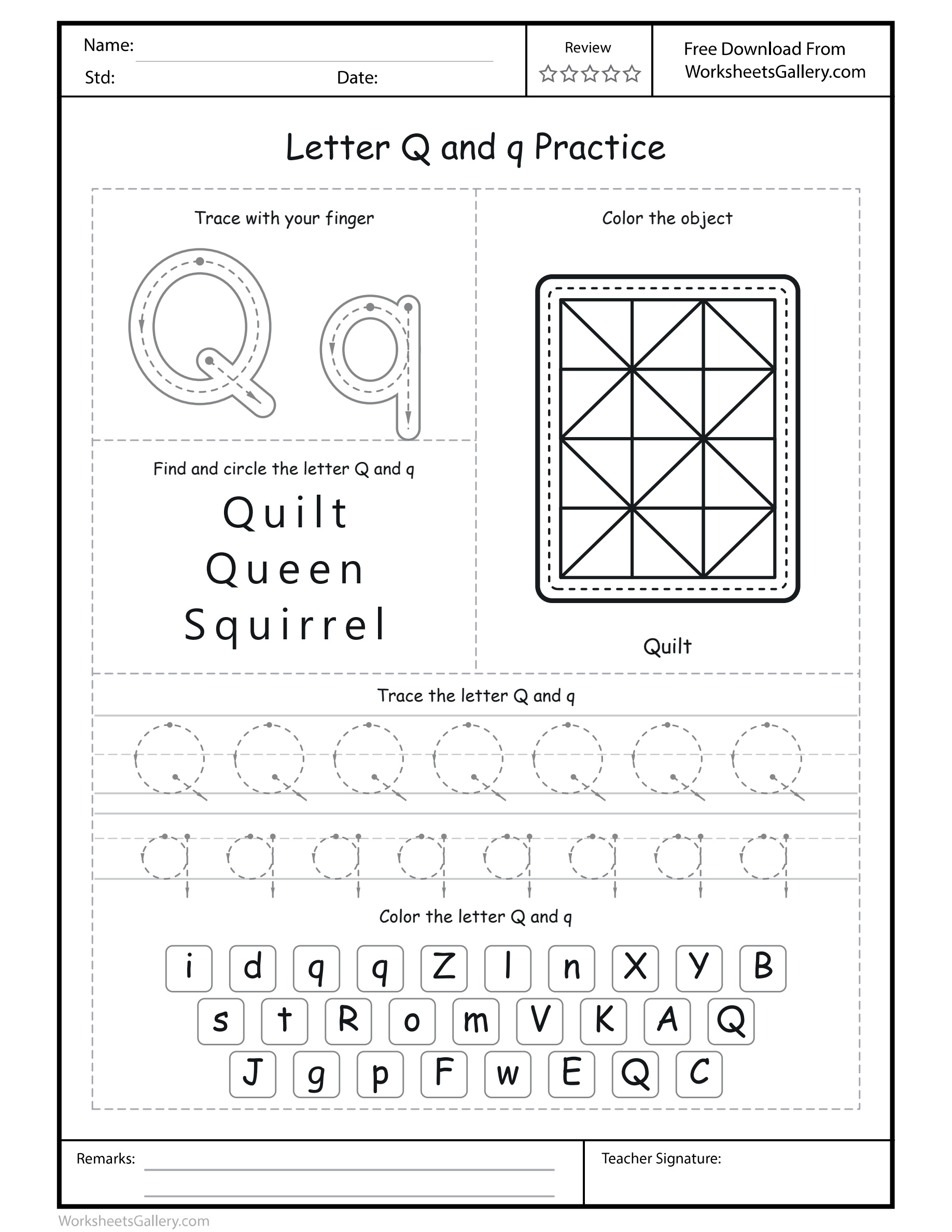
Qq Letter Quest belongs to the 26-page collection. Find q in Squirrel and keep the letter search separate from learning the qu spelling unit.
Squirrel brings q into the middle of a familiar animal label. Qq Letter Quest pairs that quieter discovery with Quilt and Queen, whose capital Q stands at the front. The letter family has tails worth inspecting: a short capital tail and a lowercase stem that descends beside its bowl. Children can compare the models, colour a quilt and search printed words with adult reading support. A few chosen traces and a complete tile sweep offer further practice, with time to notice why a candidate fits rather than simply collecting quick circles.
Open the quilt pocket with three labels — Qq Letter Quest
Read Quilt, Queen and Squirrel in Qq Letter Quest. Quilt begins with Q, Queen begins with Q, and Squirrel contains q as its second character, just after S. This explicit word panel has three target letters. Each belongs inside its own character-sized circle, leaving the remaining letters visible.
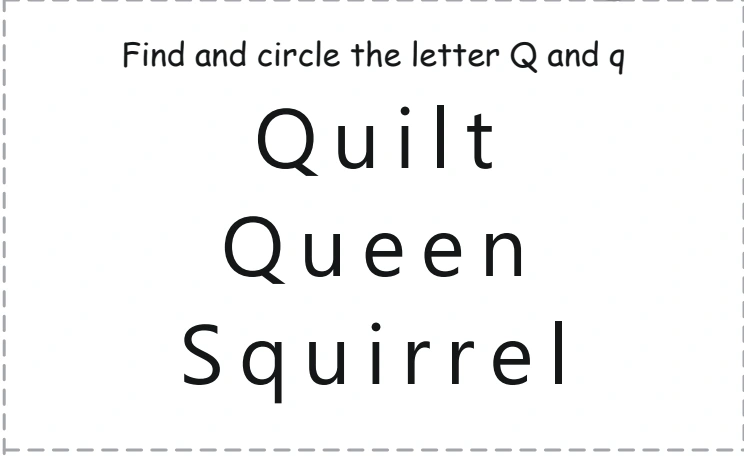
The q in Squirrel is easy to overlook when attention stays on the first character. Slide a finger one place beyond S and compare the printed form with the lowercase model. An adult can supply the whole word while a child supplies the shape decision. Independent reading of Squirrel is not required to make that observation.
| Word to read aloud | Target | Useful comparison |
|---|---|---|
| Quilt | First Q | Find the capital's short tail. |
| Queen | First Q | Match another capital opening. |
| Squirrel | Second q | Inspect the lowercase stem after S. |
These labels also contain the spelling pair qu. Qq Letter Quest does not require a separate lesson on that unit to complete its visual search. Name the letter Q and read the words naturally. If the child asks about sounds, answer briefly and accurately without turning the circle task into a new decoding exercise.
Two tails, two case forms: Qq Letter Quest
Study the large pair on Qq Letter Quest. Capital Q has a round body with a short tail. The supplied lowercase q has a bowl and a descending stem. Point to the tail or lower reach before tracing so the learner knows which small feature distinguishes the form being followed.
The printed arrows and start cues show the route to use. A finger can preview it while the other hand rests. For the capital, notice that a closed round form alone is incomplete without the tail. For lowercase q, compare the bowl and the side of its stem together rather than judging from a curve in isolation.
If p or another rounded form is selected, bring its actual shape into comparison with the q model. In Qq Letter Quest, orientation supplies useful evidence. Avoid a rapid list of mnemonic rules when one direct side-by-side inspection would let the learner see the difference and explain it through pointing.
A home quilt label, imagined: Qq Letter Quest
Imagine Quin helping a family member display a small quilt. The adult provides a finished Quilt label, reads it and places Qq Letter Quest nearby. Quin points to the first Q and notices its tail. A Queen card offers another capital opening, which he compares without needing to read the complete word alone.
Squirrel is the surprise card. Quin first selects S because it begins the label. The adult names S, then asks whether q could be immediately after it. Quin brings the lowercase model into view and inspects the second character. He notices the stem below the bowl and changes his choice.
The family member describes the evidence he used rather than praising speed. This imagined visit can finish with a colour choice for the quilt picture. It gives Qq Letter Quest a familiar display setting while keeping the learner's print comparison distinct from the adult's word reading.
Six pieces of evidence to value: Qq Letter Quest
Interior searching. Squirrel requires one step beyond its first character. Qq Letter Quest lets a child show that a known letter can occur inside a word with a different opening.
Case identity. The two capital labels and one lowercase label connect Q with q. Naming the forms together helps link their identity while retaining their different tails and proportions.
Attention to a small extension. Capital Q's tail changes a round outline into the supplied letter. A learner can point to that feature as a reason for choosing a tile.
Orientation checking. The lowercase bowl and descending stem need to be considered together. Qq Letter Quest provides a nearby model whenever a rounded candidate feels uncertain.
Hand movement planning. Finger tracing separates learning the route from managing pencil pressure. The child can rehearse a curve and extension before making a smaller mark.
Useful revision. An initial choice can be reconsidered through model comparison. That action gives the learner a role in improving the answer rather than waiting for an adult to replace it.
The quilt invites its own pattern: Qq Letter Quest
The quilt object on Qq Letter Quest is available for colouring without a prescribed palette. A child may choose repeating colours, a patchwork mixture or a single favourite shade. Ask about one decision and allow the picture to remain a creative space rather than adding an invented colour-answer key.
If the child wants to plan a pattern, use a completed spoken example such as “red, blue, red, blue.” There is no need to add blank labels or new written tasks over the source exercise. Keep the word panel legible so the three target positions can be revisited after the picture pause.
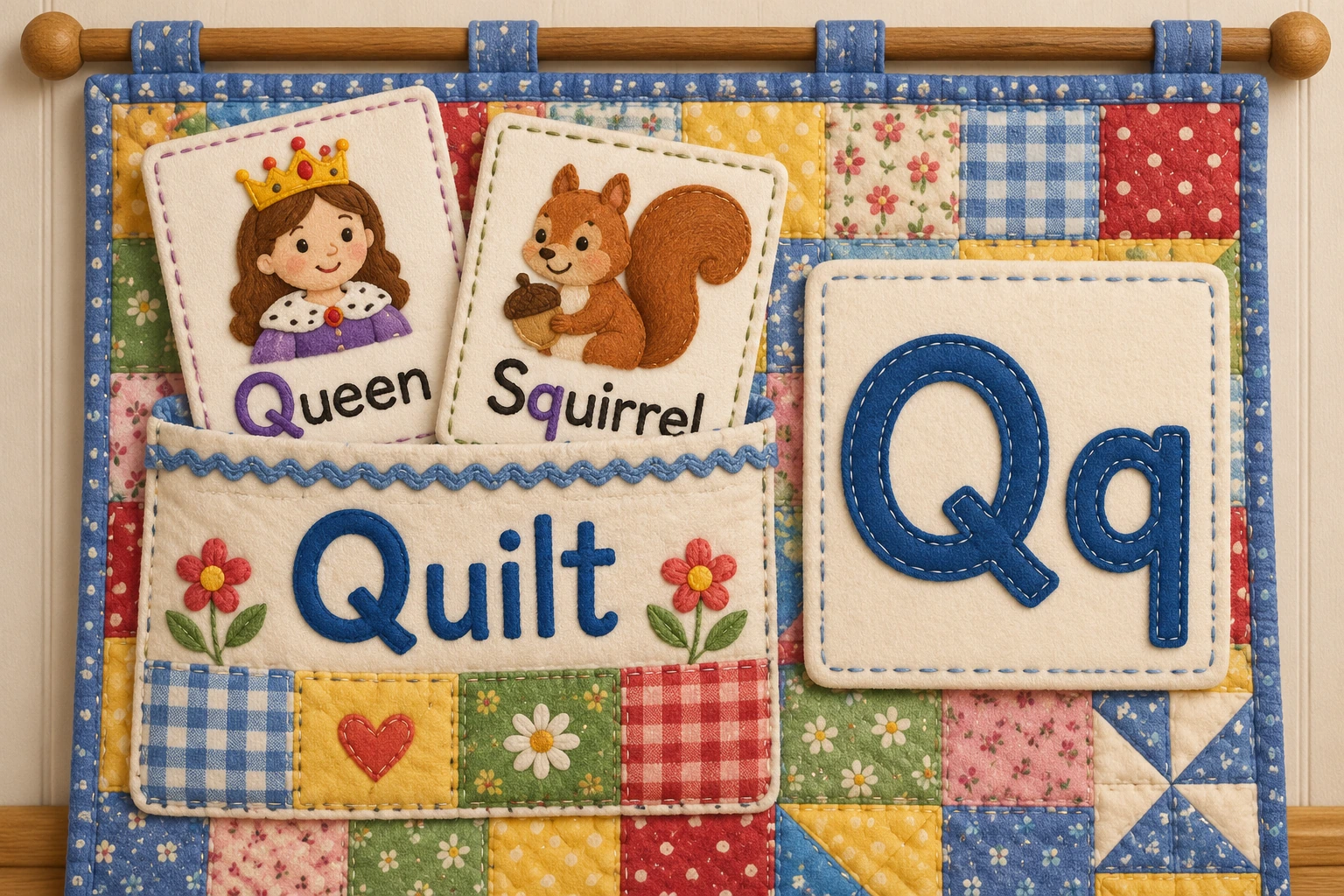
The supporting quilt-pocket illustration displays completed Queen and Squirrel cards with a Q/q reference. Its coloured q can make the interior position easier to discuss. Return to the unhighlighted print in Qq Letter Quest afterward, where the learner can apply the same observation without the colour cue.
Plan a few tail-aware traces: Qq Letter Quest
Seven uppercase guides and eight lowercase guides appear in the handwriting area of Qq Letter Quest. Choose a few that match the child's present hand comfort. Preview the tail and stem positions before starting, then compare one attempt with the large model instead of requiring the whole row immediately.
If a capital remains an O-like outline, point to the short extension in the model. If a lowercase stem rises or sits on the wrong side, compare the orientation before another try. A fresh guide can be more useful than repeatedly erasing one attempt. Keep the sheet steady and pressure modest.
Ask the child to show the part they want to remember for next time. A gesture toward the tail is enough. Qq Letter Quest can be revisited in short intervals, with movement, picture conversation and word inspection spread across different encounters rather than squeezed into one long sitting.
Four targets in the mixed-letter field: Qq Letter Quest
The tile search on Qq Letter Quest contains twenty-seven characters, arranged ten, nine and eight across its rows. Two Q forms and two q forms are targets. Adult whole-field checking positions are 3, 4, 19 and 26. Children can inspect visually with the models nearby; the coordinates are for adult verification.
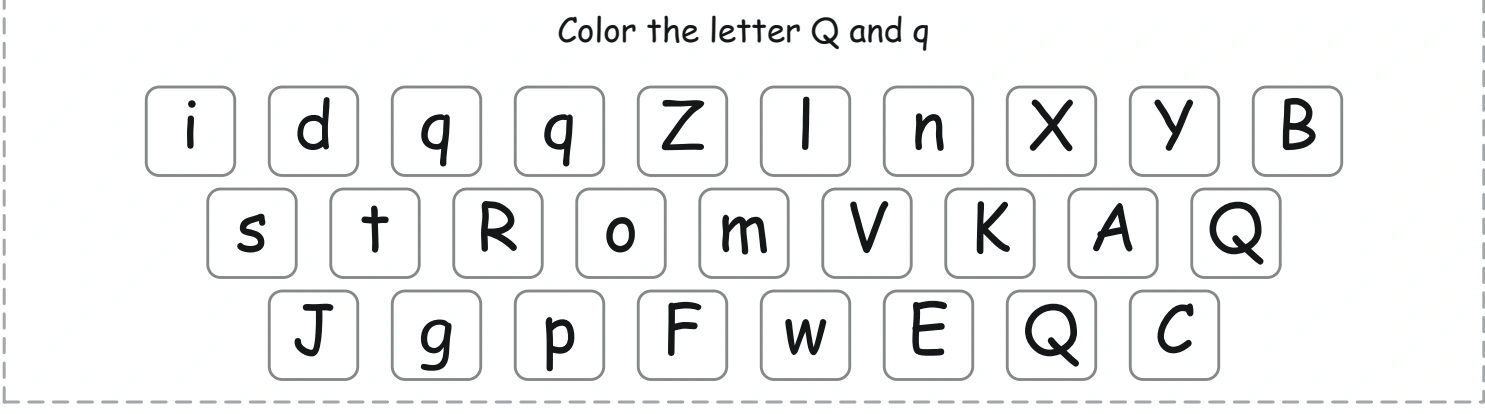
The early neighbouring targets make continuing after a find especially helpful. Compare one candidate, mark it if appropriate, and inspect the next character rather than jumping ahead. Use a pointer to mark the q candidate being inspected before consulting the Q/q models.
Look for the complete body-and-tail relationship. A round letter without the capital's tail or a differently oriented lowercase stem should be compared carefully. Qq Letter Quest can make uncertainty productive: ask which feature seems to fit, then see whether that reason survives a closer look at the model.
A classroom royal post, imagined: Qq Letter Quest
Picture Quin helping deliver pretend post in class. The teacher reads Queen on a completed address card and asks him to match its first Q with Qq Letter Quest. Another envelope reads Squirrel. Quin follows its print beyond S and points to q, recalling that the target need not start the label.
A partner notices the capital's tail, while Quin shows the lowercase stem. The teacher lets each child demonstrate one feature to the other. No child has to read the long animal label independently, and no score depends on answering before a partner.
The group returns to one tile row, keeping the two models visible. The teacher records whether Quin used orientation to review a rounded candidate. This imagined classroom route gives the worksheet an active social use, with a specific observation to guide the next encounter rather than a demand for immediate fluency.
Five Q/q pocket games: Qq Letter Quest
Quilt card keeper: Qq Letter Quest
Read a completed Quilt card beside a quilt picture. Invite the learner to park the capital model beside Q, then show the same opening on Qq Letter Quest. The picture gives meaning while the printed tail gives letter evidence.
Second-place squirrel: Qq Letter Quest
Track a completed Squirrel label from its first character to its second. Compare q with the model and stop there. Naming every other character is optional; the game is about locating this interior target.
Tail builder: Qq Letter Quest
Make a closed cord loop with a short separate strip positioned as the capital tail. Compare the finished Q construction with the supplied model. Clear it away before following the printed handwriting arrows.
Queen's model tour: Qq Letter Quest
Let a puppet ask to see capital Q and lowercase q on Qq Letter Quest. The child can point to both and show how their tails differ. A partner supplies the letter names if needed, keeping the tour cooperative.
Neighbour pocket check: Qq Letter Quest
After a tile match, inspect its neighbour before putting a token in a pretend pocket. The token celebrates a completed comparison, not speed. Continue through the row while the models stay visible.
Match the help to the actual question: Qq Letter Quest
For children approximately three to six, Qq Letter Quest may involve adult reading and shared pointing, assisted circles or a more independent search. A child who identifies q confidently may still need help controlling its descending stroke. Let recognition and handwriting be observed separately when choosing the next action.
If Squirrel is treated as target-free, track after S. If a capital has no tail, compare the model's extension. If lowercase orientation is reversed, inspect the stem's side. If a whole word receives a circle, demonstrate a smaller loop on a separate completed example. Each response addresses a visible issue rather than a general label of difficulty.
Return to Qq Letter Quest with a remembered feature, perhaps “the little tail” or “the letter after S.” Let the learner select a short section to revisit. Regular, comfortable encounters can keep print interesting while giving a specific detail repeated attention. Stop before the activity turns into an argument over finishing.
Further ideas and file access: Qq Letter Quest
Compare Qq Letter Quest with Qq Worksheet. A listening follow-up to Qq Letter Quest is First Sound Choices. For Qq Letter Quest, explore Rr Worksheet.
For an adult perspective on participatory learning, consult NAEYC's play topic pages. PBS Parents' literacy resources offer shared reading and conversation ideas. These optional links can inform an extension while the source sheet retains its own clear instructions.
Use the page controls for the original Qq Letter Quest sample. Eligible active members can also reach the protected clean single-sheet PDF. Before printing, check that the full frame fits and that the small Q tail and lowercase descenders remain visible. Those details are central to the comparisons described here.
The collection card connects this page to the separate $5 Alphabet Wordwork Collection, a combined PDF of all twenty-six clean letter worksheets. It offers a convenient full sequence when wanted. Membership access to this individual clean file does not itself purchase the collection; the two routes remain distinct and clearly available from Qq Letter Quest.
Popular Worksheets
Printable resources families and teachers are downloading now.
 Free
 Free
 Free
 Free