
Rainbow Dot Routes: 5 Joyful Color-Code Missions
Take the rainbow route into the complete $3 collection. The single download gathers 25 clean picture-key sheets, including these coloured-dot journeys and the later object and texture fields.
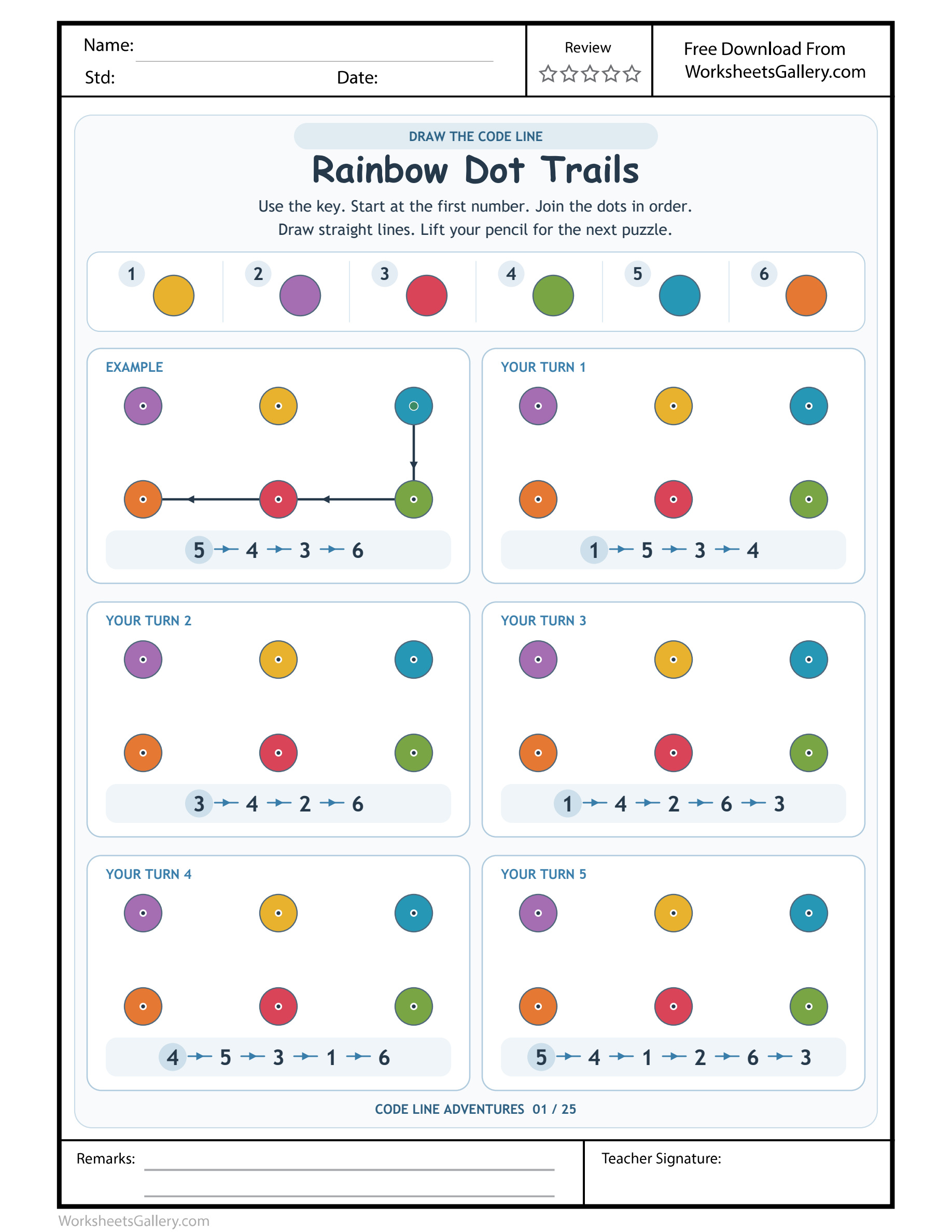
Yellow does not always mean “first,” even on a rainbow page. In Rainbow Dot Routes, six coloured circles become destinations, and each short number code chooses the order of travel. Children use the legend above the puzzles to turn a numeral into a colour, locate its centre dot and draw a straight connection. Five independent routes offer several chances to practise that decision. The appealing colour palette keeps the task approachable, while a useful surprise waits in the instructions: the journey follows its printed code, rather than the familiar counting sequence.
Read the colour, then choose the movement — Rainbow Dot Routes
The main challenge in Rainbow Dot Routes is separating two orders. The legend displays numbers one through six, but the puzzle may request one, five, three and four. The six circles inside a field occupy fixed places on this sheet; those positions are not a numbered reading row. A child has to refer upward, find the colour, then return to the correct drawing box.
Try saying, “The code chooses; the colour tells us where.” During Rainbow Dot Routes, pointing to teal for five is a useful response even before a pencil is picked up. Keep the key uncovered. Remembering every match is optional; learning to consult the printed reference is part of the activity.
Rainbow Dot Routes legend at a glance
| Rainbow Dot Trails numeral | Keyed picture |
|---|---|
| 1 | yellow circle |
| 2 | purple circle |
| 3 | red circle |
| 4 | green circle |
| 5 | teal circle |
| 6 | orange circle |

Rainbow Dot Routes example before independent drawing
Rainbow Dot Trails demonstrates 5 → 4 → 3 → 6. The Rainbow Dot Trails itinerary is teal circle → green circle → red circle → orange circle. In Rainbow Dot Trails, the green start selects teal circle. Rainbow Dot Trails arrows lead to orange circle. Rainbow Dot Trails has 3 worked segments. The Rainbow Dot Routes example supports finger rehearsal. Inspect the Rainbow Dot Trails practice strip separately.
Rainbow Dot Routes — practice 1
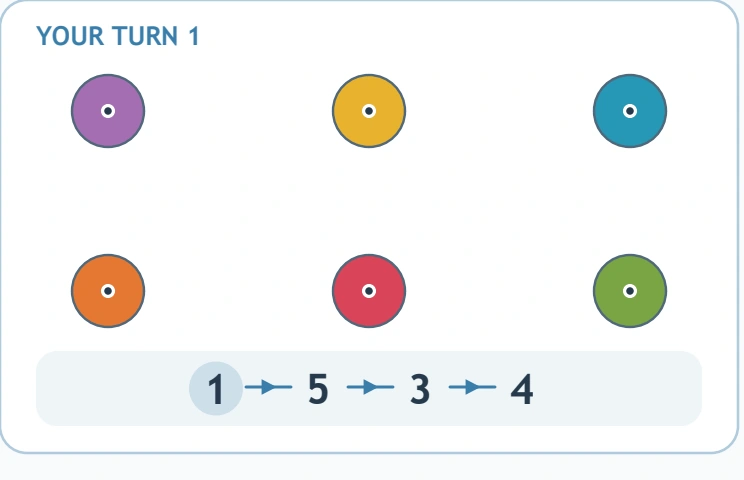
Practice 1 on Rainbow Dot Trails: 1 → 5 → 3 → 4. Translate those Rainbow Dot Routes destinations as yellow circle → teal circle → red circle → green circle. Begin on yellow circle for Rainbow Dot Trails; next locate teal circle. The Rainbow Dot Trails centre-to-centre connections are yellow circle to teal circle; teal circle to red circle; red circle to green circle. Segment count for Rainbow Dot Routes: 3, from 4 listed stops. The Rainbow Dot Trails endpoint is green circle. Against the Rainbow Dot Trails strip, verify final 4.
Rainbow Dot Routes leaves purple circle, orange circle outside practice 1. Leave these Rainbow Dot Trails alternatives unvisited. Practice 1 for Rainbow Dot Trails requests 1 → 5 → 3 → 4.
Rainbow Dot Routes — practice 2
Practice 2 on Rainbow Dot Trails: 3 → 4 → 2 → 6. Translate those Rainbow Dot Routes destinations as red circle → green circle → purple circle → orange circle. Begin on red circle for Rainbow Dot Trails; next locate green circle. The Rainbow Dot Trails centre-to-centre connections are red circle to green circle; green circle to purple circle; purple circle to orange circle. Segment count for Rainbow Dot Routes: 3, from 4 listed stops. The Rainbow Dot Trails endpoint is orange circle. Against the Rainbow Dot Trails strip, verify final 6.
Rainbow Dot Routes leaves yellow circle, teal circle outside practice 2. Leave these Rainbow Dot Trails alternatives unvisited. Practice 2 for Rainbow Dot Trails requests 3 → 4 → 2 → 6.
Rainbow Dot Routes — practice 3
Practice 3 on Rainbow Dot Trails: 1 → 4 → 2 → 6 → 3. Translate those Rainbow Dot Routes destinations as yellow circle → green circle → purple circle → orange circle → red circle. Begin on yellow circle for Rainbow Dot Trails; next locate green circle. The Rainbow Dot Trails centre-to-centre connections are yellow circle to green circle; green circle to purple circle; purple circle to orange circle; orange circle to red circle. Segment count for Rainbow Dot Routes: 4, from 5 listed stops. The Rainbow Dot Trails endpoint is red circle. Against the Rainbow Dot Trails strip, verify final 3.
Rainbow Dot Routes leaves teal circle outside practice 3. Leave these Rainbow Dot Trails alternatives unvisited. Practice 3 for Rainbow Dot Trails requests 1 → 4 → 2 → 6 → 3.
Rainbow Dot Trails — practice 4
Practice 4 on Rainbow Dot Trails: 4 → 5 → 3 → 1 → 6. Translate those Rainbow Dot Routes destinations as green circle → teal circle → red circle → yellow circle → orange circle. Begin on green circle for Rainbow Dot Trails; next locate teal circle. The Rainbow Dot Trails centre-to-centre connections are green circle to teal circle; teal circle to red circle; red circle to yellow circle; yellow circle to orange circle. Segment count for Rainbow Dot Routes: 4, from 5 listed stops. The Rainbow Dot Trails endpoint is orange circle. Against the Rainbow Dot Trails strip, verify final 6.
Rainbow Dot Routes leaves purple circle outside practice 4. Leave these Rainbow Dot Trails alternatives unvisited. Practice 4 for Rainbow Dot Trails requests 4 → 5 → 3 → 1 → 6.
Rainbow Dot Trails — practice 5
Practice 5 on Rainbow Dot Trails: 5 → 4 → 1 → 2 → 6 → 3. Translate those Rainbow Dot Routes destinations as teal circle → green circle → yellow circle → purple circle → orange circle → red circle. Begin on teal circle for Rainbow Dot Trails; next locate green circle. The Rainbow Dot Trails centre-to-centre connections are teal circle to green circle; green circle to yellow circle; yellow circle to purple circle; purple circle to orange circle; orange circle to red circle. Segment count for Rainbow Dot Routes: 5, from 6 listed stops. The Rainbow Dot Trails endpoint is red circle. Against the Rainbow Dot Trails strip, verify final 3.
Rainbow Dot Trails uses every Rainbow Dot Routes entry in practice 5 of Rainbow Dot Trails: 5 → 4 → 1 → 2 → 6 → 3. First Rainbow Dot Trails selection: teal circle; final selection: red circle.
A manageable start for a young colour explorer
Around ages four to seven, Rainbow Dot Routes can suit children who are beginning to recognise small numerals and control deliberate pencil strokes. Readiness varies. If numeral names are unfamiliar, an adult can read them aloud while the child performs the colour match. If the colour differences are difficult to distinguish, use a larger, clear colour print and identify each position together.
Begin Rainbow Dot Routes with one practice box, a comfortable pencil and room for the other hand to steady the paper. Do a finger journey before drawing. A child who is confident in colour lookup but tires during longer strokes can tell an adult the route instead. Separate the thinking demand from hand endurance rather than treating both as one pass-or-fail task.
Six gains you can actually notice
Referring to a visible source
When Rainbow Dot Routes sends a child back to the legend, notice the deliberate checking. This is an opportunity to find information, not a memory contest. You might ask what made the teal circle the right choice and listen for a reference to five.
Looking beyond the nearest circle
A nearby circle can be tempting. Rainbow Dot Routes gives a reason to ignore proximity and look for the symbol requested by the current numeral. Praise a correct distant selection, especially when the child paused to locate it before moving the hand.
Keeping two consecutive stops in mind
Work with pairs during Rainbow Dot Routes: yellow to teal, then teal to red. A route becomes less burdensome when the child need not hold the entire strip in memory. A finger resting under the present numeral can make that pair visible.
Landing near a purposeful target
Each white centre in Rainbow Dot Routes supplies a small landing place. Aim for an intentional stroke that arrives near it; avoid insisting on mechanical straightness. Watch for a controlled beginning and a slowing hand rather than judging the picture's neatness alone.
Explaining a colour decision
Invite a brief account of Rainbow Dot Routes: “Five showed me teal.” Saying the numeral and colour together can reveal a mismatch quickly. Accept pointing or familiar home-language colour words when those communicate the intended selection more comfortably.
Stopping when the instruction ends
The last numeral in Rainbow Dot Routes matters as much as the first. Leaving an unlisted circle untouched requires restraint. A finished route need not visit the whole rainbow, return to its origin or become a closed shape; its code determines completion.
Anya's kitchen-table detour, imagined
Imagine Anya trying Rainbow Dot Routes while a parent sits beside her. She says “one, two” out of habit and reaches for purple after yellow. Her parent does not erase the whole attempt. They point to the second printed numeral, five, then find teal in the legend. Anya finger-traces the yellow-to-teal connection and draws that single corrected segment.
Afterwards, Anya chooses whether to continue Rainbow Dot Routes or save the other fields. The parent describes the recovery: she used the code to change her decision. That small observation keeps the mistake tied to one lookup, with room for another attempt later.
A classroom colour courier, imagined
At a small-group table, a teacher introduces Rainbow Dot Routes with a pretend message that must visit named colour stations. One child reads a numeral, another finds its legend colour, and a third points inside the selected panel. They switch roles after a short route, so no child spends the whole session copying a partner's finished drawing.
The teacher uses Rainbow Dot Routes to observe where help is needed. A child who chooses colours correctly but loses their place in the code gets a tracking finger. Another who understands the strip but overshoots a centre gets time for a slow finger rehearsal. Their supports follow different needs.
Four colourful games away from the worksheet
Send a two-colour message
Set out large yellow, teal and red cards for a Rainbow Dot Routes follow-up. Say just two colour names and ask the child to touch them in order. Trade roles and let the child check your response. Keep this spoken game distinct from the printed number code.
Find a missing explanation
Point to a completed Rainbow Dot Routes segment and say, “I know the start, but why did you go there?” Let the child show the relevant numeral. The puzzle becomes an invitation to explain a decision, with no need to add more marks or finish another box.
Arrange a rainbow delivery tray
Use labelled colour tokens inspired by Rainbow Dot Routes, with all words or numerals written clearly. A toy courier carries a message through the chosen tokens. Change the order of two tokens and discuss how the spoken journey changes even though the colours stay the same.
Draw a route in the air
Pick a short Rainbow Dot Routes code and indicate its destinations with broad arm movements before returning to paper. Adults can help keep the order visible. The larger gesture offers a different way to rehearse a stop-and-turn movement without demanding another small pencil drawing.
Correct a rainbow shortcut without removing the fun
Common Rainbow Dot Routes mix-ups include counting upward automatically, using the example's line in a practice box, and connecting every circle because it is visible. Ask the child to identify the first point where their drawing and the route strip disagree. Review that pair before considering the rest of the path.
Keep each puzzle independent. In Rainbow Dot Routes, the pencil lifts before the next field begins. Repeated visits can be short: one box today, another after a colour story tomorrow. Offer a choice of starting panel, let the child request help, and celebrate a careful lookup rather than rewarding speed or demanding a flawless page.
Save and print the version you choose
Use the page's original sample option for the supplied worksheet, or use a qualifying active membership after signing in to download the clean Rainbow Dot Routes premium PDF. That clean printable has no watermark, no website domain and no ads on the sheet. The separately offered $3 collection combines all twenty-five themes in one purchase.
After downloading Rainbow Dot Routes, open the PDF and inspect the portrait print preview. Preserve the complete frame and colour key; a fit-to-page adjustment may be useful for your printer. Print one clear copy, place it flat and keep the legend visible while the child works.
More invitations for reference-based play
Compare Rainbow Dot Routes with Castle Color Codes. After Rainbow Dot Trails, try Number Letter Switching. For Rainbow Dot Trails, consider Exact Path Detective.
Adults extending Rainbow Dot Routes can explore NAEYC's family learning ideas for shared activities and PBS Parents resources for playful conversation. Use these broader educational sources as optional inspiration around your child's interests, alongside the specific colour-code instructions printed here.
Popular Worksheets
Printable resources families and teachers are downloading now.
 Free
 Free
 Free
 Free