
Shape Key Trails: 5 Brilliant Playground Connections
Keep the playground shapes beside 24 other themes for $3. One clean collection PDF offers these five shape routes together with fruit, weather, robot and other numbered-picture activities.
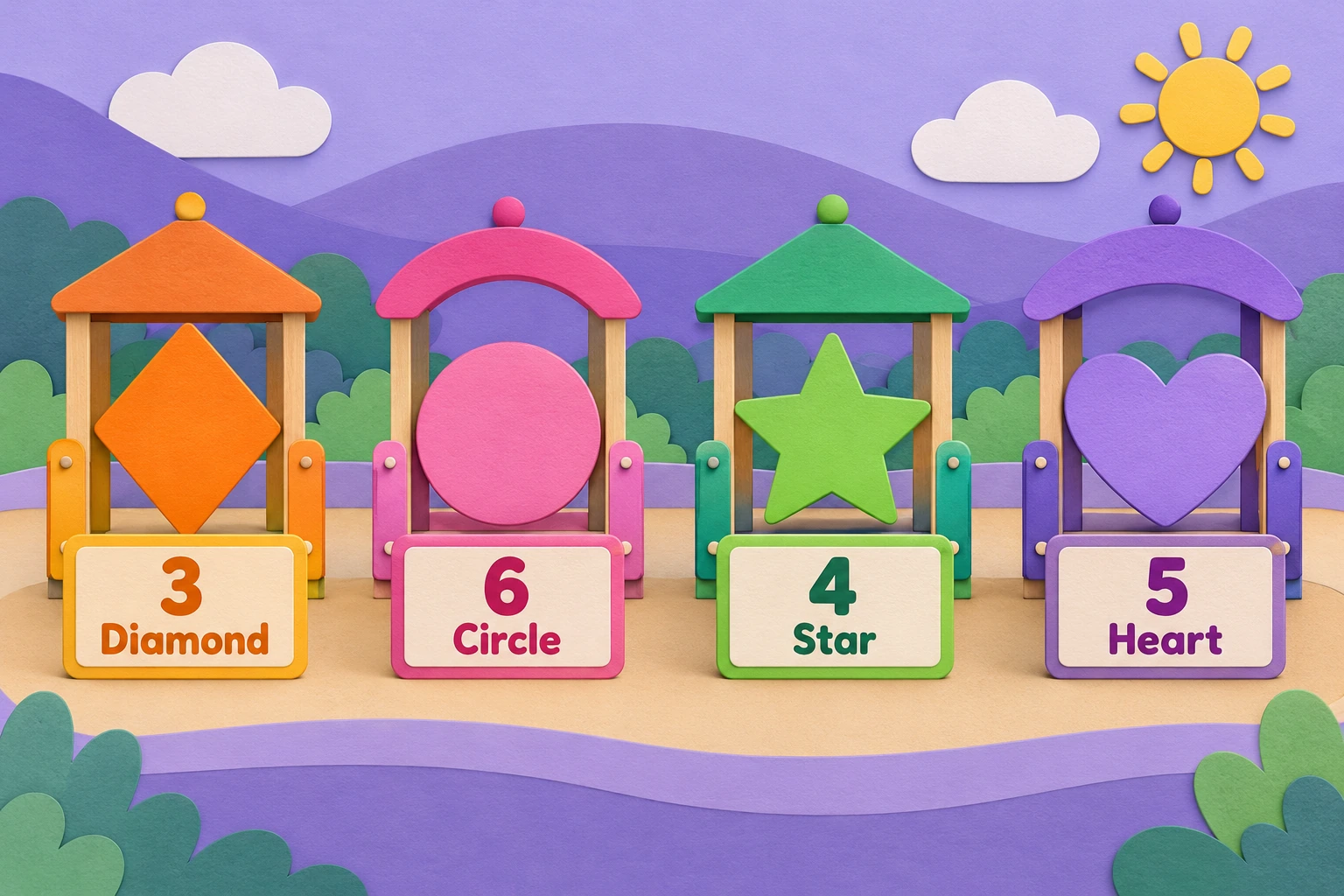
An orange diamond and a pink circle can be neighbours without being consecutive stops. Shape Key Trails turns a small playground of six shapes into a reference-reading game: check the numeral, find its shape in the legend and connect the matching centre dots in the requested order. The worksheet supplies a finished example and five new routes. Children meet triangles, squares, diamonds, stars, hearts and circles, but the drawing challenge goes beyond naming them. Each route asks a young explorer to choose deliberately, rather than simply joining whichever shape happens to be closest.
Start with a playground conversation — Shape Key Trails
Before drawing on Shape Key Trails, ask the child to show a shape they recognise. Compare the diamond with the square and the star with the heart. Accept familiar descriptions such as “the pointy one,” then add a more specific name while pointing. A short naming conversation makes the number key easier to use later.
The symbols in Shape Key Trails have little centre dots. Those dots are the connection targets; tracing around a heart's outline would answer a different question. The code names the destinations, not the shapes' edges. Demonstrate the distinction with a finger so a child can see where a line begins and lands.
Shape Key Trails legend at a glance
| Shape Playground numeral | Keyed picture |
|---|---|
| 1 | triangle |
| 2 | square |
| 3 | diamond |
| 4 | star |
| 5 | heart |
| 6 | circle |

Shape Playground example before independent drawing
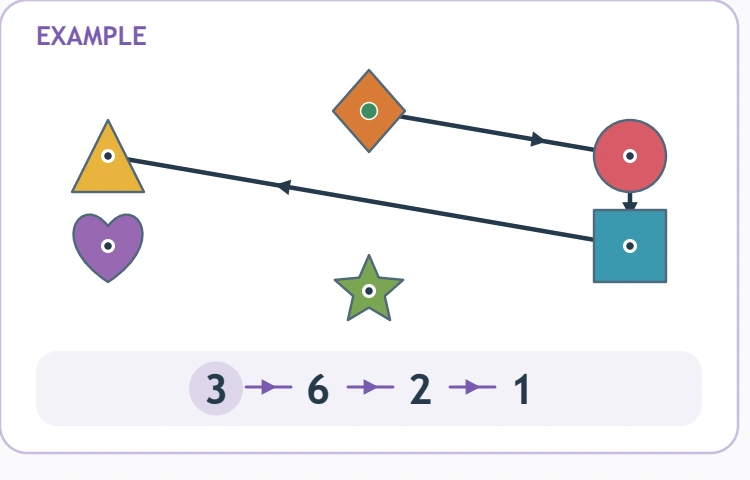
Shape Playground demonstrates 3 → 6 → 2 → 1. The Shape Playground itinerary is diamond → circle → square → triangle. In Shape Playground, the green start selects diamond. Shape Playground arrows lead to triangle. Shape Playground has 3 worked segments. The Shape Key Trails example supports finger rehearsal. Inspect the Shape Playground practice strip separately.
Shape Playground — practice 1
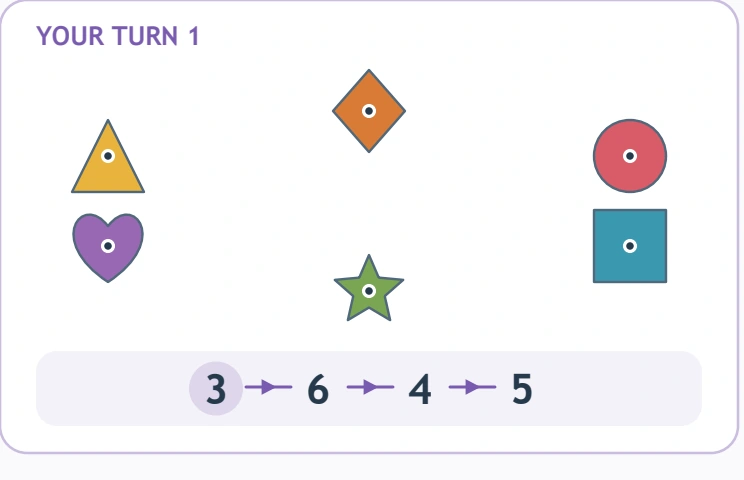
Practice 1 on Shape Playground: 3 → 6 → 4 → 5. Translate those Shape Key Trails destinations as diamond → circle → star → heart. Begin on diamond for Shape Playground; next locate circle. The Shape Playground centre-to-centre connections are diamond onward to circle; circle onward to star; star onward to heart. Segment count for Shape Key Trails: 3, from 4 listed stops. The Shape Playground endpoint is heart. Against the Shape Playground strip, verify final 5.
Shape Key Trails leaves triangle, square outside practice 1. Leave these Shape Playground alternatives unvisited. Practice 1 for Shape Playground requests 3 → 6 → 4 → 5.
Shape Playground — practice 2
Practice 2 on Shape Playground: 4 → 1 → 3 → 6. Translate those Shape Key Trails destinations as star → triangle → diamond → circle. Begin on star for Shape Playground; next locate triangle. The Shape Playground centre-to-centre connections are star onward to triangle; triangle onward to diamond; diamond onward to circle. Segment count for Shape Key Trails: 3, from 4 listed stops. The Shape Playground endpoint is circle. Against the Shape Playground strip, verify final 6.
Shape Key Trails leaves square, heart outside practice 2. Leave these Shape Playground alternatives unvisited. Practice 2 for Shape Playground requests 4 → 1 → 3 → 6.
Shape Playground — practice 3
Practice 3 on Shape Playground: 6 → 3 → 1 → 4 → 5. Translate those Shape Key Trails destinations as circle → diamond → triangle → star → heart. Begin on circle for Shape Playground; next locate diamond. The Shape Playground centre-to-centre connections are circle onward to diamond; diamond onward to triangle; triangle onward to star; star onward to heart. Segment count for Shape Key Trails: 4, from 5 listed stops. The Shape Playground endpoint is heart. Against the Shape Playground strip, verify final 5.
Shape Key Trails leaves square outside practice 3. Leave these Shape Playground alternatives unvisited. Practice 3 for Shape Playground requests 6 → 3 → 1 → 4 → 5.
Shape Playground — practice 4
Practice 4 on Shape Playground: 5 → 4 → 3 → 6 → 2. Translate those Shape Key Trails destinations as heart → star → diamond → circle → square. Begin on heart for Shape Playground; next locate star. The Shape Playground centre-to-centre connections are heart onward to star; star onward to diamond; diamond onward to circle; circle onward to square. Segment count for Shape Key Trails: 4, from 5 listed stops. The Shape Playground endpoint is square. Against the Shape Playground strip, verify final 2.
Shape Key Trails leaves triangle outside practice 4. Leave these Shape Playground alternatives unvisited. Practice 4 for Shape Playground requests 5 → 4 → 3 → 6 → 2.
Shape Playground — practice 5
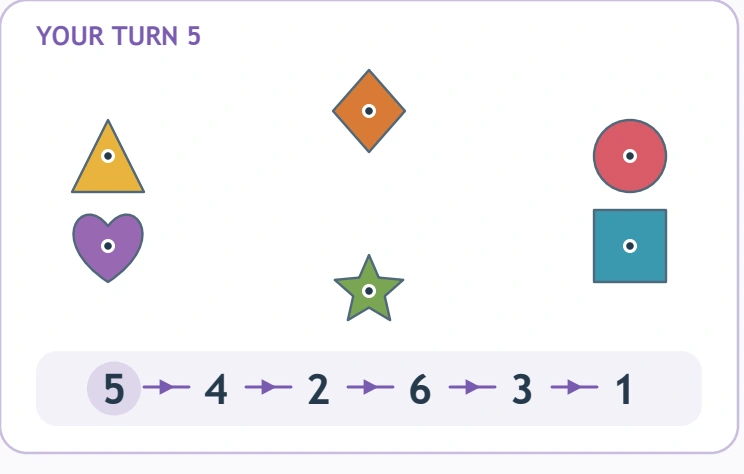
Practice 5 on Shape Playground: 5 → 4 → 2 → 6 → 3 → 1. Translate those Shape Key Trails destinations as heart → star → square → circle → diamond → triangle. Begin on heart for Shape Playground; next locate star. The Shape Playground centre-to-centre connections are heart onward to star; star onward to square; square onward to circle; circle onward to diamond; diamond onward to triangle. Segment count for Shape Key Trails: 5, from 6 listed stops. The Shape Playground endpoint is triangle. Against the Shape Playground strip, verify final 1.
Shape Playground uses every Shape Key Trails entry in practice 5 of Shape Playground: 5 → 4 → 2 → 6 → 3 → 1. First Shape Playground selection: heart; final selection: triangle.
Place the task within a comfortable age range
Preschoolers and early-primary children, often about four to seven, may enjoy Shape Key Trails with different levels of assistance. Numeral recognition, shape matching and hand control develop unevenly. An adult can read a code while the child points, or let a confident reader explain the route while an adult demonstrates one stroke.
For Shape Key Trails, keep the page upright and the legend in sight. Position the paper so the drawing hand does not cover the instruction strip. Work through the example slowly, then offer one unanswered field. Finishing all five is optional; a correct choice followed by a comfortable stop can be a useful first encounter.
Six things a shape explorer can practise
Describe a silhouette precisely
On Shape Key Trails, a vague “that one” can become “the green star.” Naming a visible feature makes a selection understandable to another person. Pointing still counts as communication; the adult can provide the word without requiring a repeated spoken performance.
Connect two kinds of information
A numeral in Shape Key Trails stands for a shape elsewhere. Looking from the strip to the legend and back gives practice relating separate representations. Watch whether the child checks the same numeral they are currently following, rather than an entry remembered from another puzzle.
Resist a convenient neighbour
The closest shape in Shape Key Trails is not always next. A planned reach toward the keyed symbol can reveal thoughtful selection. Give the child time to locate that destination before making a line, especially where a nearby shape would offer an easier stroke.
Aim without outlining
Small targets in Shape Key Trails invite purposeful motor control. The pencil travels toward the centre of a figure and then changes direction at the next decision. A slightly wobbly segment can preserve the correct itinerary; focus first on chosen destinations and comfortable movement.
Keep a code available as a reference
Children need not memorise the Shape Key Trails route before acting. Following with a spare finger supports place-keeping. Gradually let the child manage that finger themselves, so consulting the instruction becomes a usable strategy instead of an adult's constant reminder.
Compare a result with its instruction
After a Shape Key Trails route, ask which two shapes the first segment connects. Compare that pair with the initial two numerals. Checking a visible pair is more informative than deciding whether a finished path merely “looks right.” Repeat the comparison where a mistake appears.
Bren's heart-first plan at home, imagined
Picture Bren choosing the heart as a favourite shape during Shape Key Trails. When a code starts with a diamond, Bren wants to begin at the heart anyway. A parent separates the choices: Bren can pick the drawing pencil, while the printed strip picks the first station. They locate three in the key and point to the diamond together.
Bren draws one Shape Key Trails connection, then describes the next shape before continuing. The parent avoids moving Bren's hand. That leaves the child responsible for the motion, with verbal guidance available for the lookup. They end by naming the actual finishing shape, whether or not it was the favourite.
A small-group station with shared language, imagined
In a possible classroom use of Shape Key Trails, children describe destinations to a partner without touching the partner's page. “Circle, then star” is clear enough to check against the code. If descriptions become confusing, the teacher models including both a numeral and a shape name.
Partners take turns with Shape Key Trails after a panel, keeping individual paper for each drawing. The teacher notes whether a child can identify the requested shape even when speech is brief. A correct point can show the concept before a long explanation is possible, so oral confidence does not become the only measure.
Extend the playground in four different ways
Build a toy shape stop
Arrange large labelled shapes on a table after Shape Key Trails. Let a toy visit two requested stations. The child can name a destination or indicate its numeral. Switch who gives directions, keeping the sequence short enough that both partners can remember what was requested.
Give a shape a helpful description
Choose one Shape Key Trails figure and describe it without using its usual name. “It has a curved top and a point below” may suggest the heart. Discuss which details narrow the choice, then reveal the legend entry. This extension practises description rather than adding another printed route.
Challenge a puppet's outline tracing
Let a puppet pretend to trace the outside of a Shape Key Trails star instead of connecting its centre. Ask the child what the printed instruction requests. The puppet can retry with a centre-to-centre movement. Keep the joke focused on the action, with no teasing about a child's earlier error.
Match a route with a spoken report
Read two short reports of a completed Shape Key Trails path, changing one shape name in the second. Invite the child to select the accurate report by pointing to the drawing. They can also invent the changed version for an adult to inspect.
When a playful page becomes frustrating
If Shape Key Trails feels crowded, cover the lower fields temporarily while keeping the legend visible. If a child draws to the square when the diamond was requested, compare those two entries directly. Avoid replacing the task with a lecture about every possible shape. One contrast can be enough to restore the route.
In Shape Key Trails, praise an observable choice: noticing the diamond, finding the present numeral or ending at the instructed heart. Return to the page in a short, predictable invitation after shape play. A child can decline or complete only one panel. Careful looking is the interesting achievement here, and repeating the routine should leave room for curiosity.
Choose a sample or a clean printable
The original supplied Shape Key Trails sheet is available through its sample download. The clean premium version is delivered through an eligible active membership after sign-in. Its printable PDF contains no watermark, no domain name and no ads. For all twenty-five themes together, use the separate $3 collection purchase shown on this page.
Open the saved Shape Key Trails PDF before printing, confirm portrait orientation and check that no outer edge disappears in the printer preview. Colour helps distinguish the pictured shapes, although silhouette naming remains useful. Give the child space beside the sheet for a comfortable drawing arm and a stable supporting hand.
Related forms of following a reference
Compare Shape Key Trails with Exact Path Detective. After Shape Playground, try Castle Color Codes. For Shape Playground, consider Number Letter Switching.
Families planning more shared play after Shape Key Trails may browse NAEYC's resources for families. For further adult-led activity ideas, PBS Parents offers a broader educational library. Select ideas that match the child's interests rather than turning a single shape page into a long sequence of required tasks.
Popular Worksheets
Printable resources families and teachers are downloading now.
 Free
 Free
 Free
 Free