
Sweet Shop Sequences: 5 Joyful Treat-Label Routes
Keep the sweet-shop orders in a $3 printable library. The 25-page clean collection places these treat sequences beside other picture keys, offering fresh destinations while the useful checking routine stays available.
A cookie, a lollipop and an ice cream cone make an appealing delivery round, but remembering the whole order is not the aim. Sweet Shop Sequences lets children keep a number strip available while they look up each pictured destination and connect its centre dot to the next. Five practice fields follow a ready-drawn example. The sweet-shop theme gives the journey a friendly setting, while a tracking finger can solve a practical problem: keeping your place when your eyes repeatedly travel between the code, the key and the drawing field.
Three places for the eyes, one current step — Sweet Shop Sequences
Using Sweet Shop Sequences involves looking at the strip for a numeral, the legend for its picture and the panel for the matching target. Losing the current step during those shifts is understandable. Rest a spare finger under the numeral being followed, then move it only after that connection has been checked.
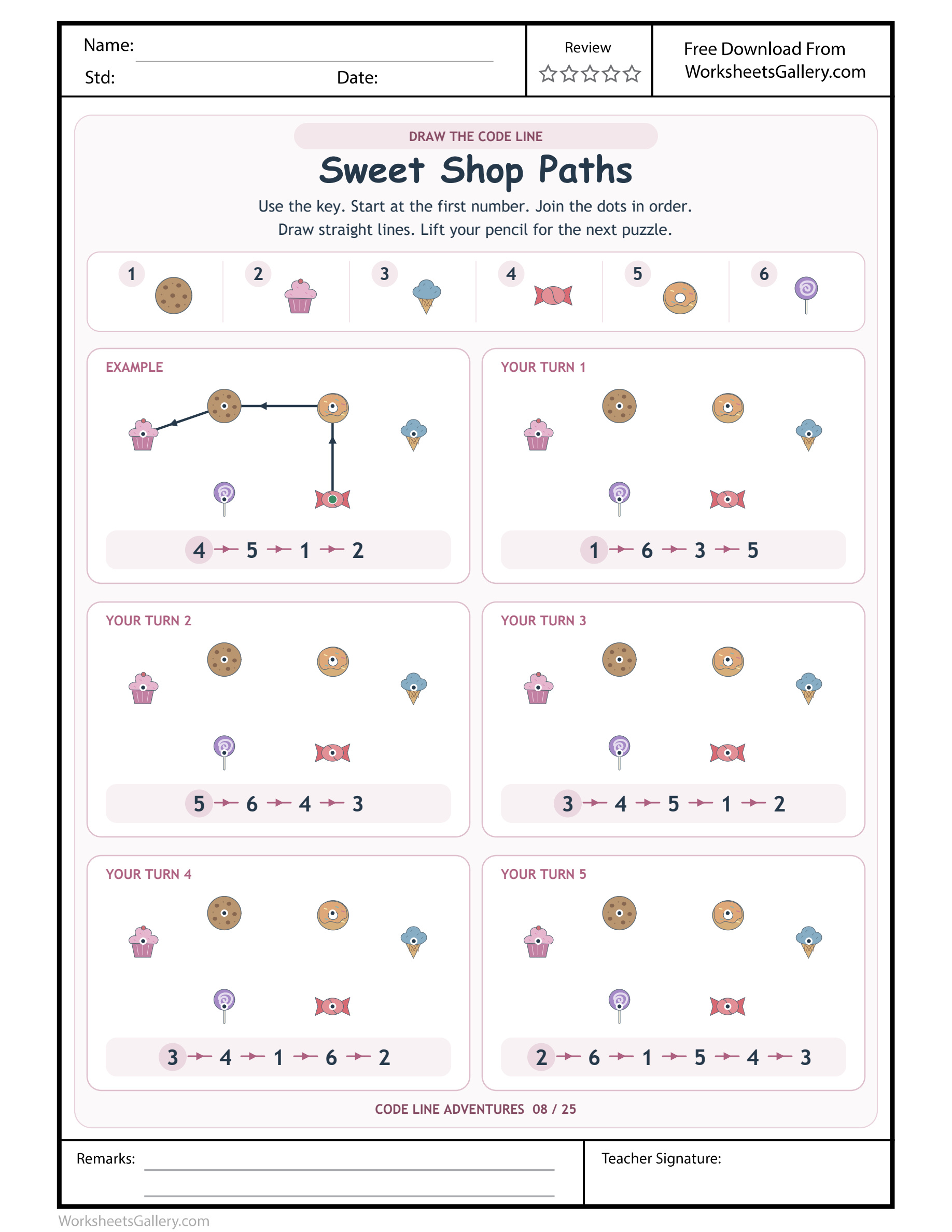
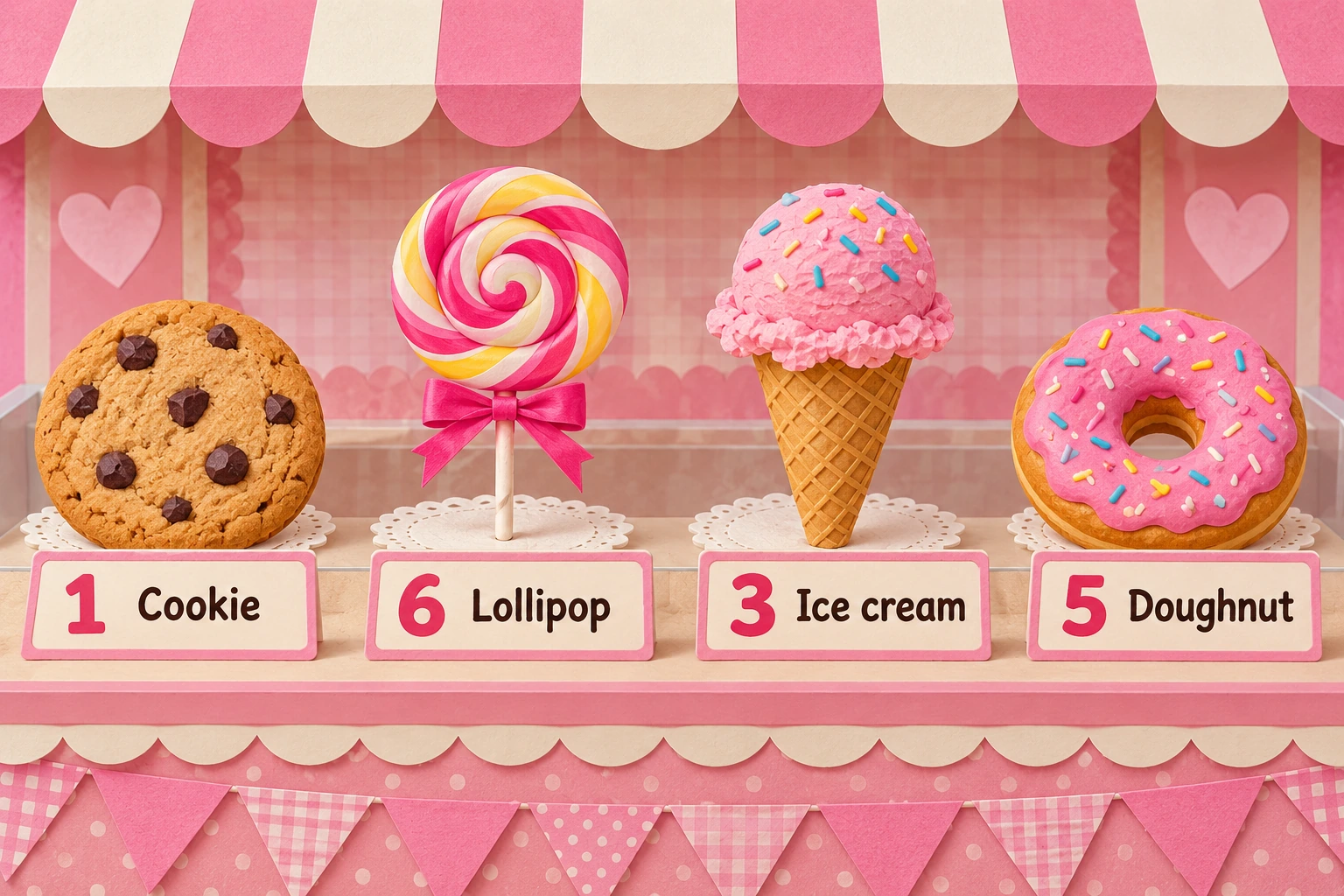
In Sweet Shop Sequences, the legend labels cookie as one, cupcake as two, ice cream as three, candy as four, doughnut as five and lollipop as six. Those are lookup assignments rather than quantities of treats. Read the printed delivery order instead of arranging the sweets by preference.
Sweet Shop Sequences legend at a glance
| Sweet Shop Paths numeral | Keyed picture |
|---|---|
| 1 | cookie |
| 2 | cupcake |
| 3 | ice cream |
| 4 | candy |
| 5 | doughnut |
| 6 | lollipop |

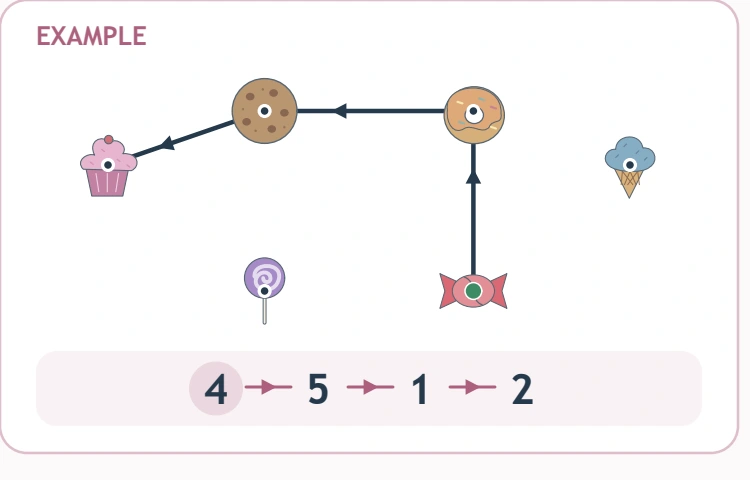
Sweet Shop Sequences example before independent drawing
Sweet Shop Paths demonstrates 4 → 5 → 1 → 2. The Sweet Shop Paths itinerary is candy → doughnut → cookie → cupcake. In Sweet Shop Paths, the green start selects candy. Sweet Shop Paths arrows lead to cupcake. Sweet Shop Paths has 3 worked segments. The Sweet Shop Sequences example supports finger rehearsal. Inspect the Sweet Shop Paths practice strip separately.
Sweet Shop Sequences — practice 1
Practice 1 on Sweet Shop Paths: 1 → 6 → 3 → 5. Translate those Sweet Shop Sequences destinations as cookie → lollipop → ice cream → doughnut. Begin on cookie for Sweet Shop Paths; next locate lollipop. The Sweet Shop Paths centre-to-centre connections are cookie followed by lollipop; lollipop followed by ice cream; ice cream followed by doughnut. Segment count for Sweet Shop Sequences: 3, from 4 listed stops. The Sweet Shop Paths endpoint is doughnut. Against the Sweet Shop Paths strip, verify final 5.
Sweet Shop Sequences leaves cupcake, candy outside practice 1. Leave these Sweet Shop Paths alternatives unvisited. Practice 1 for Sweet Shop Paths requests 1 → 6 → 3 → 5.
Sweet Shop Paths — practice 2
Practice 2 on Sweet Shop Paths: 5 → 6 → 4 → 3. Translate those Sweet Shop Sequences destinations as doughnut → lollipop → candy → ice cream. Begin on doughnut for Sweet Shop Paths; next locate lollipop. The Sweet Shop Paths centre-to-centre connections are doughnut followed by lollipop; lollipop followed by candy; candy followed by ice cream. Segment count for Sweet Shop Sequences: 3, from 4 listed stops. The Sweet Shop Paths endpoint is ice cream. Against the Sweet Shop Paths strip, verify final 3.
Sweet Shop Sequences leaves cookie, cupcake outside practice 2. Leave these Sweet Shop Paths alternatives unvisited. Practice 2 for Sweet Shop Paths requests 5 → 6 → 4 → 3.
Sweet Shop Paths — practice 3
Practice 3 on Sweet Shop Paths: 3 → 4 → 5 → 1 → 2. Translate those Sweet Shop Sequences destinations as ice cream → candy → doughnut → cookie → cupcake. Begin on ice cream for Sweet Shop Paths; next locate candy. The Sweet Shop Paths centre-to-centre connections are ice cream followed by candy; candy followed by doughnut; doughnut followed by cookie; cookie followed by cupcake. Segment count for Sweet Shop Sequences: 4, from 5 listed stops. The Sweet Shop Paths endpoint is cupcake. Against the Sweet Shop Paths strip, verify final 2.
Sweet Shop Sequences leaves lollipop outside practice 3. Leave these Sweet Shop Paths alternatives unvisited. Practice 3 for Sweet Shop Paths requests 3 → 4 → 5 → 1 → 2.
Sweet Shop Paths — practice 4
Practice 4 on Sweet Shop Paths: 3 → 4 → 1 → 6 → 2. Translate those Sweet Shop Sequences destinations as ice cream → candy → cookie → lollipop → cupcake. Begin on ice cream for Sweet Shop Paths; next locate candy. The Sweet Shop Paths centre-to-centre connections are ice cream followed by candy; candy followed by cookie; cookie followed by lollipop; lollipop followed by cupcake. Segment count for Sweet Shop Sequences: 4, from 5 listed stops. The Sweet Shop Paths endpoint is cupcake. Against the Sweet Shop Paths strip, verify final 2.
Sweet Shop Sequences leaves doughnut outside practice 4. Leave these Sweet Shop Paths alternatives unvisited. Practice 4 for Sweet Shop Paths requests 3 → 4 → 1 → 6 → 2.
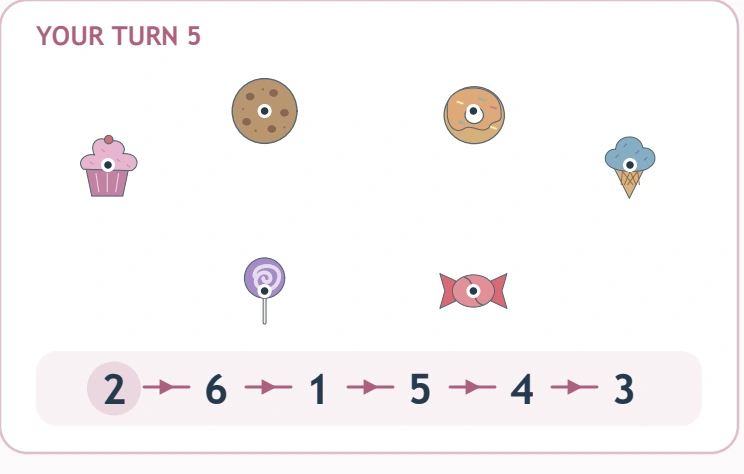
Sweet Shop Paths — practice 5
Practice 5 on Sweet Shop Paths: 2 → 6 → 1 → 5 → 4 → 3. Translate those Sweet Shop Sequences destinations as cupcake → lollipop → cookie → doughnut → candy → ice cream. Begin on cupcake for Sweet Shop Paths; next locate lollipop. The Sweet Shop Paths centre-to-centre connections are cupcake followed by lollipop; lollipop followed by cookie; cookie followed by doughnut; doughnut followed by candy; candy followed by ice cream. Segment count for Sweet Shop Sequences: 5, from 6 listed stops. The Sweet Shop Paths endpoint is ice cream. Against the Sweet Shop Paths strip, verify final 3.
Sweet Shop Paths uses every Sweet Shop Sequences entry in practice 5 of Sweet Shop Paths: 2 → 6 → 1 → 5 → 4 → 3. First Sweet Shop Paths selection: cupcake; final selection: ice cream.
Six small skills behind the shop counter
Hold a place visibly
A tracking finger during Sweet Shop Sequences reduces the need to remember where the eyes left the strip. The child can manage that support themselves. Watch whether the finger moves along with the completed connections, rather than staying at the beginning of every route.
Distinguish remembering from consulting
The Sweet Shop Sequences key is meant to remain usable. Returning to it is a sensible response to uncertainty, not an error. A child may remember cookie's numeral while checking doughnut, gradually finding a comfortable balance between recall and visible reference.
Translate a label into a destination
The numeral six on Sweet Shop Sequences sends the child to lollipop even when another treat is closer. That translation connects a simple printed symbol with a specific pictured referent. An adult can read six aloud while leaving the picture selection to the learner.
Link hand movement with eye planning
Before a Sweet Shop Sequences stroke, locate the next centre. A planned target gives the hand somewhere definite to travel. Encourage comfortable pressure and a controlled arrival; a slight bend in the line does not erase a correct route decision.
Name an itinerary for another person
Invite a short Sweet Shop Sequences report such as cookie, lollipop, ice cream, doughnut. The spoken sequence can be checked against the numeral strip. Accept familiar words such as ice cream cone and provide vocabulary support without turning the activity into a spelling task.
Recover from an interrupted sequence
If attention drifts during Sweet Shop Sequences, inspect the last completed pair instead of restarting automatically. Locate that position in the strip, then determine what follows. This gives the child a practical recovery method when a conversation or small distraction interrupts the drawing.
An imagined bakery-table visit with Hugo
Imagine Hugo working through Sweet Shop Sequences beside a caregiver. Halfway through a route, he looks up to answer a question and forgets his position. The caregiver asks which picture his last line reached. Hugo identifies it and finds the matching point in the current instruction before selecting the next treat.
They repeat one Sweet Shop Sequences pair with a fingertip, then let Hugo finish the line. The adult praises his method of finding his place, rather than telling him to concentrate harder. They end after one route and leave the other shop deliveries available for a later invitation.
An imagined classroom order desk
At a possible classroom station for Sweet Shop Sequences, children alternate between describing one route and drawing on their own copy. The teacher models moving a finger under the strip while looking upward to the legend. Children choose whether that support is helpful for the current panel.
The teacher observes Sweet Shop Sequences place-keeping separately from picture matching. A child who knows each treat but repeats a numeral may need tracking support; a child who tracks accurately but selects the wrong treat may need a key comparison. Those observations lead to more useful help than simply asking everyone to finish faster.
Readiness and a comfortable first order
Children around four to seven may enjoy Sweet Shop Sequences, with adults supplying numeral names or picture words where needed. Age alone is not a readiness test. Begin by seeing whether the child can match a requested numeral to its treat and point between two pictured centres.
For Sweet Shop Sequences, choose a clear print, a stable tabletop and one practice box. Finger-follow the example before drawing. Keep the remaining panels for later if attention fades or the hand becomes tense. A short, comprehensible delivery is a better starting place than a crowded session spent struggling through all five strips.
Five sweet-shop extensions without extra worksheet marks
Pass a spoken order along
After Sweet Shop Sequences, give a toy shopkeeper a two-treat request using clearly labelled picture cards. The child repeats or points through it, then gives an order to the adult. Increase the length only when the short exchange remains enjoyable and easy to check.
Pause a pretend delivery
Interrupt a tabletop journey inspired by Sweet Shop Sequences with a planned rest. Leave a marker at the current destination, then resume by checking what follows. This rehearses returning after a pause without demanding that a child remember an entire sequence through a distraction.
Describe the treat's distinguishing feature
Choose a Sweet Shop Sequences symbol and give a visible clue: a stick for lollipop, a ring for doughnut or a wrapper for candy. A partner finds its legend entry. The game builds precise descriptions while keeping numeral lookup available as a separate action.
Be a courteous order checker
Let an adult name a completed Sweet Shop Sequences route with one treat in the wrong place. The child compares the spoken list with the drawing and points to the disagreement. Trade roles, keeping the correction friendly and the listening sequence short.
Give the final customer a story
Invent a tiny shop tale that ends at a finished Sweet Shop Sequences destination. The child decides who arrives there and why. Retell the actual printed stops in order before adding imaginative details, so story preferences do not replace the code's instructions.
A calm response to a mixed-up delivery
Common Sweet Shop Sequences slips are returning to the first numeral after every lookup, counting upward or connecting a favourite treat without checking. Show the present place in the strip and compare its next pair. If the correct picture is selected but a line misses its centre, rehearse the movement rather than repeating numeral names.
Offer Sweet Shop Sequences in brief visits around pretend-shop play. Let a child request a pause, choose one panel and explain a successful recovery. Finding your place is a useful accomplishment. Regular practice can mean returning to a partly completed sheet instead of printing and finishing another whole page.
Obtain the printable sweet-shop route
Choose the original Sweet Shop Paths worksheet through its sample control, or use an eligible active membership to download its clean premium edition after sign-in. That printable PDF is free of domain text and watermarks, with no advertisements on the activity page. The complete collection containing Sweet Shop Paths is separately priced at $3.
Save Sweet Shop Sequences locally, review its portrait layout and preserve all borders and code strips in the printer preview. Use a clear colour copy if possible. A test print can reveal clipped margins before classroom copies are prepared; adjust fitting only as needed for the printer.
Continue the conversation about directions
Compare Sweet Shop Sequences with Exact Path Detective. After Sweet Shop Paths, try Castle Color Codes. For Sweet Shop Paths, consider Number Letter Switching.
Families extending Sweet Shop Sequences may find shared-play reading at NAEYC's family hub and activity inspiration at PBS Parents' resource pages. Choose an idea that supports enjoyable conversation, with this worksheet's specific treat key kept available for its drawn routes.
Popular Worksheets
Printable resources families and teachers are downloading now.
 Free
 Free
 Free
 Free