
Space Signal Lines: 4 Brilliant Helmet-to-Rocket Trips
Launch another theme with the $3 code-line collection. These helmet-start missions are retained in the clean 25-sheet file, alongside other worked examples and independent numeral-to-picture routes.
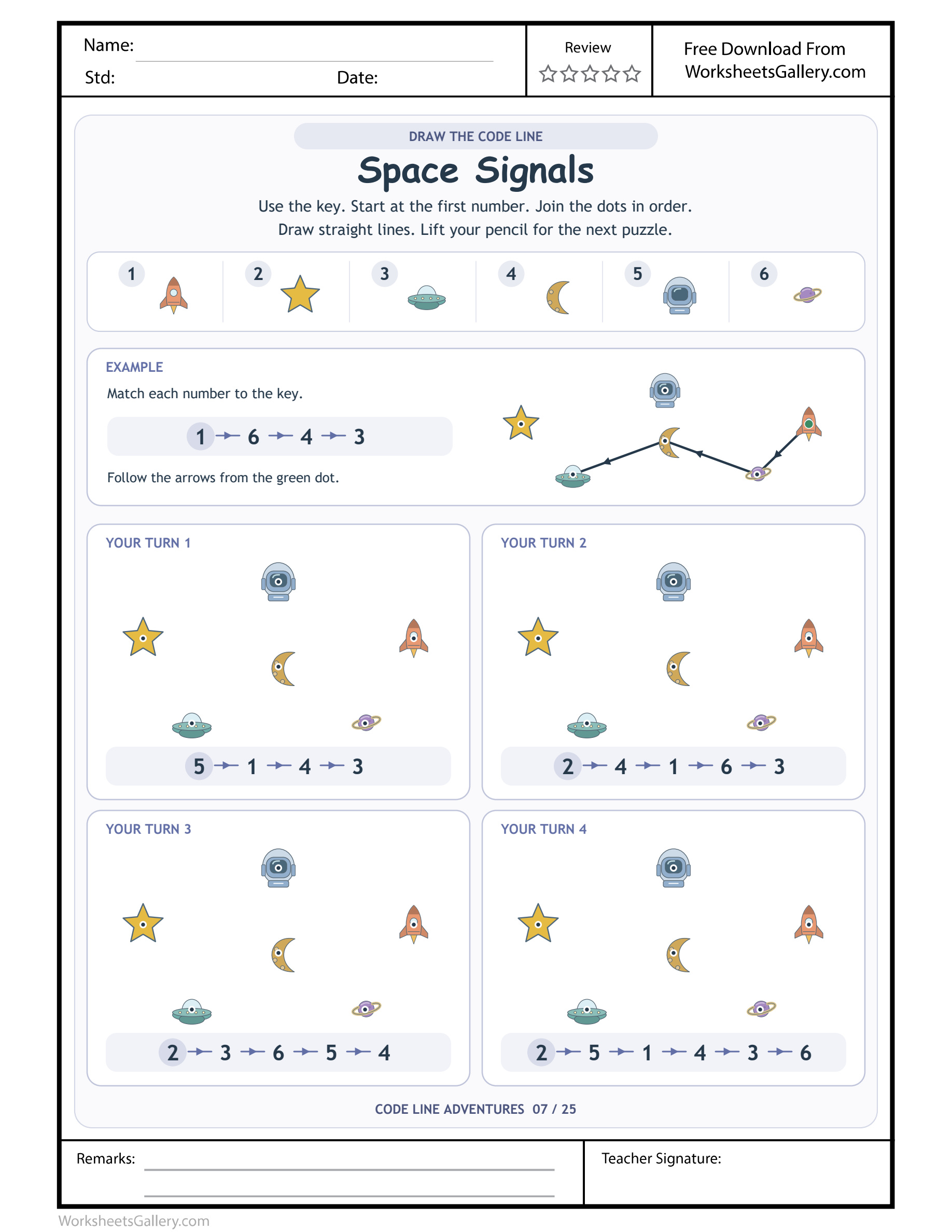
The example launches from a rocket, but the first independent mission starts at a helmet. That change makes Space Signal Lines an inviting exercise in checking a beginning instead of copying a model. Children match each numeral to a space picture, locate the matching centre dot and draw toward the next requested destination. Four practice routes follow the wide demonstration. Rockets, stars, a UFO, a moon, a helmet and a planet provide the scenery; the small instruction strip supplies the flight plan, including where each separate mission begins and ends.
The launch check comes before the launch — Space Signal Lines
On Space Signal Lines, a drawn example explains how to interpret a code. It does not establish a starting picture for every panel. Compare the example's initial one with the first practice strip's five. One identifies rocket; five identifies helmet. Asking the child to find both makes the changed beginning visible without explaining the whole sheet at once.
Introduce Space Signal Lines with a brief launch check: point to the selected field, identify its first numeral, look up the picture, then find its centre. Keep the pencil waiting until the starting symbol is chosen. This deliberate pause can prevent an attractive rocket from becoming an automatic answer.
Space Signals legend at a glance
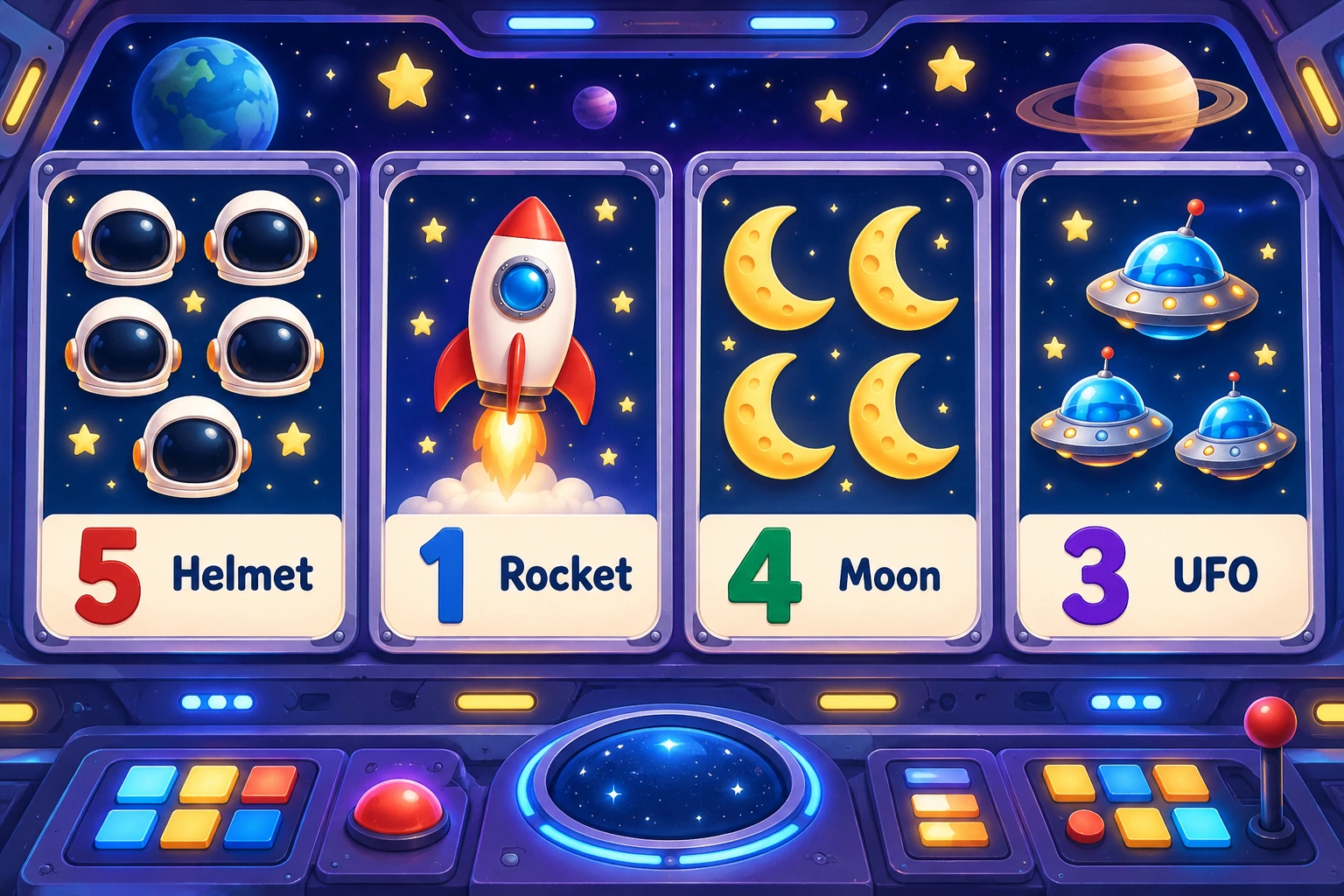
| Space Signals numeral | Keyed picture |
|---|---|
| 1 | rocket |
| 2 | star |
| 3 | UFO |
| 4 | moon |
| 5 | helmet |
| 6 | planet |

Space Signals example before independent drawing
Space Signals demonstrates 1 → 6 → 4 → 3. The Space Signals itinerary is rocket → planet → moon → UFO. In Space Signals, the green start selects rocket. Space Signals arrows lead to UFO. Space Signals has 3 worked segments. The Space Signal Lines example supports finger rehearsal. Inspect the Space Signals practice strip separately.
Space Signals — practice 1
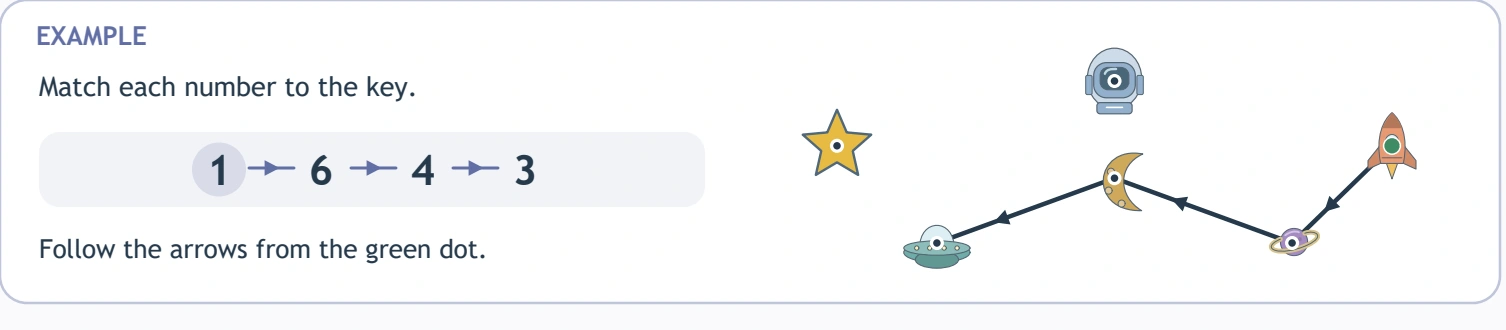
Practice 1 on Space Signals: 5 → 1 → 4 → 3. Translate those Space Signal Lines destinations as helmet → rocket → moon → UFO. Begin on helmet for Space Signals; next locate rocket. The Space Signals centre-to-centre connections are helmet onward to rocket; rocket onward to moon; moon onward to UFO. Segment count for Space Signal Lines: 3, from 4 listed stops. The Space Signals endpoint is UFO. Against the Space Signals strip, verify final 3.
Space Signal Lines leaves star, planet outside practice 1. Leave these Space Signals alternatives unvisited. Practice 1 for Space Signals requests 5 → 1 → 4 → 3.
Space Signals — practice 2
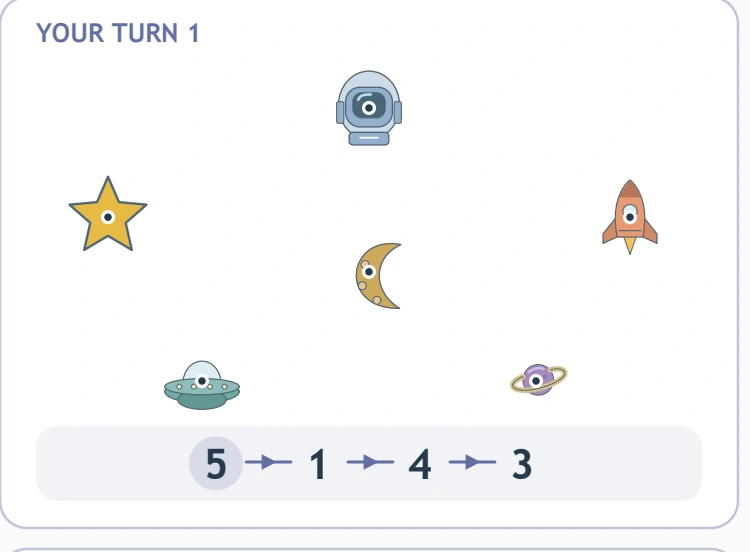
Practice 2 on Space Signals: 2 → 4 → 1 → 6 → 3. Translate those Space Signal Lines destinations as star → moon → rocket → planet → UFO. Begin on star for Space Signals; next locate moon. The Space Signals centre-to-centre connections are star onward to moon; moon onward to rocket; rocket onward to planet; planet onward to UFO. Segment count for Space Signal Lines: 4, from 5 listed stops. The Space Signals endpoint is UFO. Against the Space Signals strip, verify final 3.
Space Signal Lines leaves helmet outside practice 2. Leave these Space Signals alternatives unvisited. Practice 2 for Space Signals requests 2 → 4 → 1 → 6 → 3.
Space Signals — practice 3
Practice 3 on Space Signals: 2 → 3 → 6 → 5 → 4. Translate those Space Signal Lines destinations as star → UFO → planet → helmet → moon. Begin on star for Space Signals; next locate UFO. The Space Signals centre-to-centre connections are star onward to UFO; UFO onward to planet; planet onward to helmet; helmet onward to moon. Segment count for Space Signal Lines: 4, from 5 listed stops. The Space Signals endpoint is moon. Against the Space Signals strip, verify final 4.
Space Signal Lines leaves rocket outside practice 3. Leave these Space Signals alternatives unvisited. Practice 3 for Space Signals requests 2 → 3 → 6 → 5 → 4.
Space Signals — practice 4
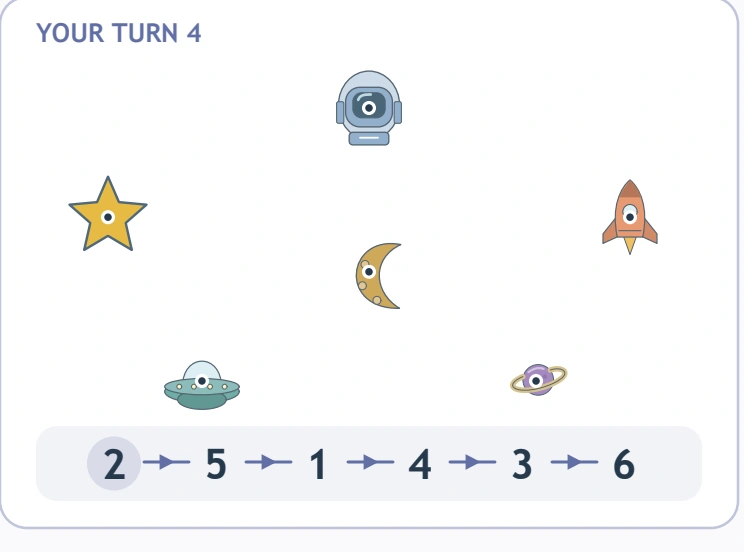
Practice 4 on Space Signals: 2 → 5 → 1 → 4 → 3 → 6. Translate those Space Signal Lines destinations as star → helmet → rocket → moon → UFO → planet. Begin on star for Space Signals; next locate helmet. The Space Signals centre-to-centre connections are star onward to helmet; helmet onward to rocket; rocket onward to moon; moon onward to UFO; UFO onward to planet. Segment count for Space Signal Lines: 5, from 6 listed stops. The Space Signals endpoint is planet. Against the Space Signals strip, verify final 6.
Space Signals uses every Space Signal Lines entry in practice 4 of Space Signals: 2 → 5 → 1 → 4 → 3 → 6. First Space Signals selection: star; final selection: planet.
A home mission with Gia, imagined
Imagine Gia bringing Space Signal Lines to a sofa-side table. She enjoys rockets and points to rocket before reading the first unanswered code. A caregiver asks her to inspect the circled first numeral. Together they find five in the legend, and Gia moves her fingertip to helmet. She has corrected the launch before making a pencil mark.
After one Space Signal Lines connection, Gia explains where the next numeral sends her. The caregiver supplies the word UFO when needed but leaves the lookup to Gia. Their session ends after a complete short mission, with the other panels ready for another day rather than an unfinished obligation.
Six mission-control habits
Separate a demonstration from a fresh instruction
The contrasting starts in Space Signal Lines offer a concrete reason to inspect new information. A child can use the example's method while changing its starting picture. Watch for that distinction rather than expecting the entire example route to be remembered.
Use a numeral as a symbol label
The helmet is five in Space Signal Lines, even when it sits above other pictures. Matching the label through the legend practises a reference-based decision. The assignment belongs to this sheet; a different space worksheet may use another mapping.
Prepare one connection at a time
Each Space Signal Lines flight can be broken into adjacent pairs. Find the present and next destinations, draw that segment, then inspect the following numeral. This makes a long strip approachable without changing the order or requiring a memorised six-stop speech.
Land with the hand under control
The Space Signal Lines centre dots create intended landing places. Encourage looking toward the destination, moving comfortably and slowing near it. A wavering line can still represent the correct flight plan; pressure for perfect straightness may obscure the successful choice.
Explain a changed destination
During Space Signal Lines, “helmet first because five starts this one” is a useful account. Adults can model that connection between evidence and action. Pointing to five and helmet can communicate the same idea when a child prefers a shorter spoken response.
Review the launch before reviewing every turn
If a Space Signal Lines mission looks wrong, begin by comparing its first symbol with the first numeral. A mistaken start can explain several later differences. Correct that local choice before asking the child to evaluate every segment at once.
Readiness and a practical desk arrangement
About four to seven is a flexible age guide for Space Signal Lines. A child may recognise the space pictures before recognising all six numerals, so an adult can read the strip. Another child may solve the lookup easily while needing larger targets or a finger demonstration for drawing.
Set Space Signal Lines flat with the legend accessible and avoid covering the current code with the drawing wrist. Name unfamiliar pictures, inspect the worked arrows and choose one panel. Keep the activity short enough for a comfortable grip and engaged attention; a single well-understood launch is a sensible first session.
A classroom launch briefing, imagined
Picture a teacher introducing Space Signal Lines to a small group by asking everyone to point silently to the start of the first practice mission. She invites two children to explain their evidence and compares the strip with the key. No one needs to draw until the helmet choice is clear.
Children then attempt Space Signal Lines on their own copies, using a partner only for a brief route explanation. The teacher distinguishes children who copied rocket from those who chose helmet but struggled to aim. She offers lookup help or movement rehearsal accordingly, without treating both difficulties as the same misunderstanding.
Four space-play follow-ups
Announce a changed launch pad
Use labelled picture stations inspired by Space Signal Lines. Give a toy one starting place, then announce a new mission with a different first station. The child points to the changed start before moving the toy. Trade roles so the adult also practises checking instead of assuming.
Give mission control one useful clue
Ask the child to help an imaginary pilot find the first Space Signal Lines destination without naming it immediately. Pointing to the relevant numeral or legend entry is a useful clue. The pilot can explain the choice back, keeping attention on evidence rather than guessing.
Compare launch and landing
Choose a completed Space Signal Lines route and identify only its first and last pictures. Invent a short sentence about travelling between them. Then inspect the middle stops to see what the sentence left out; endpoints summarise a journey without describing its full order.
Repair a puppet's copied mission
Let a puppet finger-follow the example inside a Space Signal Lines practice panel. Ask what needs checking before it continues. The child can redirect the puppet to the new strip. Keep the correction playful and limited to one clear discrepancy.
Make another mission feel welcome
Common Space Signal Lines errors include launching from the model's rocket, visiting space pictures in counting order or drawing around their outlines. Return to the first two requested symbols and rehearse their centre-to-centre link. Pause between panels so a completed flight does not carry into a new box.
For regular Space Signal Lines practice, offer a brief launch after a space story or on a quiet weekend. Let the child choose a pencil and a stopping point. Checking before drawing is an achievement worth naming. A child who asks for help is participating in mission planning, not failing to work independently.
Download the printable flight sheet
The original Space Signal Lines sample remains a separate download option. Eligible active members can sign in to receive its clean premium PDF, which removes domain branding and contains no watermark or printable-page ads. The complete set of twenty-five themes is offered as a separate $3 collection.
Check the saved Space Signal Lines file in portrait print preview, including the entire border and top legend. Colour printing supports quick picture identification. Adjust scaling if your printer clips an edge, then place the sheet on a stable surface before beginning a short flight.
Broader play around careful instructions
Compare Space Signal Lines with Castle Color Codes. After Space Signals, try Number Letter Switching. For Space Signals, consider Exact Path Detective.
Adults can pair Space Signal Lines with ideas from NAEYC's early-learning family pages or PBS Parents' educational activities. These general sources can inspire conversation and pretend missions while the worksheet's own code remains the reference for each drawn journey.
Popular Worksheets
Printable resources families and teachers are downloading now.
 Free
 Free
 Free
 Free