
Zz Letter Spotting: 4 Amazing Zebra-and-Pizza Finds
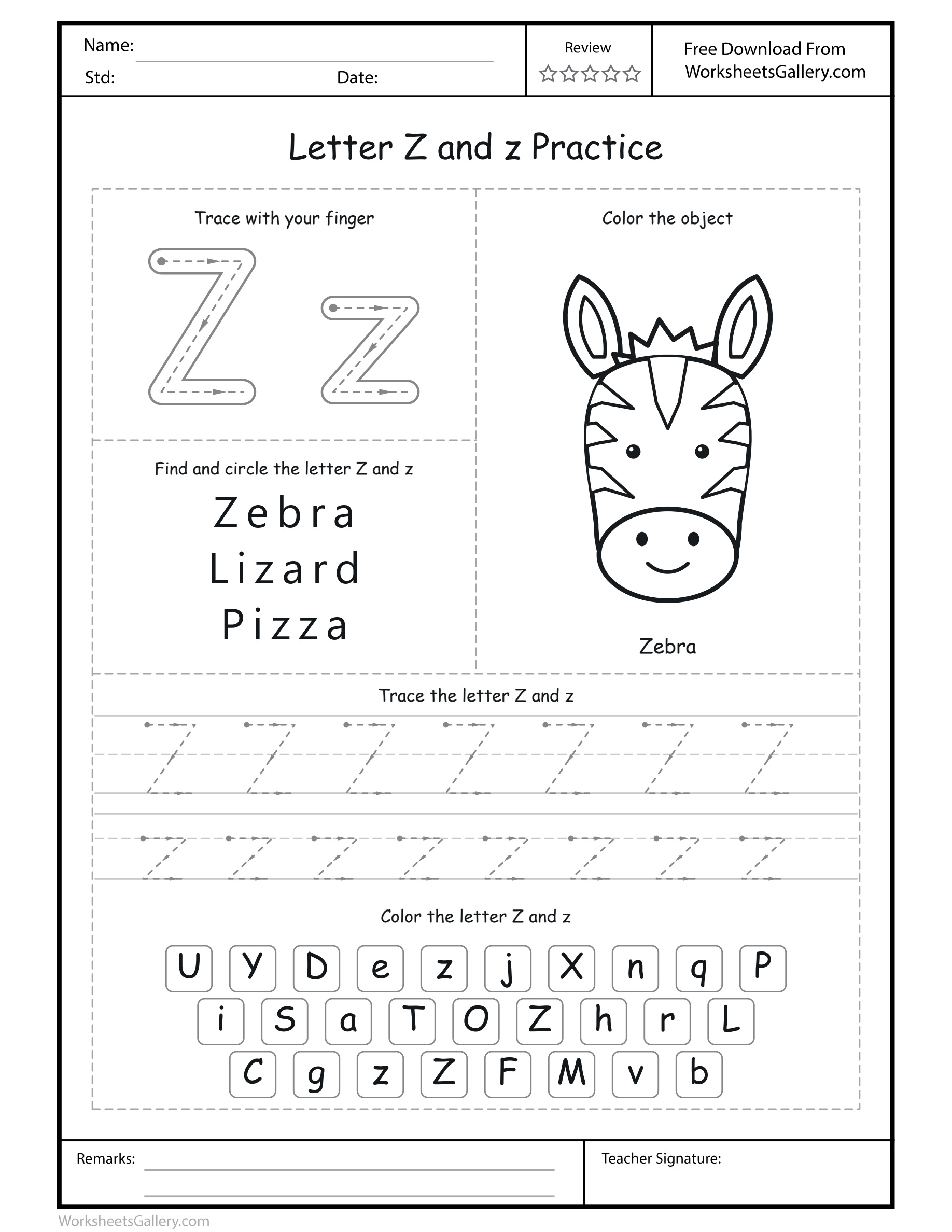
Zz Letter Spotting belongs to the 26-page collection. Count both z letters in Pizza while using the print pattern rather than a uniform sound rule.
Pizza has two z letters side by side, and both belong in this search. Zz Letter Spotting connects that pair with Zebra's opening capital and the lowercase target inside Lizard. A child can inspect the letter's two horizontal parts and diagonal link, colour a zebra and try selected movement guides. An adult reads the labels so the learner can focus on written evidence through pointing or circles. The page leaves time to check a neighbour, discuss a shape and reconsider a choice, making a thoughtful preschool visit possible without rushing through every section.
A menu word with two targets — Zz Letter Spotting
Read Zebra, Lizard and Pizza in the word panel of Zz Letter Spotting. Zebra starts with capital Z. Lizard has lowercase z as its third character. Pizza has z at positions three and four. Four written targets belong in the panel, with both neighbouring z characters in Pizza available for separate small circles.
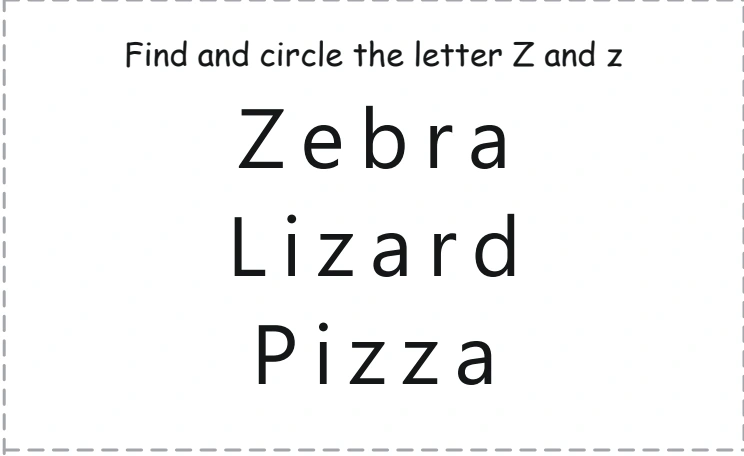
After finding Pizza's first z, inspect the next character before leaving the label. A large loop around the whole word would not show whether both had been compared. Keep the remaining print readable so the child can show where the pair occurs and how it differs from Zebra's opening.
| Printed label | Z/z evidence | Spotting cue |
|---|---|---|
| Zebra | Z at 1 | Find the capital opening. |
| Lizard | z at 3 | Inspect after i. |
| Pizza | z at 3 and 4 | Check both adjacent characters. |
Read each word naturally. The letter z in Pizza does not need to be given the same isolated sound explanation as the opening of Zebra to complete Zz Letter Spotting. This is a written-letter inspection. An adult can supply word reading while the child compares shapes and positions without having to explain the spelling's pronunciation independently.
The diagonal links two horizontal parts: Zz Letter Spotting
Study the large Z/z models on Zz Letter Spotting. Each has an upper horizontal part, a diagonal connection and a lower horizontal part, shown in the supplied case proportions. Follow the source movement arrows for a finger rehearsal, with a pause at each Z/z change of direction before a pencil is used.
If a diagonal points the other way, compare its route with the model. If a horizontal part is missing, look at the complete outline rather than asking for repeated copying without a focus. One visible feature gives the learner a useful next action. Formal angle language is unnecessary when a finger can show the connection.
Name capital Z and lowercase z together. Their family relationship can be recognised before a child controls the full handwriting sequence. Zz Letter Spotting keeps the models nearby for both tracing and tile comparison, giving an uncertain learner a reference to consult rather than an answer to memorise by position alone.
An imagined classroom zebra café: Zz Letter Spotting
Imagine Zane helping a zebra puppet run a pretend café. The teacher reads completed Zebra and Pizza signs and places Zz Letter Spotting nearby. Zane matches the opening capital, then circles one z in Pizza. A partner asks whether the next character should be compared too.
Zane checks the neighbour against the lowercase model and adds the second target. A Lizard card becomes the café's visiting customer. The teacher reads it and tracks beyond L and i, allowing Zane to inspect the interior z. He can explain the three labels with pointing rather than independent reading.
The class returns to the printable and chooses a small tracing attempt or one tile row. This imagined café makes the source labels social and memorable without adding a false common-sound rule. The teacher notes the neighbour check and diagonal comparison as specific observations to revisit later.
Six things a complete spot can show: Zz Letter Spotting
Attention after a first success. Pizza's paired z characters give Zz Letter Spotting a concrete reason to inspect beside an answer. A learner can demonstrate that continuation through two separate touches.
Different target positions. Zebra begins with Z, Lizard holds z inside and Pizza repeats it internally. The family remains recognisable across labels with different openings.
Case association. Naming the capital and lowercase forms together links their identity. The child can compare proportions without relying on physical size as the only case clue.
Direction awareness. The diagonal connection offers a specific feature to follow. Finger work on Zz Letter Spotting can preview that route before small pencil control becomes an additional demand.
Evidence-based talk. Above, below, diagonal and beside give words to visible observations. An adult can add these descriptions to the learner's gestures naturally.
Useful reconsideration. A candidate can be checked against the complete model and revised. The adult can describe the improved comparison rather than treating the first uncertain answer as the final result.
Let the zebra have a personal palette: Zz Letter Spotting
The zebra drawing on Zz Letter Spotting offers open colouring rather than a prescribed colour key. A learner can choose familiar stripes, invented colours or a patterned background and talk about one decision. The creative palette is separate from the written evidence used to identify Z/z.
When Zane asks about the animal name, read Zebra and show its initial capital. A short café story can be spoken, and an adult may write a finished caption on separate paper. Keep extra writing clear of the source word panel so its four explicit target characters remain straightforward to inspect.
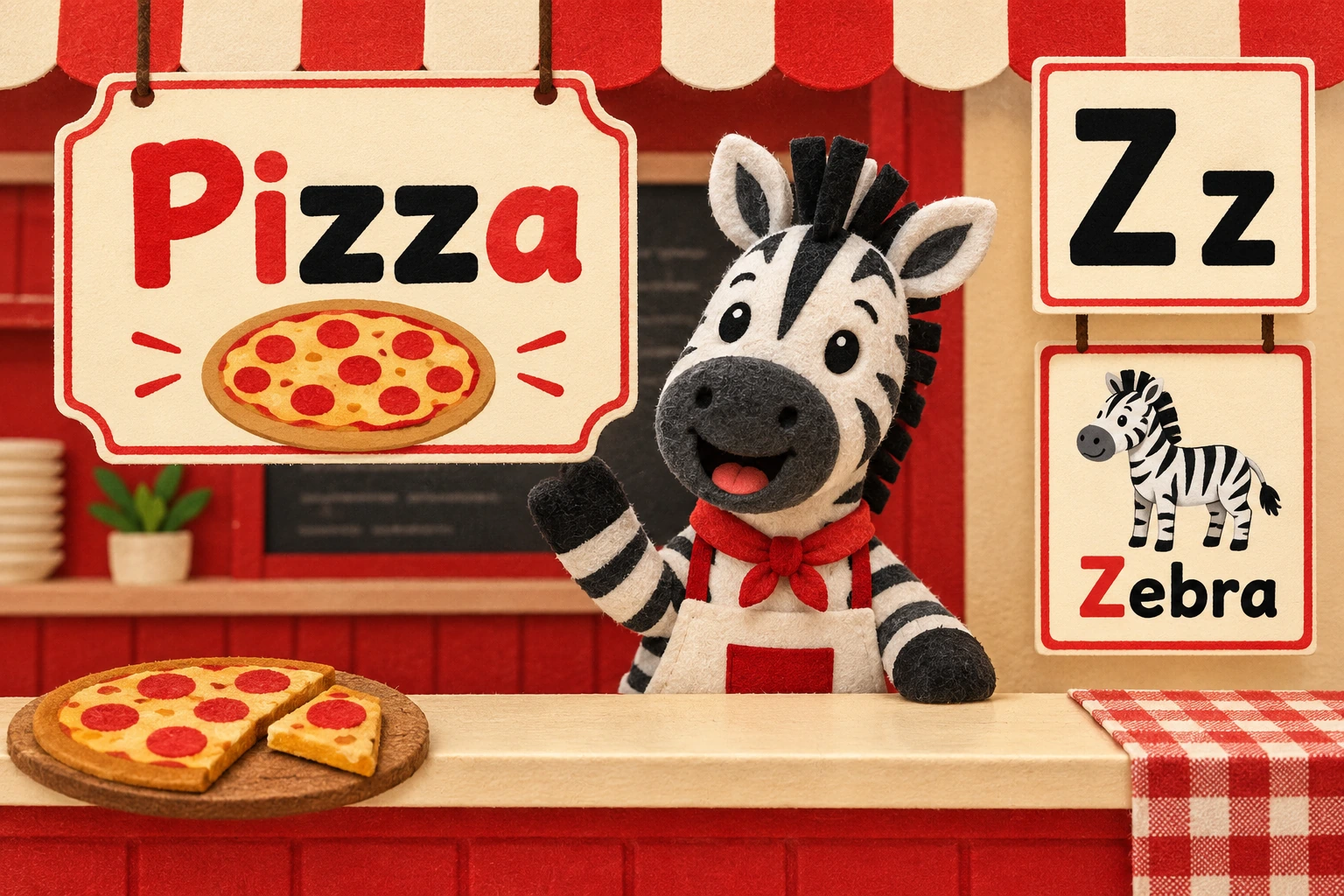
The supporting zebra café illustration displays a completed Pizza label with both z characters distinguished, alongside a Zebra sign and a Z/z reference. It makes the neighbouring print easy to discuss. Return to the ordinary labels on Zz Letter Spotting afterward, letting the learner find the targets without the highlighting.
Plan a few three-part movements: Zz Letter Spotting
The handwriting area of Zz Letter Spotting has seven Z practice examples plus eight z examples. Inspect the horizontal–diagonal–horizontal route and choose a manageable selection. One capital attempt followed by a lowercase comparison can be enough to discuss the direction changes before continuing.
If the diagonal reverses, use the large model to show its connection from the upper part to the lower part. If a horizontal is omitted, compare the complete outline and try another Z/z guide with the sheet anchored and the pencil moving gently. A single focused correction gives the child time to act.
Invite the learner to point to a mark that shows the intended connection clearly. It can differ in width or tilt and still support a useful conversation. Zz Letter Spotting offers more guides for another day, so movement practice can remain brief instead of becoming an obligation to fill every available space at once.
Four Z/z matches among twenty-seven tiles: Zz Letter Spotting
The lower field on Zz Letter Spotting spans three rows: ten characters across the top, nine in the centre and eight at the bottom. Two Z forms and two z forms are the four targets. Whole-field adult checking positions are 5, 16, 22 and 23.
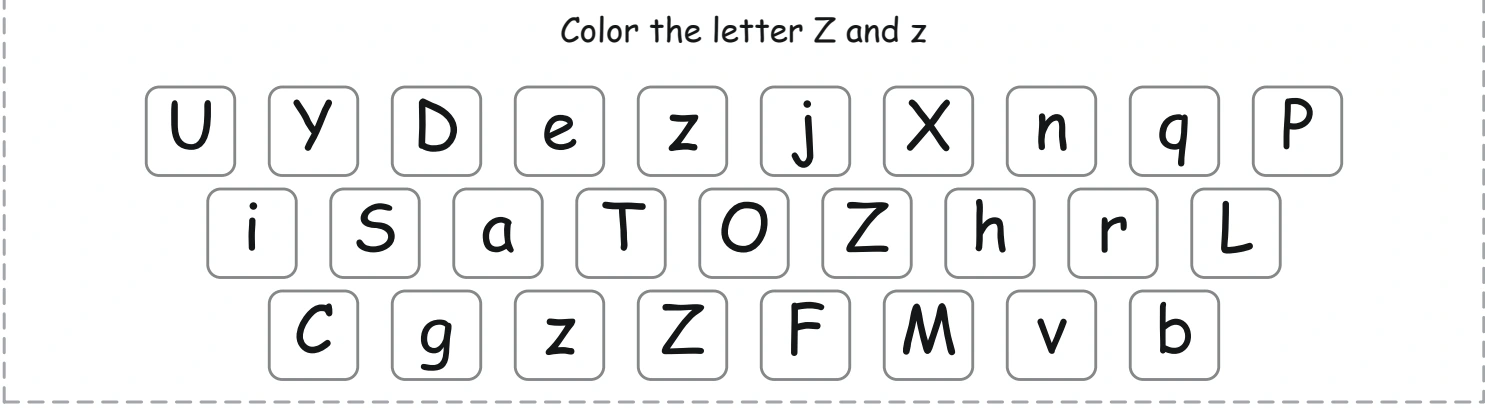
The learner's Z/z inspection can stay visual, with the adult coordinates set aside and the models in sight, compare a candidate's full outline and move to the next character after a decision. A pointer can mark the route when the learner looks up at the reference and then returns to the field.
The adjacent bottom-row targets give the neighbour habit another purpose. Finding one does not finish that section. Zz Letter Spotting supports checking beside a successful circle, with the diagonal and horizontal parts considered together. A slanted fragment alone is not enough to establish the complete letter.
Five zebra-café spotting games: Zz Letter Spotting
Pizza pair inspection: Zz Letter Spotting
Read a completed Pizza card and touch each z separately. Remove the finger cue and locate both in Zz Letter Spotting. Keep the focus on two printed targets, without asking the learner to pronounce an invented pair of isolated sounds.
Diagonal bridge: Zz Letter Spotting
Arrange strips into a finished Z and point to the diagonal linking its horizontal parts. Compare the construction with the supplied model. Put the Z construction away before tracing from the source cues.
Lizard visitor: Zz Letter Spotting
Read Lizard beside a picture and track past its opening to z after i. Invite the child to match that character with the lowercase reference. Adult reading remains available for the complete animal label.
Zebra sign keeper: Zz Letter Spotting
Place a completed Zebra sign beside the puppet and ask the learner to show its opening Z to another person. Zz Letter Spotting can support the case comparison, with a pointing answer accepted as an explanation.
Bottom-row neighbours: Zz Letter Spotting
Inspect the final tile row together and continue beside each match. One partner points while the other compares with the model, then exchange roles. Complete inspection in Zz Letter Spotting is the shared goal, rather than a race to collect circles.
A home pizza-menu note, imagined: Zz Letter Spotting
Picture Zane making a pretend menu at a kitchen table. A family member prepares Pizza on a completed card and reads it naturally. Zane finds one z, checks its neighbour and points to both. They compare the pair with Pizza on Zz Letter Spotting, keeping the ordinary source spelling visible.
The family member asks how the target connects its top and bottom. Zane follows the diagonal with a finger. “You showed the linking stroke” names an action the adult can actually observe. The visit can finish after that comparison without requiring an independently written menu or several new words.
A later return may begin with Lizard's interior letter or the adjacent bottom-row tiles. The stable model anchors a changing starting activity. This imagined use gives repeated supported attention a practical setting, with no promise that one successful encounter establishes recognition in all fonts and contexts.
Match the next step to the observation: Zz Letter Spotting
For learners approximately three to six, Zz Letter Spotting may use a child-led search, joint pointing or adult-assisted marks. Recognition of z can develop ahead of comfortable control of its complete pencil sequence. Allow an accessible response to show the letter decision, with movement help offered separately.
If Pizza's second target is missed, inspect the neighbour. If only word openings are checked, track Lizard beyond i. For an overlarge whole-word circle, show a Z/z character loop on a different label. If a diagonal reverses, return to the source route. Each response addresses a visible issue instead of labelling the learner's overall ability.
Regular short encounters can start with a remembered feature: two neighbours, an interior position or a linking diagonal. Let the child choose a small section of Zz Letter Spotting and stop with a discovery they can show. The next visit can continue from that observation without repeating a long full-page routine.
Printable options and further ideas: Zz Letter Spotting
Compare Zz Letter Spotting with Zz Worksheet. A listening follow-up to Zz Letter Spotting is First Sound Choices. For Zz Letter Spotting, explore Aa Worksheet.
Adults can explore NAEYC's play resources when planning another participatory setting. For shared reading and language activities, visit the PBS Parents literacy pages. These optional resources can support an extension while the source worksheet keeps its own clear instructions.
Use the page's controls to download the original Zz Letter Spotting sample. A qualifying member can choose the protected clean Z/z single through its own download control. Before printing, inspect the complete frame and check that the small diagonals and paired Pizza letters remain distinct. A comfortable scale supports a clear character-by-character comparison.
To obtain the full A–Z document for $5, use the Alphabet Wordwork Collection card and its separate purchase route. The file brings the twenty-six clean letter pages together. Buying that collection and accessing this individual clean worksheet through membership are different choices. The direct card keeps the larger set easy to find from Zz Letter Spotting.
Popular Worksheets
Printable resources families and teachers are downloading now.
 Free
 Free
 Free
 Free