
Animal Line Copywork: 3 Joyful Picture Studies
Animal Line Copywork: Keep angular animal motifs faithful to the model instead of embellishing their outlines.
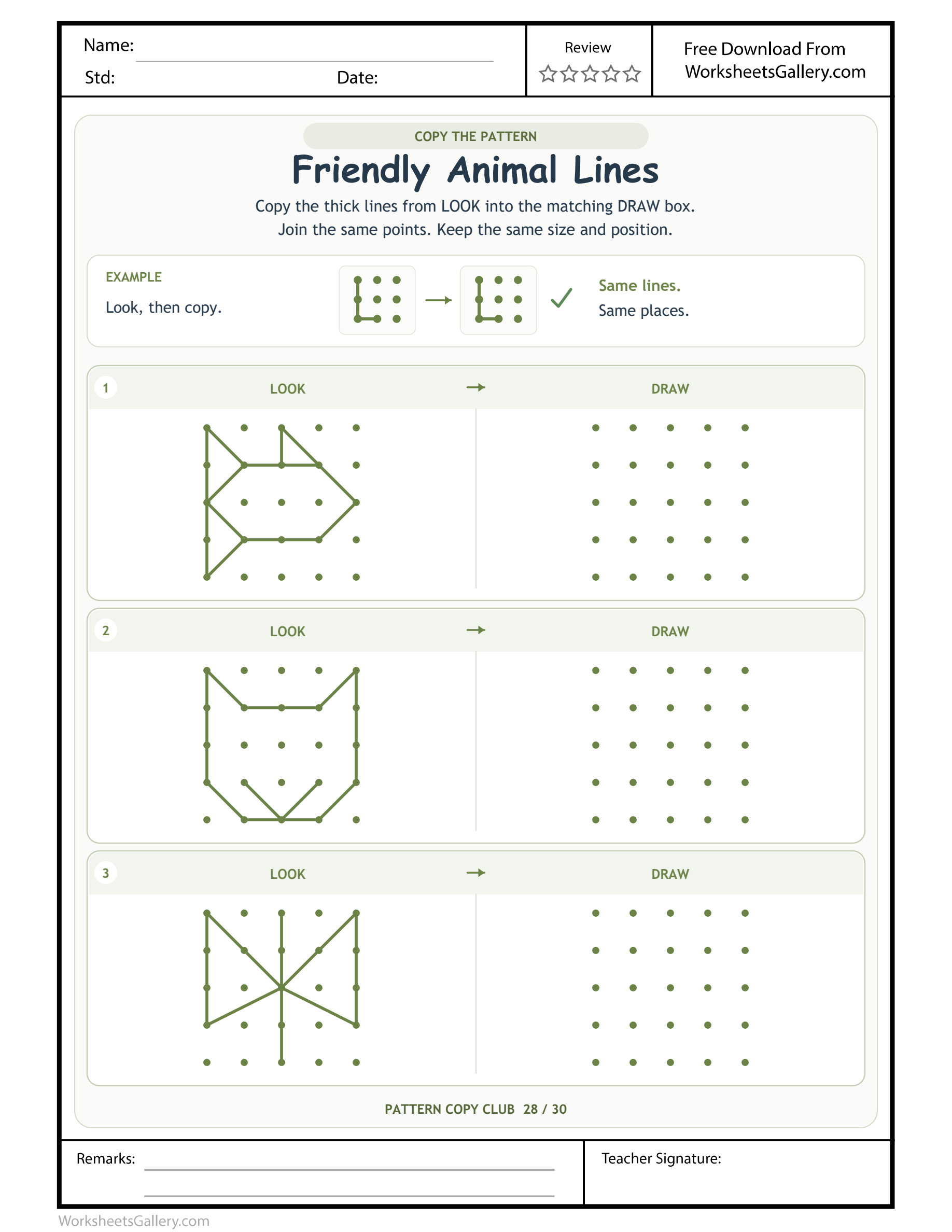
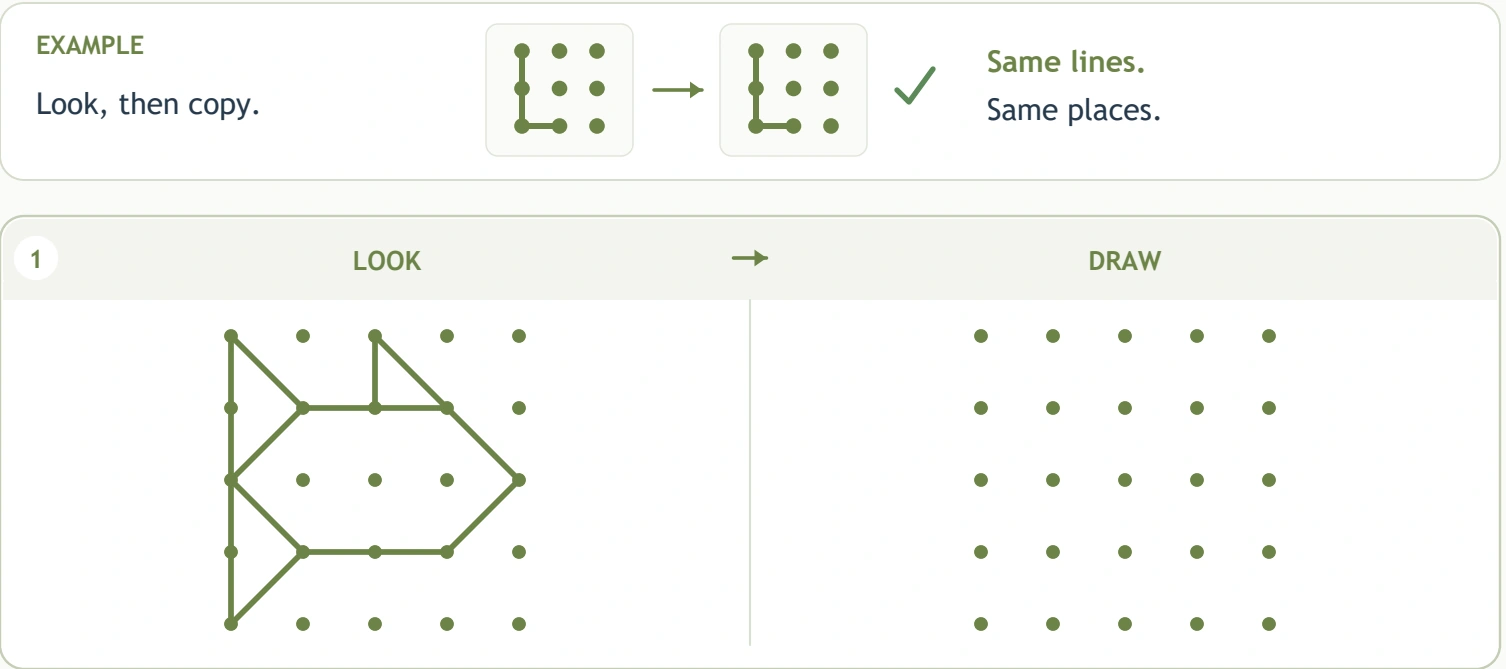
Creatures can be suggested by corners and slants without a single curved outline. Animal Line Copywork offers three animal-inspired models for children to recreate on twenty-five-point fields. The Friendly Animal Lines source includes a right-facing fish-like design, a pointed-ear face and a bow-like angular motif with a raised centre. Its small completed example introduces the transfer from LOOK to DRAW. Choose this printable for a learner who enjoys guessing what a geometric picture suggests, then inspecting the actual line connections rather than replacing them with a familiar animal drawing from memory.
Let the creature name start a conversation — Animal Line Copywork
Children may give the angular pictures different names, especially the final motif. That discussion can make Animal Line Copywork engaging without changing the copying goal. Ask what visible feature prompted the child's idea, then inspect the endpoints of that feature. The geometry remains available even if two people imagine different creatures.
Copy the supplied lines rather than an expected animal symbol. A child who adds round ears, eyes or whiskers may produce an expressive picture, but those additions need their own creative surface. Here, the exact reference determines which connections belong in the answer field.
Meet the three angular constructions: Animal Line Copywork
| Animal Line Copywork pair | Visible Friendly Animal Lines model | Model structure |
|---|---|---|
| 1 | Right-facing fish with angular tail | Friendly Animal Lines: 16 selected segments / 25 markers |
| 2 | Pointed-eared animal face | Friendly Animal Lines: 16 selected segments / 25 markers |
| 3 | Bow-like animal motif with a centre upright | Friendly Animal Lines: 16 selected segments / 25 markers |
Every Animal Line Copywork practice area has twenty-five markers. The sixteen bold segments in each model describe the printed construction; the equal totals do not mean the shapes are interchangeable. Aligned short pieces can be grouped for drawing, and the learner need not make sixteen separate pencil lifts or follow a prescribed stroke route.
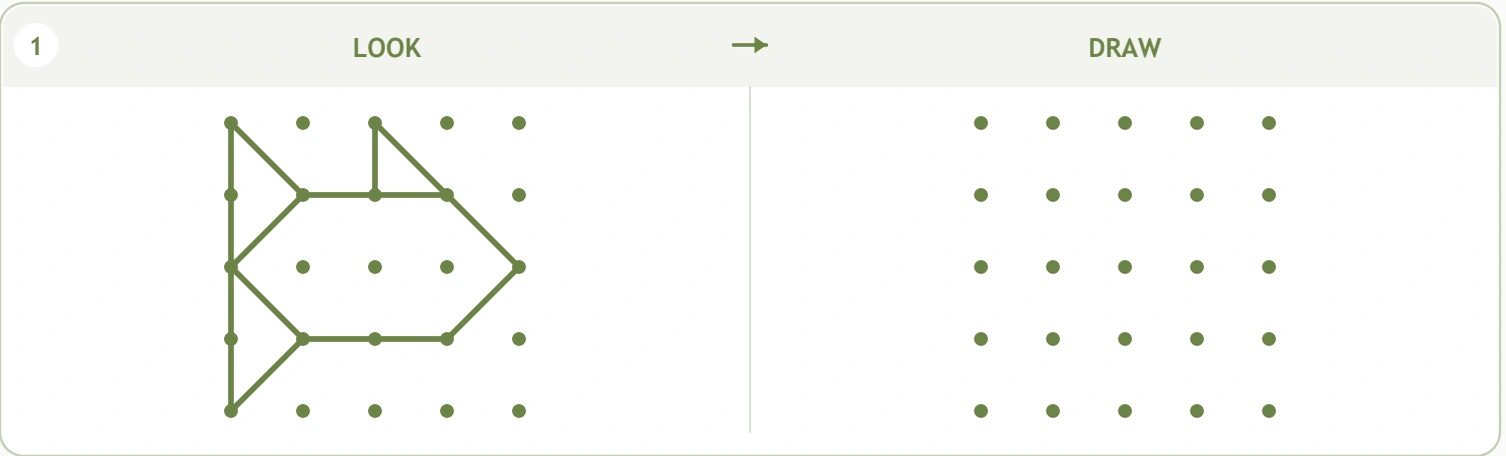
The fish-like form has a particular direction: Animal Line Copywork
The first Animal Line Copywork model suggests a creature facing right, with an angular tail at the opposite end. Identify the pointed or projecting parts before drawing. Then locate one clear counterpart in DRAW and compare the next corner it connects to. Copy a short portion before inspecting the rest.
A child might know many ways to draw a fish. Keep that knowledge available for another picture while making the present question specific: where does this tail edge end? Repeated returns to LOOK support a visible comparison, avoiding the assumption that recognition supplies the whole drawing plan.
Bodhi's imagined animal-design table: Animal Line Copywork
Imagine Bodhi arranging strips into a fish at home. An adult brings Animal Line Copywork nearby and asks which parts resemble the printed first model. Bodhi notices the direction of the tail, then chooses one long slant to transfer onto paper. They compare its two ends before continuing.
This invented home example illustrates a teaching conversation rather than a measured result. The strip creature can later gain invented eyes, fins or a companion. On Animal Line Copywork, Bodhi's small copying goal stays tied to the reference. A lively spoken underwater story can continue even when the paper attempt stops after one inspected section.
Six observations hidden inside a recognisable picture
- Feature discrimination. A learner identifies the specific corners that suggest a tail, ear or central point.
- Direction awareness. A picture's facing direction is preserved rather than flipped to a preferred familiar version.
- Part-to-whole planning. Head-like and tail-like sections become manageable groups within an overall line design.
- Pencil aiming. Straight slants and short corners call for controlled movement toward selected anchors.
- Reference checking. Recognising an animal does not replace looking back at its actual supplied construction.
- Descriptive reasoning. Children explain which visible feature supports an interpretation and where that feature belongs.
These opportunities within Animal Line Copywork support adult observation, not a formal judgement about development. A child may accurately explain a tail's position while drawing an uneven edge. Appreciate the spatial understanding and offer a larger construction when the small pencil demand becomes uncomfortable.
Pointed ears need their own corner checks: Animal Line Copywork
The second Animal Line Copywork design suggests a face with raised pointed ears. Locate one ear tip and follow the two edges that meet there. Notice how it sits relative to the lower face shape. Copying a standard pet face with rounded ears would overlook those particular relationships.
The source does not require facial decoration. If the learner wants to give the creature an expression, welcome a separate original drawing. Keeping the comparison task specific does not mean all animal art must follow a model; it simply clarifies what this particular page asks the child to inspect.
A classroom gallery of different interpretations: Animal Line Copywork
In a possible classroom use of Animal Line Copywork, invite pupils to say what one angular model reminds them of and point to their visual clue. The teacher acknowledges different interpretations, then demonstrates copying one actual edge on a larger spare field. Each learner keeps their printed reference visible.
This hypothetical gallery activity separates naming from connection accuracy. An adult can observe whether a child preserves the chosen ear or tail endpoint without requiring everyone to tell the same story. Some learners may copy a short feature while others attempt a whole outline. Their comparison choices matter more than uniform completion.
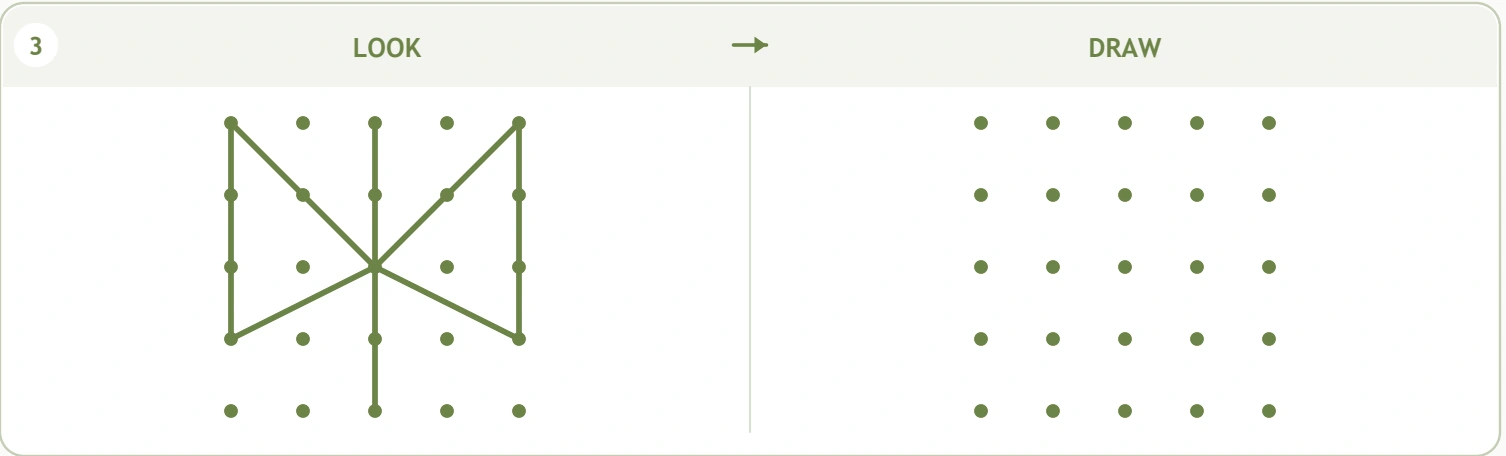
Check the raised centre in the final motif: Animal Line Copywork
The last Animal Line Copywork reference has opposed angular parts around a central upward feature. Its bow-like appearance can tempt children to draw a familiar symmetrical bow or butterfly. Inspect the exact outline before settling on that shortcut. A creature name is useful conversation, not an answer key.
Follow one side from a recognisable outer corner and compare the matching side separately. Do not add a centre line merely because the imagined creature seems to need one. Pencil lifts are allowed, and an adult can help organise a manageable group without deciding every movement for the child.
A detailed animal invitation for early drawers: Animal Line Copywork
Supported later-preschool and early-primary learners, broadly four to seven, may explore Animal Line Copywork. The twenty-five-point fields and long angular contours can be demanding for children still beginning with simple marks. Try locating one tail or ear corner by pointing before asking for pencil work.
If the many anchors compete for attention, use broad sticks or tape on another surface. Let the learner compare the same relationship at a larger scale. Return to print when a short feature feels approachable. The presence of three models does not mean all three must be finished during one sitting.
Four animal-art games outside the answer boxes
Build a creature from straight pieces: Animal Line Copywork
Invite the child to invent an angular animal with strips. A partner recreates the visible model and describes the features they noticed. Discuss how straight pieces can suggest a creature without tracing curves. Relate one positional comparison to Animal Line Copywork if the learner is interested.
Hold a tail-direction inspection: Animal Line Copywork
Make two broad fish-like designs facing opposite directions. Ask which one corresponds to a supplied reference and what clue makes the choice clear. Keep both visible, then swap roles. This gives left-right comparison a meaningful picture context.
Give the ear-maker an order: Animal Line Copywork
A pretend craftsperson receives a request for one pointed ear at a particular height. The child identifies the relevant corner in a large model and places matching pieces. The short roleplay uses descriptive language without adding invented instructions to Animal Line Copywork.
Open an expressive animal studio: Animal Line Copywork
Offer spare paper for round faces, whiskers and imaginative features. Display that original art beside an exact line copy. Discuss what each task allowed. Creative freedom is welcome in the studio, while the copied reference keeps its supplied outline and connections.
Correct a feature without criticising the creature: Animal Line Copywork
Common Animal Line Copywork differences include reversing the fish, rounding angular ears, adding facial details or replacing the final motif with a familiar symbol. Ask which endpoint first departs from LOOK. A local comparison about an ear tip or tail corner is easier to use than a judgement that the animal looks wrong.
The visible construction matters more than agreeing on an animal name. If repeated erasing makes a feature difficult to inspect, discuss the intended repair with movable pieces. The session can end with a clear explanation. There is no need to darken every edge repeatedly just to produce a more finished-looking page.
Leave room for a willing return: Animal Line Copywork
The animal associations may give Animal Line Copywork an inviting story, while the distinct features provide natural small goals. Let the learner choose which feature to compare next. A specific observation such as “You checked the ear's top point before drawing both sides” makes encouragement concrete.
Offer occasional short returns among storytelling, construction and free art. Regular practice can mean one careful feature rather than another complete page. Stop while the child still has enough energy to explain a discovery. A later visit can begin with that familiar feature before exploring a new part of the model.
Download an animal reference at its original size: Animal Line Copywork
The free file preserves the supplied Friendly Animal Lines original. The separate clean Animal Line Copywork PDF is available through the premium download to accounts with qualifying active membership. Its website watermark, domain wording and promotional ads are removed, while the line models, guides, activity text and student fields are retained.
The native package card points to all thirty clean sheets together, sold separately for $3. Save the edition authorised for your account. Choose US Letter paper in the print settings and retain original size with 100% scaling or Actual Size. Inspect the full border before printing Animal Line Copywork, so the fine ear and tail anchors keep their intended spacing.
More drawing comparisons and adult resources: Animal Line Copywork
Compare Animal Line Copywork with Path Copy Thinking. After Friendly Animal Lines, try Drawing Size Choices. For Friendly Animal Lines, consider Shape Border Journeys.
For activities around Animal Line Copywork, adults can explore PBS Parents' ideas for learning through everyday activities and NAEYC resources about family play. These educational links offer optional independent reading, not collection attachments or endorsements of this printable.
Popular Worksheets
Printable resources families and teachers are downloading now.
 Free
 Free
 Free
 Free