
Honeycomb Pattern Copy: 4 Brilliant Scaffold Games
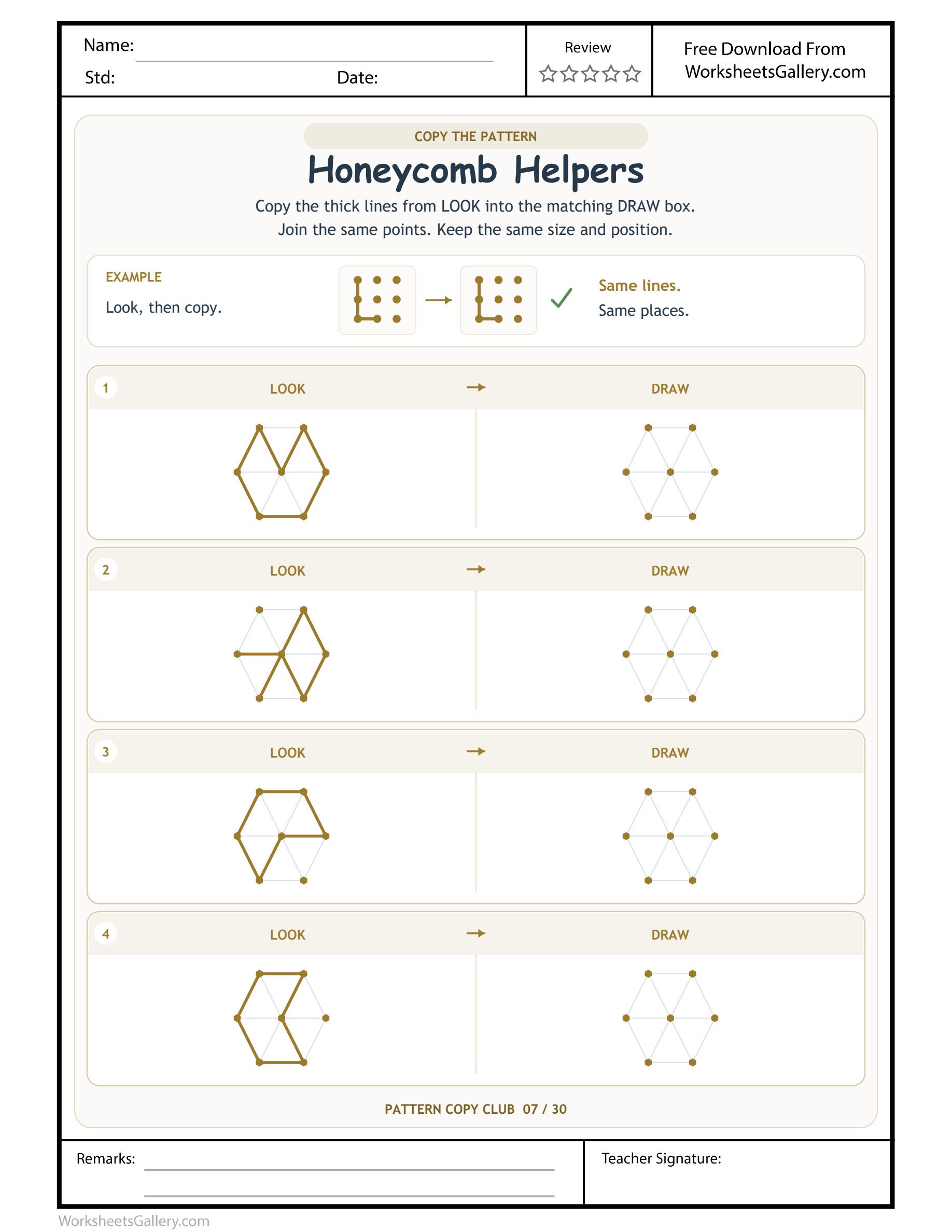
Honeycomb Pattern Copy: Distinguish thick target segments from the pale full hexagonal scaffold.
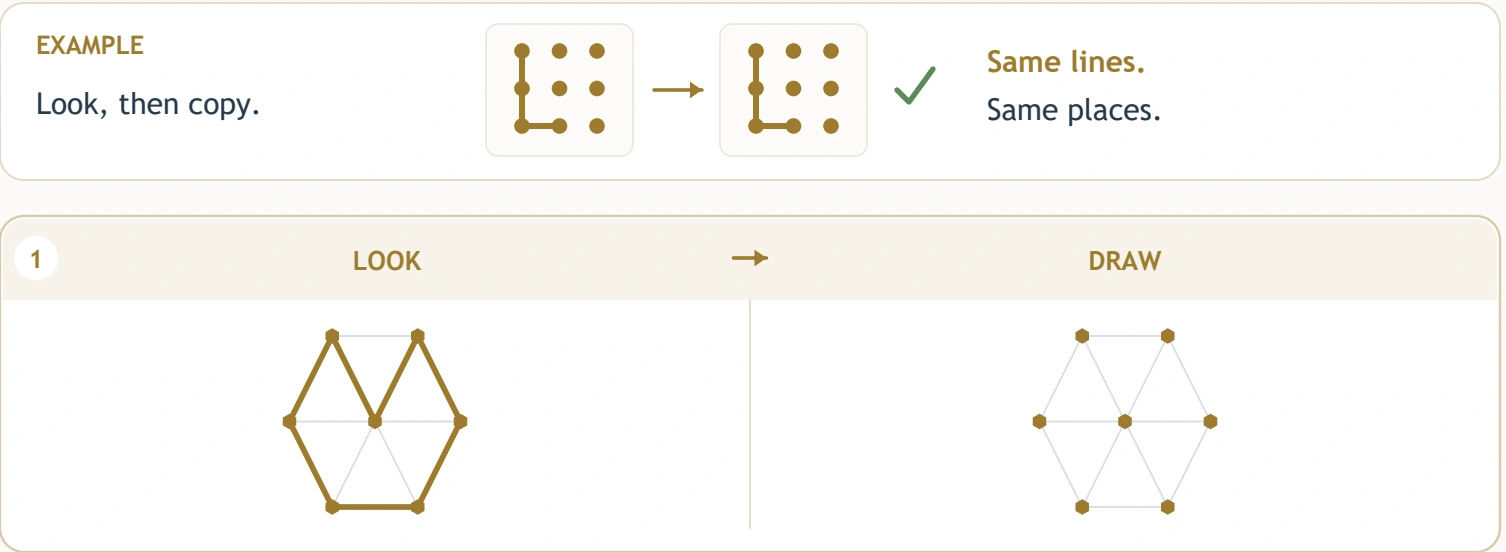
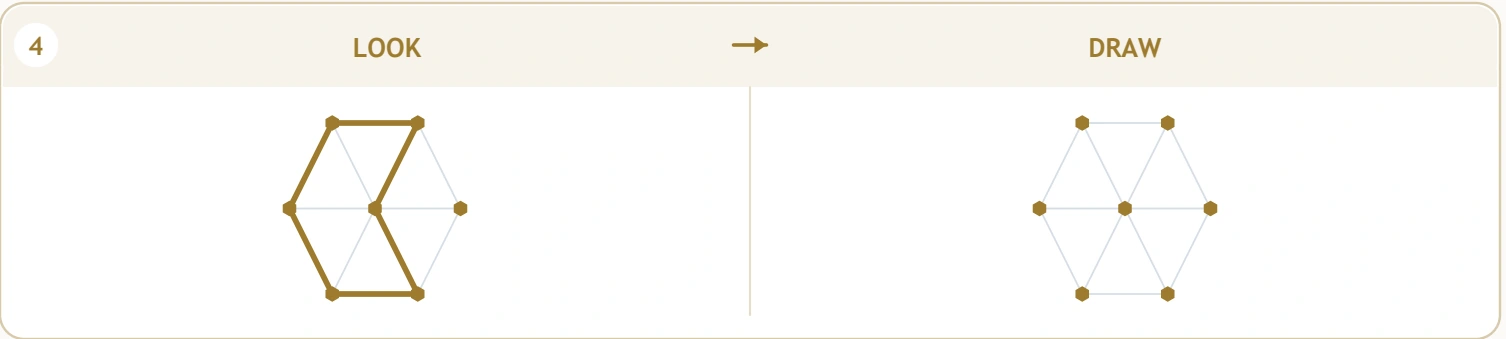
Pale lines can offer support without giving away the drawing. In Honeycomb Pattern Copy, a light seven-point hexagonal network appears beneath four golden models and beside them in DRAW. Children study the bold selected segments on the LOOK side and reproduce those segments on the matching scaffold. The Honeycomb Helpers worksheet begins with a completed example, then changes the arrangement of its thick lines in each practice pair. Use this printable to explore selective looking: which connections are part of today's design, and which faint lines simply help the child find a place?
Why the DRAW side already has faint lines — Honeycomb Pattern Copy
The light network is intentional. Honeycomb Pattern Copy uses the same pale scaffold in both halves of a pair, while only LOOK supplies the complete bold design. A child is not expected to erase the faint structure, cover it, or assume the right side is already finished.
Compare one thin connection with one thick gold connection. Ask which line would need to be added to make DRAW agree with LOOK. The support network stays pale. This opening distinction keeps Honeycomb Pattern Copy from becoming an exercise in darkening every available edge, which would produce the same web regardless of the model.
Seven anchors, several different relationships: Honeycomb Pattern Copy
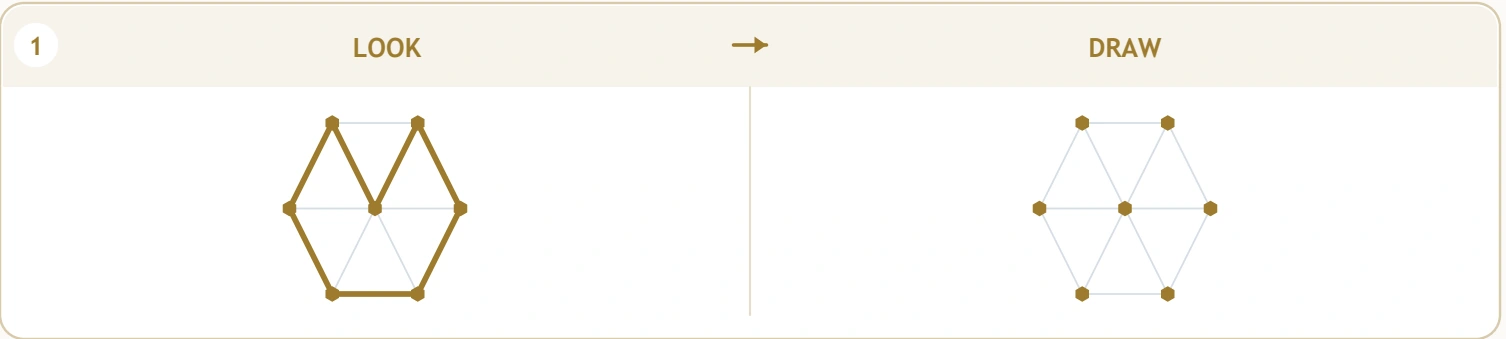
The Honeycomb Pattern Copy points include a centre and surrounding hexagonal positions. They are not a square three-by-three field, so simply counting rows as if every row were equally full can be misleading. Invite the child to inspect the top pair, the side points, the low pair and the central meeting place.
The opening model has a crown-like upper shape and a lower outline. Other models shift their interior connections, leave particular outside edges unselected or create an inward bend. With Honeycomb Pattern Copy, the child transfers those choices across matching anchors. There is no printed number code specifying a route through every point.
Four honeycomb designs to inspect
| Honeycomb Pattern Copy pair | Visible Honeycomb Helpers model | Model structure |
|---|---|---|
| 1 | Crown-like outline on a pale hexagon scaffold | 7 anchors / 7 bold pieces in Honeycomb Helpers |
| 2 | Central crossing with a right diamond | 7 anchors / 6 bold pieces in Honeycomb Helpers |
| 3 | Upper cap and inward lower angle | 7 anchors / 6 bold pieces in Honeycomb Helpers |
| 4 | Left outline with a central kink | 7 anchors / 6 bold pieces in Honeycomb Helpers |
The Honeycomb Pattern Copy counts refer to heavy model segments only. Faint scaffold lines are not included in those totals. They remain visible to guide position, even when the particular model does not use them. Adults can consult the structure while the child works through a small chosen part rather than counting every line aloud.
A quiet way to introduce bold and pale: Honeycomb Pattern Copy
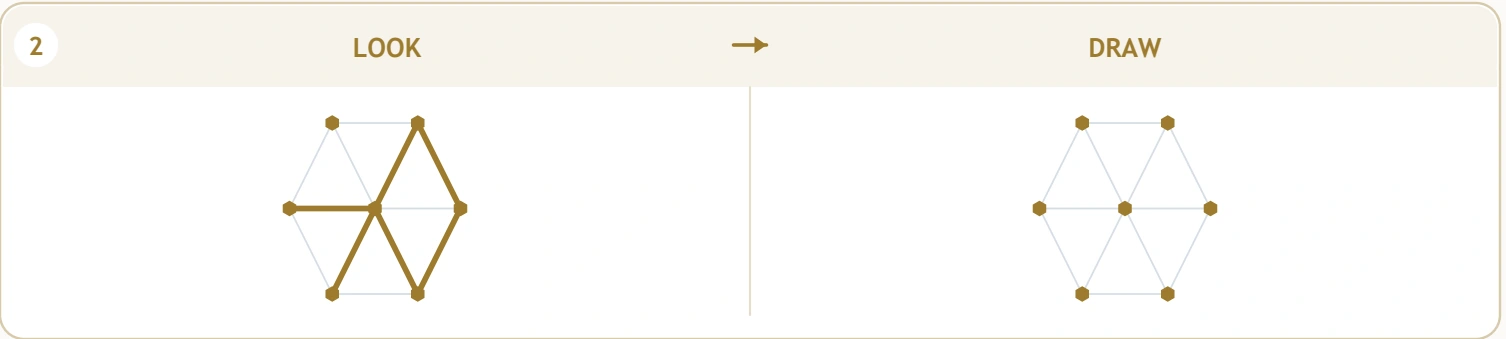
Before using Honeycomb Pattern Copy, draw a light pencil line and a darker line on spare paper. Compare their appearance without asking the child to press harder and harder on the worksheet. A comfortable pencil can make a visible copied stroke; there is no requirement to match the printed gold or create a perfectly uniform thickness.
Next, show the worked L example and explain how it demonstrates correspondence. Return to one honeycomb pair and identify a single bold segment. Find its two partner anchors on DRAW, make the connection and compare it. Repeating that small decision is a clearer start to Honeycomb Pattern Copy than presenting the whole network as one drawing to memorise.
A helpful entry level for this scaffold: Honeycomb Pattern Copy
Children around four to seven may explore Honeycomb Pattern Copy when they can distinguish the two line weights and attempt short slants. Some preschool learners will need an adult to point out the bold design initially. More experienced children can describe a selected edge or central join before copying it.
If the scaffold's pale lines make the sheet feel busier rather than easier, return to a simpler field with fewer competing marks. Support should be useful to the individual learner. Offer one Honeycomb Pattern Copy pair at a time and take a break when attention or pencil comfort fades, even if three appealing designs remain untouched.
Five practice opportunities inside the web: Honeycomb Pattern Copy
- Selective attention. The child separates target strokes from background guides instead of treating every visible line equally.
- Centre recognition. A shared inner anchor gives several segments a common meeting place that must be transferred accurately.
- Orientation matching. A connection on the left remains on the left in its partner field; the task does not request reflection.
- Short slant control. A child chooses two anchors and guides the pencil between them, pausing before the next connection.
- Reasoned explanations. Saying why a faint edge stays untraced makes the child's interpretation available for discussion.
These Honeycomb Pattern Copy opportunities involve attention, planning, movement and vocabulary. They do not require the learner to know a formal definition of a hexagon or promise a particular developmental result. Keep observations attached to a visible action, such as finding the middle join without adding an unprinted branch.
Gus's pretend hive desk at home: Honeycomb Pattern Copy
Imagine Gus making a paper-bee display while an adult offers Honeycomb Pattern Copy. Gus initially traces the entire pale outline on DRAW. The adult places a finger beside one unused edge in LOOK and asks whether it is as bold as the selected design. Together they inspect the difference in line weight.
This invented home scenario suggests a conversation rather than reporting a child's outcome. Gus can build a complete pretend honeycomb elsewhere, while Honeycomb Pattern Copy asks for the specific thick-line arrangement. The adult might begin a fresh pair and compare only its top two connections, giving the learner an achievable way to apply the new distinction.
Make a classroom comparison circle: Honeycomb Pattern Copy
In an imagined classroom use of Honeycomb Pattern Copy, a small group discusses one model before anyone draws. Children point to selected and unselected scaffold edges, explaining their choices with words such as dark, pale, centre and side. An adult confirms the distinction by referring directly to the printed model.
Each learner then works on a separate copy. The teacher watches whether a child preserves one intentional gap instead of judging the whole page by how much has been traced. A note about distinguishing background from target can inform the next lesson. Honeycomb Pattern Copy need not become a competition to complete the darkest or most decorated honeycomb.
Copy a connection, then decide again: Honeycomb Pattern Copy
Begin with an edge the child can clearly identify. Point to its two anchors in LOOK and then in DRAW. Draw that connection and pause. Return to the model to choose another heavy segment rather than continuing automatically around the outside. Some parts may be easier to group together; others deserve a pencil lift and a fresh starting point.
For Honeycomb Pattern Copy, checking after a short group of lines limits confusion. Ask whether a new segment is supported by the model or merely available in the pale guide. A correct location with a wobbly stroke can be acknowledged before discussing steadiness. The adult can demonstrate a similar movement elsewhere without taking over the child's copy.
Five honeycomb extensions for hands-on play
Create a removable-edge hive: Honeycomb Pattern Copy
Place a few broad paper strips over a lightly drawn large hexagonal guide. A partner copies only the strips using a second guide. Remove one strip and compare the new design. The game gives the bold-versus-background distinction from Honeycomb Pattern Copy a physical form.
Play centre or rim
Put large tokens at a centre and around a ring. Name one position and ask the child to point to it. Then let the child become the caller. Keep the field large and uncluttered so the relationship is easier to discuss than on a small printed diagram.
Make a bee's gallery label: Honeycomb Pattern Copy
Choose a completed stick design and invent a short spoken description of its special corner. An adult can write a label such as central fork or open side. This extends Honeycomb Pattern Copy's spatial vocabulary without asking the child to spell unfamiliar words independently.
Sort pale and bold samples
Draw a few light and dark lines on separate cards. Sort them by appearance and discuss which would be easier to notice from across a table. Avoid turning the game into a pressure exercise; line weight is a visual clue, not a demand to grip the pencil tightly.
Curate one missing connection
An adult builds a simple strip model and a copy missing one selected edge. The child identifies which connection would make the copies agree. Swap the roles and enjoy the adult's inspection. This cooperative puzzle complements Honeycomb Pattern Copy without altering its supplied answer fields.
Errors that can turn every hive into the same web: Honeycomb Pattern Copy
Darkening the complete scaffold is the main Honeycomb Pattern Copy misunderstanding. Rotating a model mentally, adding a symmetrical partner to an open branch, or connecting a nearby but incorrect outer point can also change the copied design. Compare the exact chosen edge rather than relying on whether the result looks attractive.
Leave unselected guide edges light. If a child has already traced too much, explain the difference on another model instead of repeatedly rubbing at the page. A fresh short attempt may be kinder and clearer. The learner can still talk about which edges belong even when the original pencil marks cannot be neatly removed.
Keep selective looking enjoyable
The pale network can feel like a puzzle waiting to be revealed. Use that interest to invite another Honeycomb Pattern Copy visit, perhaps choosing the design with the inward bend next time. Let the child name a feature and decide whether to draw one connection or a small group.
Store the sheet with a dated note about a strategy rather than a score. “You noticed the guide without tracing all of it” recognises useful restraint. Rotate Honeycomb Pattern Copy with construction play and free art, allowing the child's invented hive to be as elaborate as they wish on separate paper.
Save the scaffold sheet for printing: Honeycomb Pattern Copy
The free download choice supplies the original Honeycomb Helpers sample. Eligible active members can use their account to request the separate clean Honeycomb Pattern Copy premium PDF. Its pages have no website watermark, domain wording or promotional ads, while the pale guide and bold activities remain preserved.
The native collection card leads to the complete thirty-sheet product at $3. After saving the file authorised by your access, keep the US Letter page at its original dimensions by selecting Actual Size. Inspect a test page to ensure the thin scaffold remains distinguishable from the target strokes. Keep Honeycomb Pattern Copy's original spacing and full border rather than compressing it into a small multi-page print layout.
Build another kind of comparison
Compare Honeycomb Pattern Copy with Drawing Size Choices. After Honeycomb Helpers, try Shape Border Journeys. For Honeycomb Helpers, consider Path Copy Thinking.
For families balancing Honeycomb Pattern Copy with open-ended play, NAEYC offers play-related family reading. Adults can also browse PBS Parents' everyday learning resources for activities away from paper. The linked education organisations are independent of this worksheet and its purchase options.
Popular Worksheets
Printable resources families and teachers are downloading now.
 Free
 Free
 Free
 Free