
Rainbow Point Transfer: 6 Joyful Pencil Designs
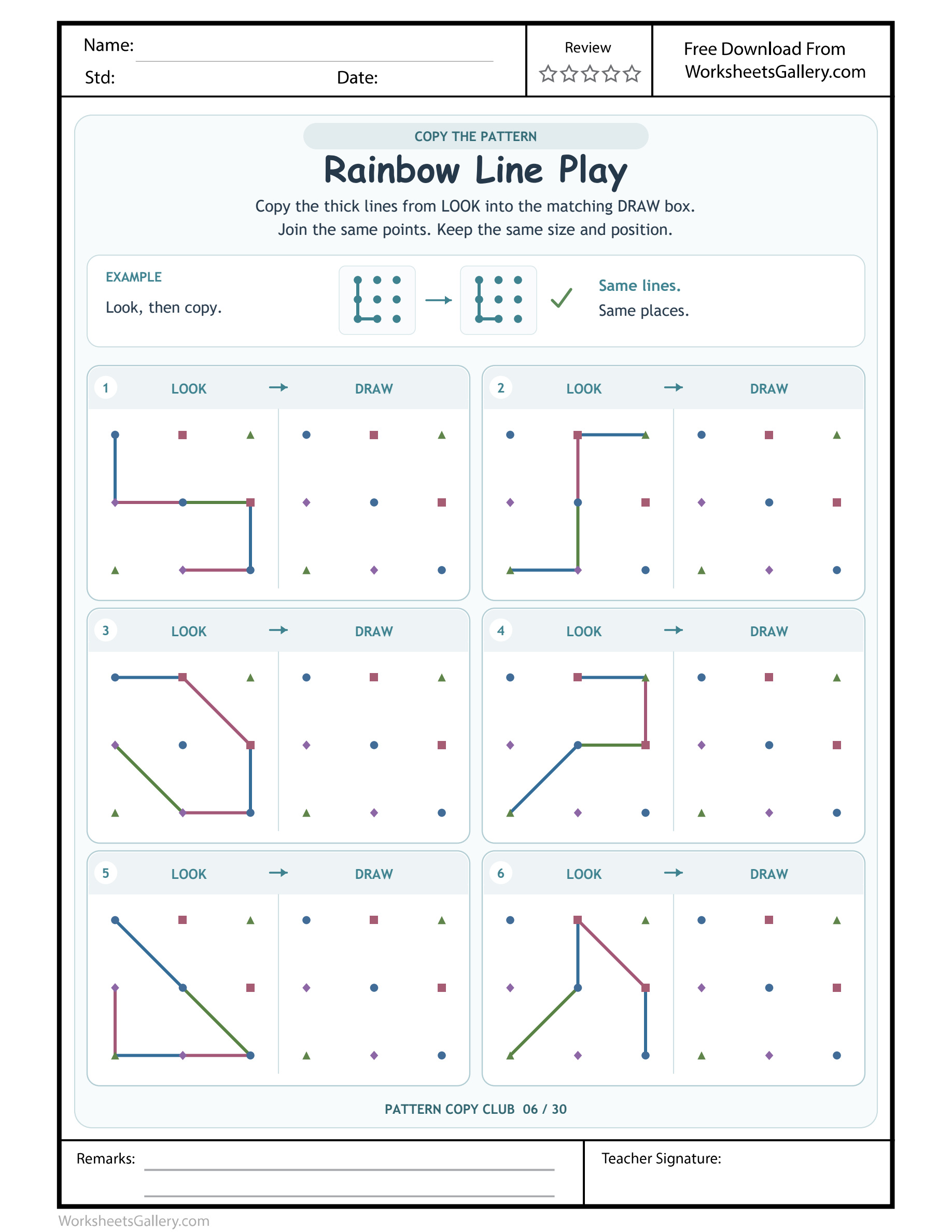
Rainbow Point Transfer: Use the positions of mixed coloured markers to copy the model rather than invent a colour sequence.
Colour can help a child notice a point without deciding the route for them. Rainbow Point Transfer uses blue circles, pink squares, green triangles and purple diamonds as anchors for six angular line models. Children copy the printed lines from LOOK into a matching DRAW field, preserving each bend and endpoint. The Rainbow Line Play sheet also carries a completed example above the independent work. Offer this colourful page when a child likes colour but is ready to look beyond it, using position and line direction to decide where the next pencil movement belongs.
The colours identify places, not a repeating rule — Rainbow Point Transfer
The source does not ask a child to continue blue, pink, green and purple as a colour sequence. Rainbow Point Transfer is a model-copying activity. The mixed markers remain in corresponding locations on both sides, and the bold lines show which of those locations to connect.
Children may work in pencil or choose their own colours. Reproducing every printed line hue is optional; keeping the endpoints and bends is the central task. A matching location matters more than a matching crayon. This distinction lets Rainbow Point Transfer stay accessible when only a pencil is available or when a child prefers one comfortable drawing tool.
Look at a point, then inspect its neighbours: Rainbow Point Transfer
One blue circle is not enough information to identify a location, because the field contains several circles. A child using Rainbow Point Transfer must also notice whether the chosen marker is high, central or low. Colour and silhouette can support attention, but position completes the identification.
Invite the learner to describe a destination with two clues, such as the middle blue circle or the upper pink square. If colour names are unfamiliar, pointing is enough. The adult can model position words without turning Rainbow Point Transfer into a separate naming test. The picture field remains a shared reference that both people can inspect.
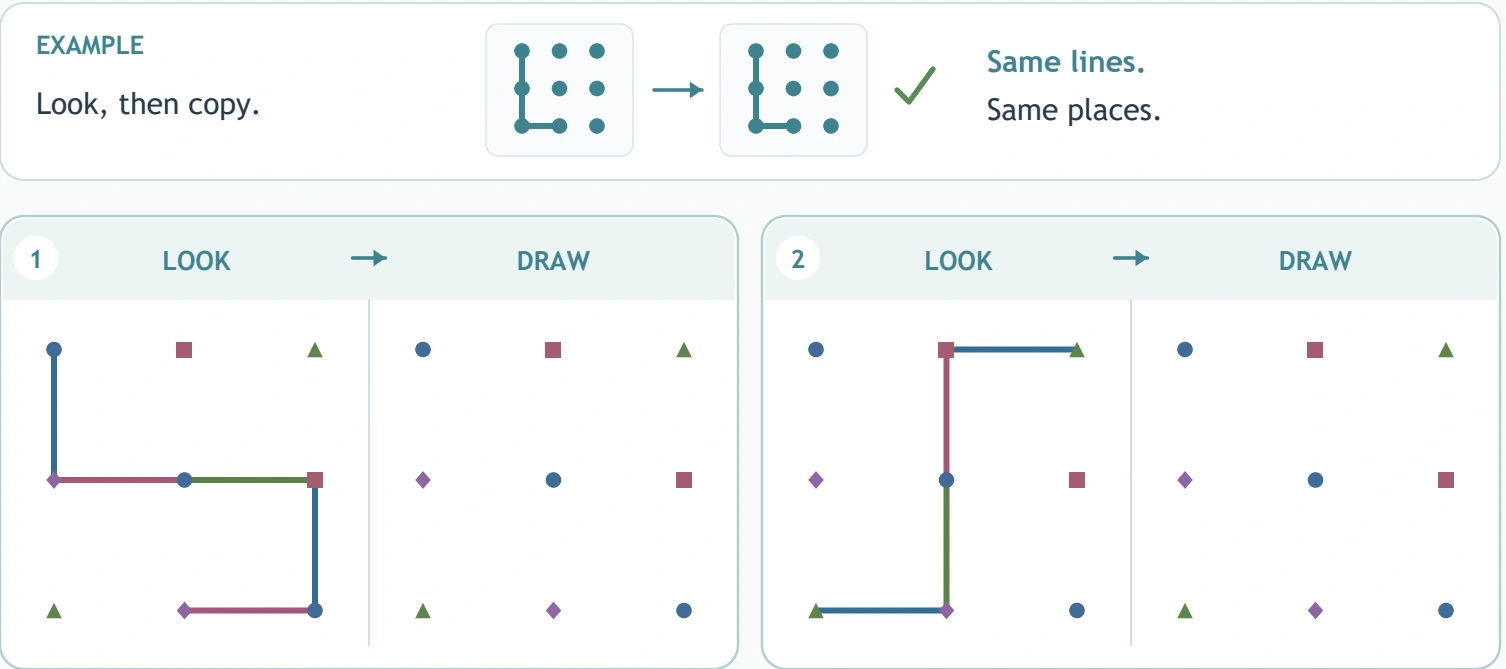
The six models change their shape: Rainbow Point Transfer
| Rainbow Point Transfer pair | Visible Rainbow Line Play model | Model structure |
|---|---|---|
| 1 | Stepped line with a lower return | 9 anchors / 5 bold pieces in Rainbow Line Play |
| 2 | Long centre upright with opposite arms | 9 anchors / 4 bold pieces in Rainbow Line Play |
| 3 | Open angular loop | 9 anchors / 5 bold pieces in Rainbow Line Play |
| 4 | Short upper bend and a long diagonal | 9 anchors / 4 bold pieces in Rainbow Line Play |
| 5 | Large diagonal beside a lower frame | 9 anchors / 5 bold pieces in Rainbow Line Play |
| 6 | Forking diagonal with a right upright | 9 anchors / 4 bold pieces in Rainbow Line Play |
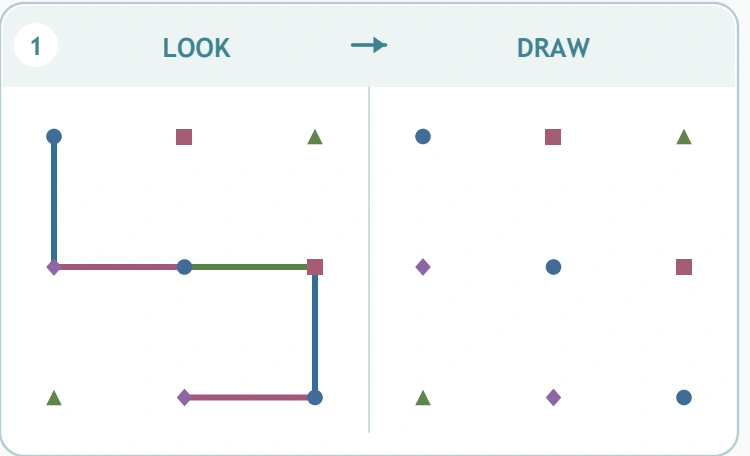
The opening Rainbow Point Transfer design steps across the centre and returns along part of the lower row. Later models introduce diagonal branches and intentional openings. These are not six identical paths in different colours. Compare a fresh LOOK model before each attempt instead of carrying the previous shape into the next field.
Before the first independent mark: Rainbow Point Transfer
Place Rainbow Point Transfer in portrait orientation and read its copying directions aloud. Show the small L example: its copied lines sit at matching points in the next box. Then choose one practice pair and identify the reference side separately from the field where the child will draw.
Ask the child to point to a promising starting endpoint. Find the same position in DRAW, compare the next destination, and only then begin the stroke. At a junction, take another look. The sheet supplies a visible model throughout; there is no need to cover it or expect the whole path to be remembered after one glance.
Choose by drawing comfort, not colour knowledge
Many learners from about four through seven in preschool or the first school years can try parts of Rainbow Point Transfer. Knowing all four colour names is not a prerequisite. More useful signs are willingness to compare nearby fields and enough pencil control to attempt a short horizontal, vertical or sloping connection.
If the mixed symbols feel busy, point to one pair and name only two endpoints. A plain corner activity may be a better entry point for another day. Keep Rainbow Point Transfer as one option within a wider mix of construction, free drawing and movement. The aim is an achievable spatial decision, not endurance in a crowded visual field.
Six things the rainbow field invites
- Combining clues. A learner uses a marker's position along with its colour or shape to locate the correct partner.
- Returning to evidence. Looking back at the model checks a decision rather than signalling that the child has forgotten something.
- Changing direction. Horizontal, upright and sloping strokes require separate movement plans at the visible bends.
- Noticing open ends. A branch stops where the source stops, even if another marker looks close enough to join.
- Controlling a landing. The hand aims at a chosen anchor and pauses before extending the design.
- Explaining a location. Short descriptions such as lower-left triangle help the adult understand what the child intends.
For Rainbow Point Transfer, these are concrete practice opportunities. Avoid attaching a general ability score to one sheet. A child may find the mixed symbols interesting while needing a larger drawing scale, or may plan accurately but prefer an adult to demonstrate the first connection elsewhere.
Faye's colour tray, imagined at home
Imagine Faye sorting large coloured tokens on a mat. A family member offers Rainbow Point Transfer, and Faye announces that all blue circles should be joined. The adult asks what the printed lines actually do. Together they inspect one blue circle that remains unused in the chosen model.
This fictional home example highlights a useful misunderstanding. The colours are clues about markers, not an instruction to link every matching colour. Faye can still make a free colour-joining picture on spare paper afterward. In Rainbow Point Transfer, the adult returns to the visible reference and helps identify one intended endpoint at a time.

A class conversation about useful clues: Rainbow Point Transfer
For an imagined small-group lesson, a teacher places Rainbow Point Transfer beside a tray containing several copies of each coloured shape. Children discover that “the blue one” is ambiguous when there are multiple blue pieces. Adding a position makes the instruction clearer.
Back at their individual worksheets, each child describes one endpoint before drawing. The teacher can accept a gesture plus a simple word and supply fuller language where helpful. A note about using two clues records a specific strategy. The class does not need to finish all Rainbow Point Transfer pairs or reproduce the exact colour order of every printed segment.
Four playful extensions with mixed markers: Rainbow Point Transfer
Open a two-clue delivery desk: Rainbow Point Transfer
Arrange large tokens at several positions on a mat. Ask a partner to deliver a toy to the upper square or lower circle. Then swap roles. Link the game to Rainbow Point Transfer by discussing why colour alone sometimes leaves more than one possible destination.
Build a colour-optional path
Make an angular model using a single-colour string and several differently coloured endpoint cards. Copy it with another string. The finished path can match even though its colour differs. This physical comparison reinforces the central Rainbow Point Transfer requirement without demanding more pencil work.
Design a marker museum: Rainbow Point Transfer
Sort tokens first by silhouette and then by location on a homemade display. Talk about how the same object can belong to different groupings. Keep this as an additional game; the worksheet itself does not ask for sorting or written colour answers.
Tell a stop-at-the-corner story: Rainbow Point Transfer
Let a toy traveller pause at each bend of a paper-strip path. The child explains where the traveller goes next and where it rests. After the story, choose one short Rainbow Point Transfer section whose change of direction resembles the physical construction.
Troubleshoot the tempting extra connection: Rainbow Point Transfer
The most common Rainbow Point Transfer trap is joining symbols because they match, rather than because the model connects them. Another is turning a diagonal into a staircase by stopping at a nearby marker that lies off its course. Ask which printed stroke supports the proposed connection before adding it.
Check the copied field in small parts. If one branch is misplaced, compare its start and finish separately. Keep a deliberate gap when the model leaves one. Do not insist that a child erase an entire design because one landing is slightly inaccurate. A targeted explanation or later retry can be enough.
Make another visit feel like a choice
The colours may draw a child back to Rainbow Point Transfer, but the adult can keep the invitation specific: choose an open branch today, or revisit the stepped model. Give the child a say in the amount and the drawing tool. A calm explanation of one bend can be more useful than a completed page made in a hurry.
Keep an earlier attempt only if the learner is happy to compare it. Notice a new strategy, such as pointing to both endpoints before drawing. “You checked its place as well as its colour” connects encouragement to an observable action. Regular Rainbow Point Transfer practice can remain brief and alternate with hands-on play.
Pick a printable file and preserve its spacing: Rainbow Point Transfer
The free option provides the uploaded Rainbow Line Play sample. Members with eligible active access can log in and choose the separate clean Rainbow Point Transfer premium PDF. The clean file contains no website watermark, domain label or promotional advertising; its original models, markers and answer fields remain intact.
For all thirty copying sheets together, follow the native collection card to the $3 product. Save whichever PDF your access authorises, then choose US Letter paper and retain the original scale with Actual Size. Examine a test page if your printer's grayscale setting makes thin details harder to see. Do not shrink Rainbow Point Transfer merely to place several sheets on one page.
Try another kind of visual comparison: Rainbow Point Transfer
Compare Rainbow Point Transfer with Path Copy Thinking. After Rainbow Line Play, try Drawing Size Choices. For Rainbow Line Play, consider Shape Border Journeys.
Adults can find hands-on companions to Rainbow Point Transfer through the NAEYC family play pages. For a broader choice of everyday learning experiences, explore PBS Parents resources for learning and growing. These outbound education links are optional reading, separate from the files offered here.
Popular Worksheets
Printable resources families and teachers are downloading now.
 Free
 Free
 Free
 Free