
Rocket Pattern Sketches: 3 Amazing Fin Challenges
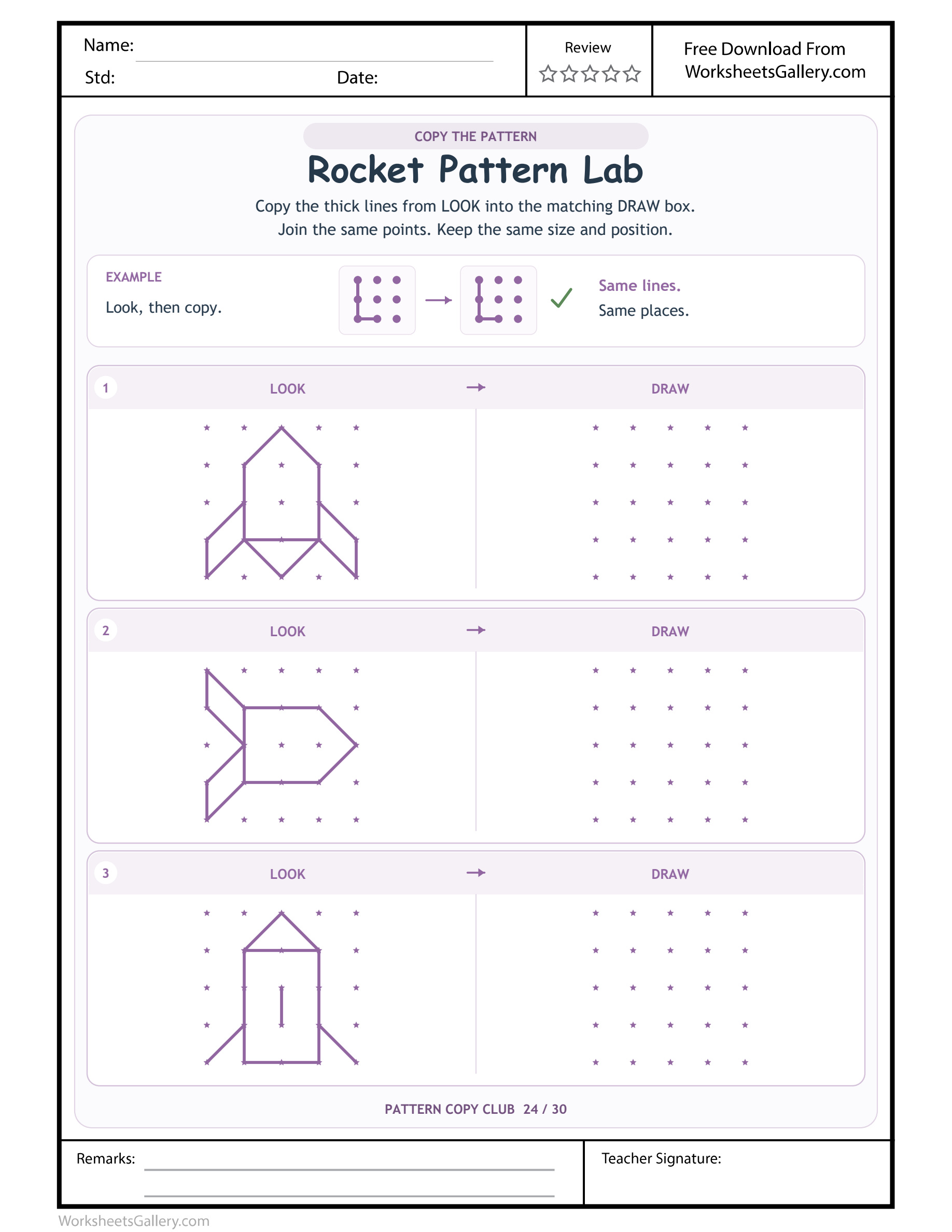
Rocket Pattern Sketches: Maintain rocket orientation and copy the exact fins rather than making every rocket upright.
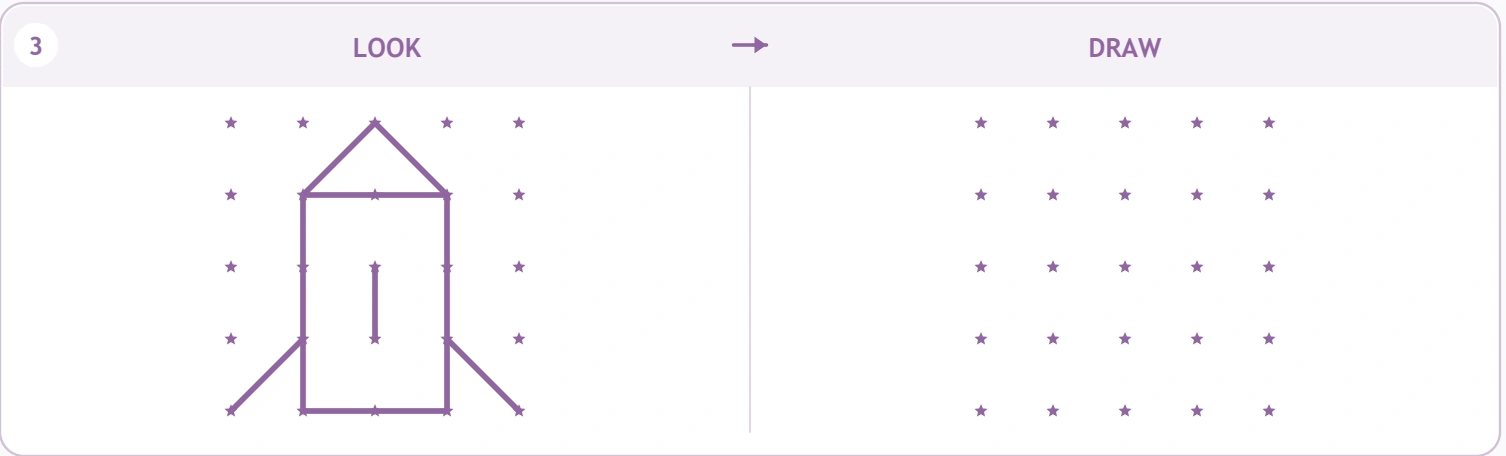
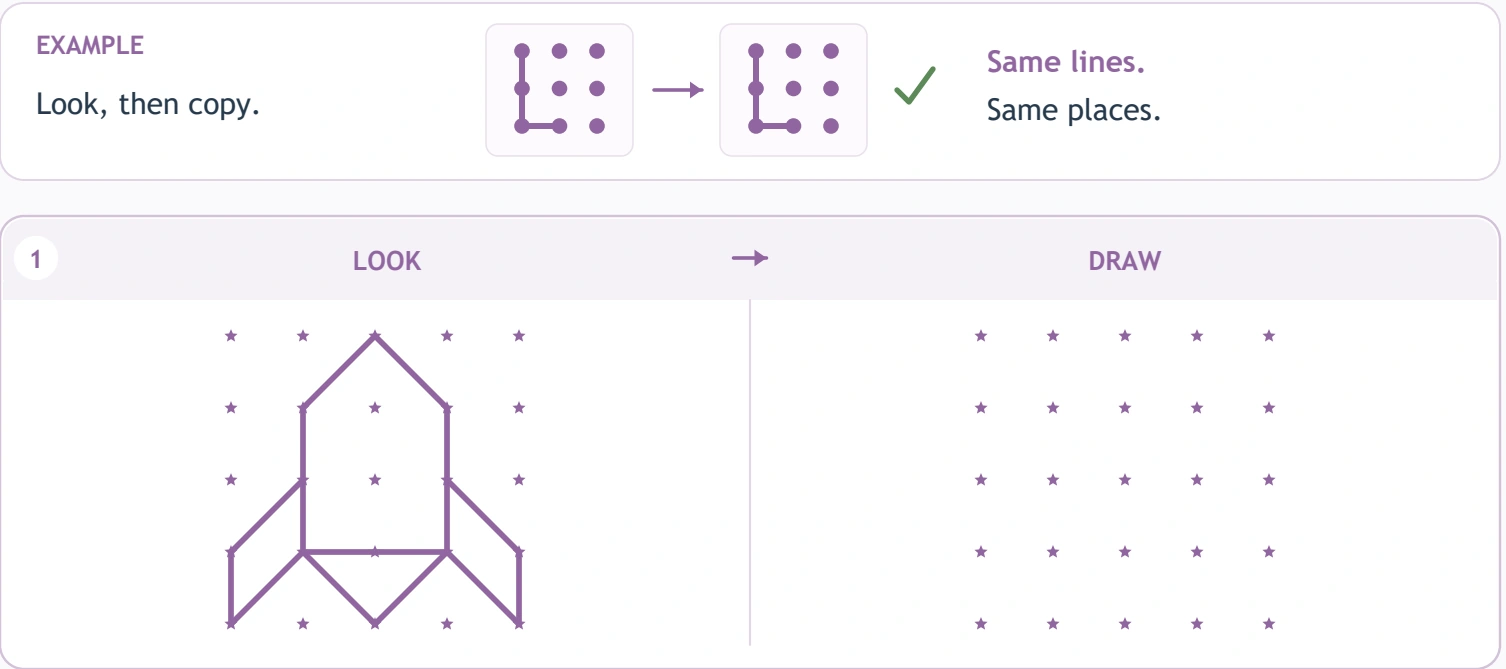
Launch pictures can point upward or sideways, and that change matters on this page. Rocket Pattern Sketches presents three angular rocket models for children to reproduce on neighbouring twenty-five-point fields. The Rocket Pattern Lab source varies pointed bodies, fins and small internal details, with a completed example introducing how LOOK corresponds to DRAW. This is a picture-copying challenge rather than a launch sequence or coding puzzle. Offer it to a young learner who can inspect a few connected lines, choose corresponding anchors and return to the model before adding another part.
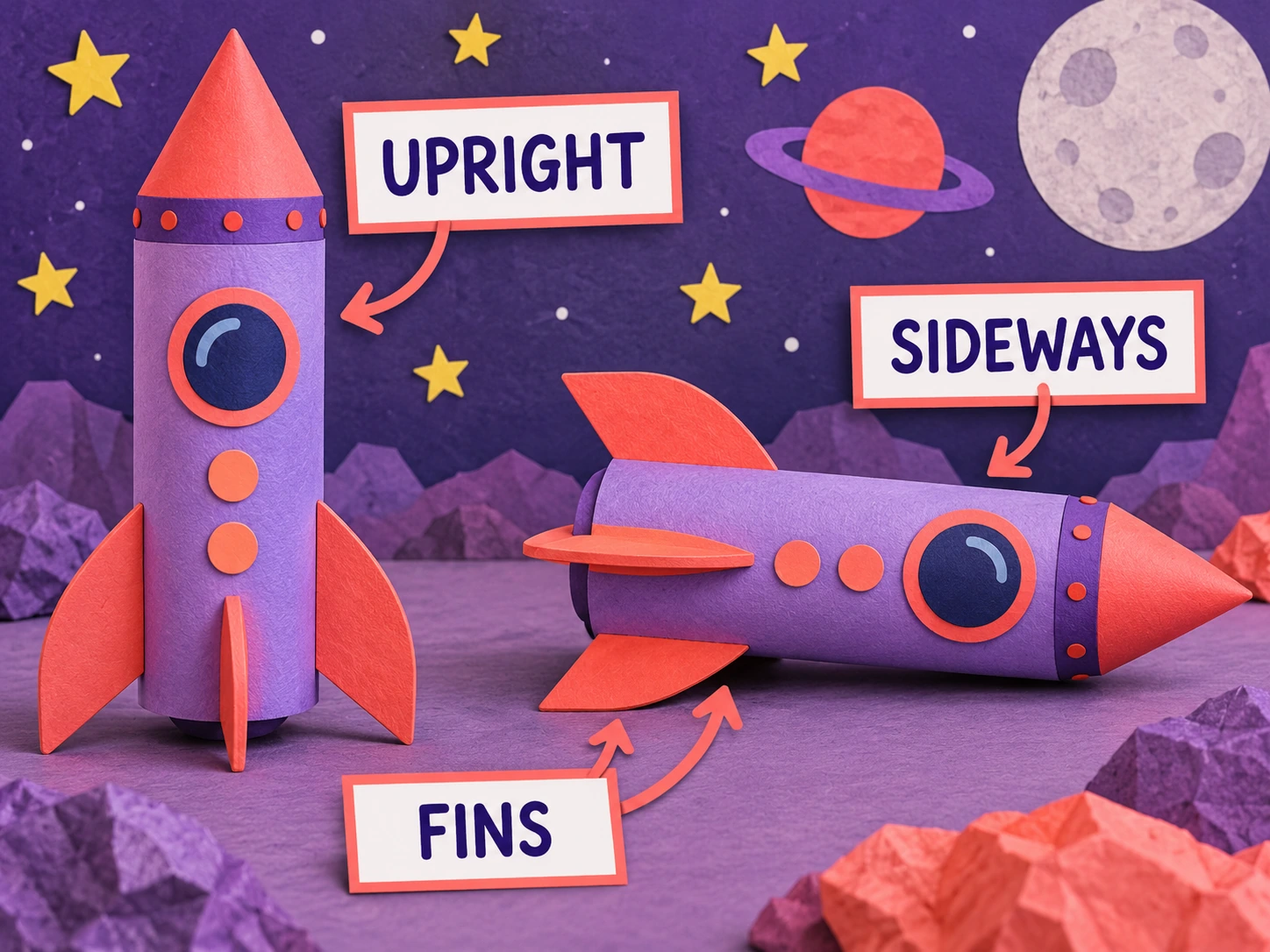
A spacecraft's orientation is part of its plan — Rocket Pattern Sketches
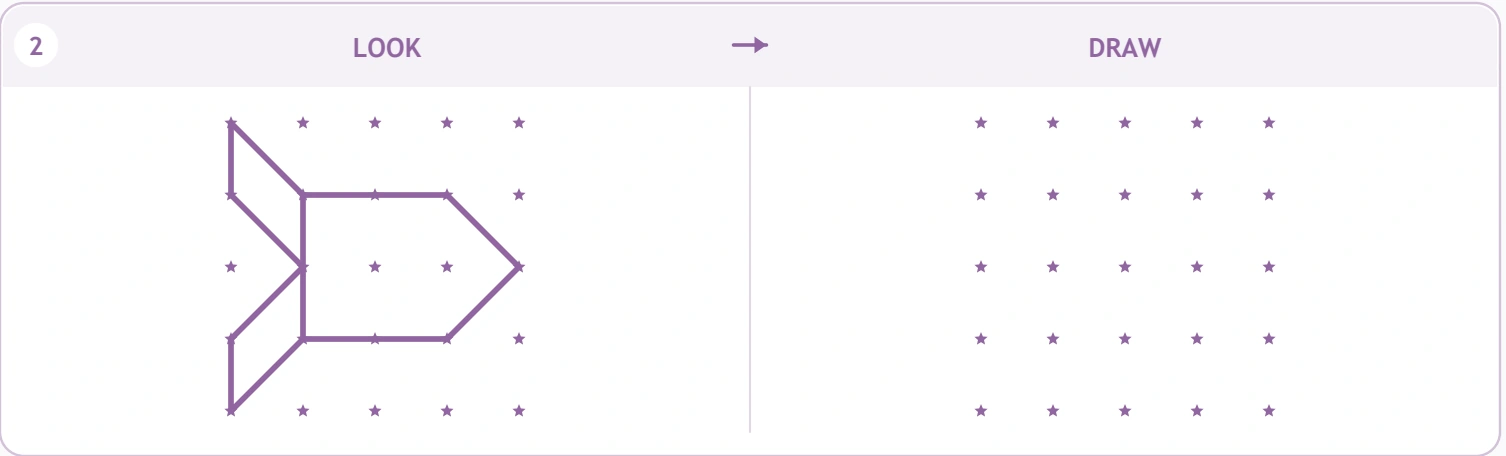
The first and last Rocket Pattern Sketches rockets stand upright, while the middle design points sideways. Ask the child to identify the pointed end in the selected model before drawing. Its location provides an immediate landmark for comparing the rest of the body.
Keep the printed direction when transferring the design. Turning every rocket upright may fit a familiar launch picture but changes the middle reference. A story about a spacecraft's destination can remain spoken while the answer field preserves the actual orientation, fins and short details shown beside it.

Compare the three rocket constructions: Rocket Pattern Sketches
| Rocket Pattern Sketches pair | Visible Rocket Pattern Lab model | Model structure |
|---|---|---|
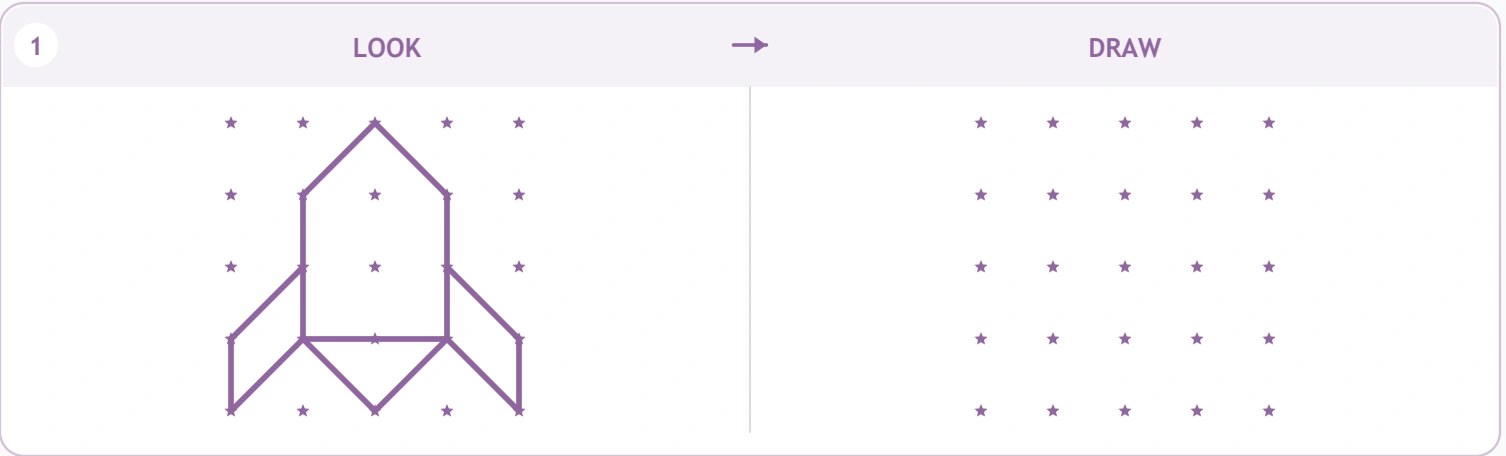
| 1 | Upright pointed rocket with angular fins | 25 anchors / 16 bold pieces in Rocket Pattern Lab |
| 2 | Sideways rocket facing right | 25 anchors / 14 bold pieces in Rocket Pattern Lab |
| 3 | Upright rocket with a short central mark | 25 anchors / 15 bold pieces in Rocket Pattern Lab |
All Rocket Pattern Sketches practice fields contain twenty-five markers. Bold segment counts describe each supplied construction, including short aligned pieces. They are not a launch countdown, an age score or a requirement for a certain number of pencil movements. Choose practical groups of lines for a comfortable copying attempt.
Locate the nose, then check a neighbouring corner: Rocket Pattern Sketches
For a first section of Rocket Pattern Sketches, point to the nose and find its counterpart in DRAW. Inspect where one sloping nose edge ends. Compare that corner before continuing along the longer body. A short pause can keep an early misplaced point from carrying the whole picture off position.
The learner may prefer to begin with a body edge or fin. That is acceptable: no prescribed starting marker appears in the source. Ask them to explain the chosen part's location, then copy a manageable section. Repeated visits to LOOK make the task a visible comparison instead of a memory performance.
Fins are attached at particular places: Rocket Pattern Sketches
The small projecting shapes in Rocket Pattern Sketches contribute to a rocket's identity, but they also provide exact positional information. Notice where each fin begins relative to the main body and how far it extends. A child who draws two equal generic triangles may overlook the particular source arrangement.
Follow a fin edge with a finger and inspect both endpoints. If the attachment seems complicated, cover no necessary reference; simply discuss that small area before continuing. Pencil lifts are useful when moving between separate details. Do not invent connecting strokes merely to keep the entire picture in one continuous journey.
Five ways the launch plan invites careful thinking
- Orientation comparison. Upright and sideways models make the direction of a recognisable picture explicit.
- Structural grouping. Nose, body and fins offer manageable parts within a detailed angular design.
- Endpoint control. The hand aims toward selected markers and stops before making a new slant or corner.
- Selective attention. Short internal marks receive a separate check instead of disappearing behind the larger outline.
- Reasoned description. Pointed end, projecting fin and lower attachment provide words for explaining a visual choice.
These are opportunities to observe during Rocket Pattern Sketches, not promised improvements or a formal developmental result. A learner's accurate verbal description can show understanding even while a short diagonal remains difficult to draw. Recognise the idea and the motor demand separately.
Xavi's imaginary space-design table: Rocket Pattern Sketches
Imagine Xavi building a spacecraft from blocks at home. An adult offers Rocket Pattern Sketches, and Xavi chooses the sideways rocket. Before drawing, they turn a broad strip construction until its nose points in the same direction as the model. Xavi then selects one body corner to locate on paper.
This invented scenario supplies a practical teaching conversation, not evidence of tested progress. The block spacecraft can gain invented passengers and equipment afterward. The worksheet copy has a narrower goal: keep the selected printed connections in corresponding places. One well-inspected fin can be a complete small task within a much longer story.
A classroom launch-design briefing: Rocket Pattern Sketches
For a possible classroom activity, invite learners to inspect Rocket Pattern Sketches and identify the design that points sideways. The teacher can demonstrate comparing its nose and body corners on a larger spare field. Children keep their references visible and choose a short section for their own attempts.
In this hypothetical lesson, an adult watches whether pupils preserve the selected direction after a pencil lift. Ask a child to describe one fin attachment, using gesture if preferred. Avoid comparing who launches a completed page first. A clear explanation of a difficult connection is more useful than filling every panel without checking its model.
Readiness for the small launchpad
Children in later preschool through early primary years, roughly four to seven, may explore Rocket Pattern Sketches with support. The twenty-five-point field and several fine details make it more demanding than a few broad slants. Try identifying one corresponding nose point together before asking for a complete picture.
If the anchors compete for attention, use larger movable pieces for the body and fins. A child can first show the intended relationship by pointing or arranging parts. Return to Rocket Pattern Sketches when a small copying section feels manageable. Interest in space is an invitation to try, not a reason to continue after the learner becomes tired.
Six space-workshop games on a larger surface: Rocket Pattern Sketches
Sort a fleet by nose direction: Rocket Pattern Sketches
Build simple upright and sideways rockets with strips. Ask a partner to group them using the pointed end as a clue. Explain the sorting choice and change one orientation. Connect the observation to Rocket Pattern Sketches's middle reference without adding another paper task.
Request a fin repair: Rocket Pattern Sketches
A toy engineer notices that one fin in a large copied model has moved. The child compares it with the original and proposes a repair. Reverse the roles. The mismatch becomes an invitation to inspect rather than an occasion to judge the whole construction.
Describe a nose before showing the body
Ask a child to explain a broad pointed-end construction to a partner while both can still inspect it. Then add the body and compare where it joins. The conversation encourages precise part language without relying on memorised drawing instructions.
Build an original research craft
Use spare paper or blocks for a completely invented vehicle with new tools and windows. Discuss which features the designer chose. Contrast the two task purposes gently: invention welcomes additions, while Rocket Pattern Sketches copies an existing reference.
Inspect a tiny detail with a large model: Rocket Pattern Sketches
Make a short internal mark on a broad rocket construction. Move it to a different level and ask what changed. The small difference becomes easier to discuss at this scale, preparing a learner to notice a similar detail in print.
Give mission control a position report: Rocket Pattern Sketches
A pretend controller asks where one fin sits relative to the body. The child reports with words or gestures and a partner checks the visible model. Keep the roleplay about description; it does not introduce a hidden code or launch answer to Rocket Pattern Sketches.
Repair the copied plan before decorating it: Rocket Pattern Sketches
Frequent Rocket Pattern Sketches changes include turning the sideways model upright, extending a fin too far, adding windows or overlooking the short central mark in the final design. Identify one altered connection, compare its endpoints and choose a local repair. A general request to make the rocket look better offers less guidance.
The supplied details define this particular spacecraft. If the child wants extra flames or equipment, welcome those on another drawing. When repeated erasing makes the field hard to inspect, stop and discuss the intended line using a larger model. The copying activity need not end with a heavily retraced, frustrating answer panel.
Another visit can begin with one chosen component: Rocket Pattern Sketches
Space stories may make Rocket Pattern Sketches appealing, while the familiar nose-and-fin parts offer natural small goals. Let the learner choose a component that seems interesting. Specific feedback, such as “You checked the fin's lower corner before joining it”, recognises a visible decision.
Offer short returns alongside construction, movement and original art. A regular invitation does not require all three spacecraft at each sitting. End with a detail the child can explain comfortably, and use the discovery as an entry into a later invitation. A willing partial copy is more useful than continuing only to fill the remaining field.
Save a printable launch plan: Rocket Pattern Sketches
The free option provides the supplied Rocket Pattern Lab original. A qualifying active membership allows a signed-in account to request the separate clean Rocket Pattern Sketches PDF through the premium download. That edition omits domain names, website promotional material and the site watermark, retaining the complete models, instructions and student information fields.
The native package card opens the thirty-page clean collection, available as an independent $3 purchase. Obtain the edition permitted by your account and inspect its print preview. Choose US Letter paper, retaining original size with Actual Size or 100% scaling. Keeping Rocket Pattern Sketches's dimensions unchanged preserves the spacing of its small body corners and fin anchors.
Further comparisons for curious designers: Rocket Pattern Sketches
Compare Rocket Pattern Sketches with Path Copy Thinking. After Rocket Pattern Lab, try Drawing Size Choices. For Rocket Pattern Lab, consider Shape Border Journeys.
Adults extending Rocket Pattern Sketches may browse family play suggestions from NAEYC and the PBS Parents learning-activity pages. These independent educational resources are optional reading, are not included downloads and do not imply that either organisation endorses this worksheet.
Popular Worksheets
Printable resources families and teachers are downloading now.
 Free
 Free
 Free
 Free